Thursday, June 25, 2026
Is It Agentic Enough? The Case for Benchmarking Models on Your Own Tooling
Posted by
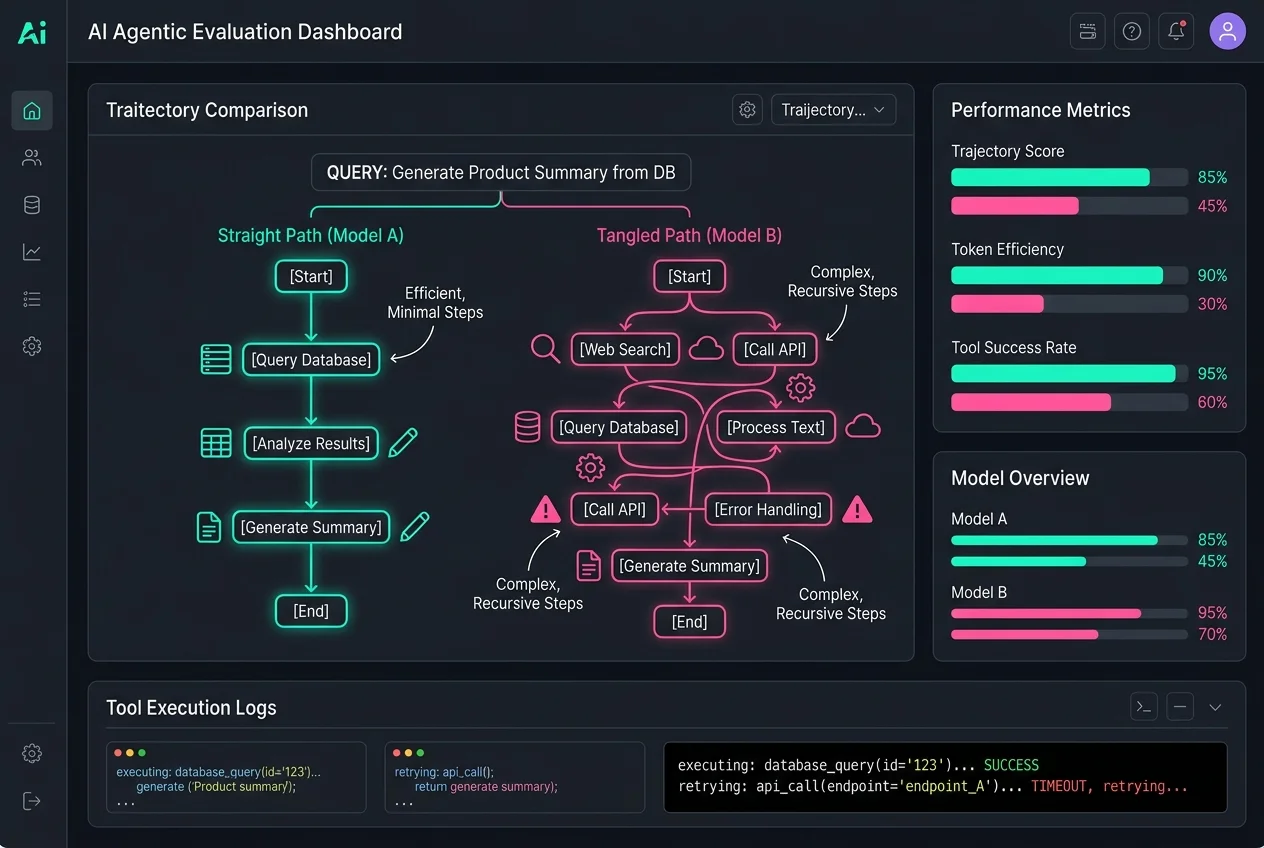
A few weeks ago, Hugging Face published a blog post that should be required reading for anyone building agents on top of open models: Is it agentic enough? Benchmarking open models on your own tooling. The title sounds like a research teaser. But the content is something more practical — a blueprint for how to stop guessing whether your model works with your tooling and start measuring it.
Here's why this matters more than any leaderboard drop you'll see this week.
The Black-Box Benchmark Problem
If you've shopped for an open model to power your agentic workflow in the last six months, you've seen the drill: pull up a leaderboard, check SWE-Bench Verified, check Terminal-Bench 2.0, compare a half-dozen scores, pick the winner, and — two days of integration work later — discover it falls apart on your actual use case.
This isn't your fault. The benchmarks measure something, but not the thing you need.
Existing agentic benchmarks, even good ones like SWE-Bench Verified and Terminal-Bench 2.0, share a structural blind spot: they check whether the model reaches the correct final answer, but they don't evaluate the path the model took to get there. Was it an efficient one-liner or a 14-step hack that consumed 50,000 tokens? The leaderboard treats them as equivalent — both say "pass."
The BenchLM.ai rankings, which carry 22% weight on agentic performance across 24 verified benchmarks, are the most comprehensive picture we have of model-level capability. And they're useful! Knowing that Holo3-35B-A3B (82.6 agentic score) or GLM-5.2 (81.0) or DeepSeek V4 Pro Max (74.0) sit at the top of open-weight rankings gives you a sane starting point. But here's the thing — none of those benchmarks are testing your library, your API, your tool structure, or your specific failure modes.
The gap between "good at benchmarks" and "good at your specific tooling" is where the real evaluation lives.
Hugging Face's agent-eval: A New Kind of Harness
Hugging Face's agent-eval harness (repo) flips the framing. Instead of asking "how does this model score on a benchmark?", it asks "how does this model interact with my library when given different levels of support?"
Here's the architecture:
Three evaluation tiers:
- bare —
pip install transformersand nothing else. The model has to figure out the library from its pre-training data. - clone — the full
transformerssource code checked out in the working directory. The model can read the actual implementation. - skill — a packaged Skill containing the CLI's docs plus task examples, loaded into context.
Core metrics — this is where it gets interesting:
- match % — exact match, substring match, or regex match for correctness
- median time & median tokens — input, cache, and generated tokens
- error rate — including silent failures (zero output tokens, no tool calls)
- marker adoption — what method did the agent use? CLI command? Python pipeline? Custom script?
The marker adoption metric is the sleeper hit. Two agents can both classify a piece of text as POSITIVE (0.9999), but one did it with a clean transformers classify CLI call and the other with a 30-line Python script that imports torch and transformers separately. Same result, dramatically different profiles in latency, token cost, and failure risk. That cost dimension is easy to underrate — a separate study found code cleanliness barely moves agent success rates but swings cost 34%.
The harness publishes all this as a Hugging Face Space so results are reproducible and shareable. Every run goes through identical hardware via Hugging Face Jobs, with traces stored in Hugging Face Buckets and viewable in the agent-traces viewer. It's not a thought experiment — it's a rig you can run yourself.
What the Data Actually Shows
Hugging Face ran the harness against transformers with a newly added CLI and Skill. The results reveal a sharp split by model size — and the implications for tool designers are uncomfortable.
Large models: the effort problem
For models like Kimi-K2.6, GLM-5.1, and MiniMax-M2.7, the problem isn't accuracy — they get the answer right almost regardless of support level. The question is effort: how many tokens, how many turns, how much time.
The surprising finding: in the skill tier, token consumption increased for these models. Median input tokens jumped from ~4K to ~6.4K because the model spent tokens reading the new CLI source to understand the interface. Time-to-completion, however, dropped significantly — the Skill commit was consistently the fastest tier.
This is the amortization problem that single-run benchmarks don't capture. Yes, the first invocation costs more tokens as the model introspects the Skill. But in a persistent agent session where that Skill is loaded once and reused across dozens of calls, the time savings compound. The benchmark penalizes what the production deployment rewards.
Smaller models: the accuracy cliff
The small-model story is more alarming. Qwen3-14B on a classify-sentiment task held 100% match in the clone tier. In the skill tier, that collapsed to 0%. The model literally couldn't complete the task — it misinterpreted the Skill documentation as a pre-registered function call (e.g., transformers(command="classify", ...)) and gave up rather than falling back to the trusty pipeline(...) API.
Qwen3-4B was even worse: token consumption exploded from ~2.4K to ~23K median new tokens — a 10x cost increase — for zero accuracy gain. The agent read the bulk Skill code, couldn't make sense of it, and burned tokens trying.
The MindStudio analysis of open-weight models for agentic coding flags exactly this pattern: "Qwen 3.6 Plus performs significantly better in a structured agent harness than raw chat mode." The scaffolding matters as much as the model. What Hugging Face's data adds is the corollary: what helps one model can actively hurt another.
As the blog puts it: "a new affordance can reduce work for strong models while adding ambiguity for smaller ones."
This Is Where Upskill Gets Interesting
The Hugging Face post points to Upskill as a potential solution — an automated pipeline where a powerful teacher model (Claude Opus 4.5) generates a Skill, the Skill is tested against smaller models, and it only gets deployed if it measurably improves performance.
This is the self-improving loop the agent ecosystem has been missing. Instead of shipping a Skill for every API and hoping models figure it out, you benchmark the Skill against the actual models that will use it. If GLM-5.1 gets a +35% boost from the Skill but Qwen3-4B goes to 0%, you gate the Skill release behind model capability detection.
The Upskill results back this up: on a CUDA kernel-building task, the Skill lifted a local model from 40% to 85% (+45%), and boosted Haiku from 60% to 95%. But it was ineffective on Claude Opus 4.5 itself — that model already had the knowledge, so the Skill just added token overhead without accuracy gains.
This is the pattern at scale: Skills are force multipliers for the models that need them, and dead weight for the models that don't.
What This Means for Developers
If you're building agents, tools, or MCP servers right now, here's the practical takeaway:
1. You cannot trust generic leaderboards for agentic performance. Not because they're wrong, but because they're measuring a different thing. SWE-Bench tells you about pull request patching. Terminal-Bench tells you about shell command execution. Neither tells you whether Kimi-K2.6 navigates your MCP server's tool hierarchy efficiently.
2. The three-tier eval model (bare / clone / skill) is directly applicable to your stack. Before shipping a new tool, API, or MCP server, run your use case through each tier. If you see the accuracy cliff pattern — strong performance on clone, collapse on skill — you have a documentation or interface design problem, not a model problem — the same shift covered in The End of Manual Documentation.
3. Deploy Skill detection, not just Skills. If you're packaging your tool as an MCP resource or agent Skill, instrument it. Track which models use which affordance paths and how many tokens they burn doing it. The data from Hugging Face's harness suggests that a one-size-fits-all Skill can silently destroy the performance of smaller models while optimizing for large ones.
4. Run your own evals. agent-eval is open source. The harness is designed to be adapted to any tool. Define your tasks, expected answers, and a profile plugin, then fan out across models on parallel hardware. The results will be more relevant to your production workload than any aggregate leaderboard.
The Bottom Line
The open model ecosystem is in a strange place in mid-2026. Models like DeepSeek V4, Kimi K2.6, GLM-5.2, and Qwen 3.6 Plus are genuinely competitive with proprietary alternatives on agentic benchmarks. But as Hugging Face's data shows, benchmark scores are a starting point, not a conclusion.
The real question isn't "which model is best?" — it's "which model is best for my specific tooling, with my specific interface design, under my specific failure tolerance?" And that question can only be answered with data from your own eval harness.
The tooling to run that eval is now open-source and battle-tested. The excuse that "there's no good way to measure agentic performance" expired last week. For what production deployment adds on top of evaluation, see the lessons from Allen AI's Shippy.
Related Articles & Deep Dives
 #google-colab
Google AI Pro Now Includes Colab: Put Your Subscription to Work on a GPU
Eligible paid Google AI plans now include Colab benefits. Explore GPUs, Google Drive, the Colab CLI, and open-weight models without a separate Colab subscription.
 #deepseek
Frontier Agent Benchmarks: DeepSeek V4 vs Qwen 3.8
DeepSeek V4 vs Qwen3.8-Max across agentic benchmarks: verified scores, vendor-reported caveats, pricing, and which model fits your workload.
 #tool-architecture
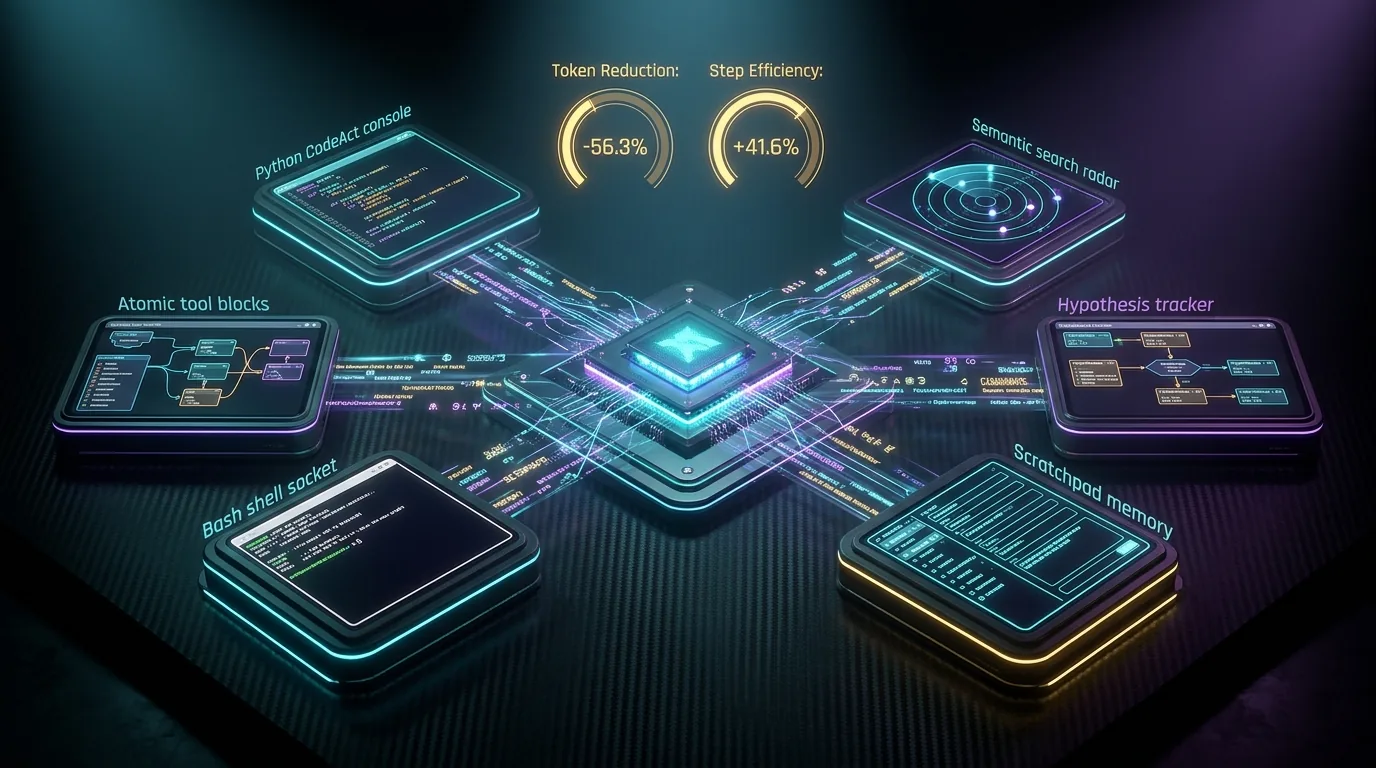
The Devil Is in the Interface: How Tool Architecture Shapes Coding Agents
11,700 trajectories show how tool organization changes agent behavior: CodeAct interfaces cut steps 41.6% and tokens 56.3%. Scaffolding barely matters.