Monday, June 15, 2026
Mirage: Persistent Spatial Memory in Video Generation Models
Posted by
The Core Problem
Every video world model that generates geometrically consistent output faces the same bottleneck: maintaining 3D spatial coherence across frames without recalculating the world from scratch at each step.
The pre-Mirage approach works like this:
- Build an explicit point cloud in RGB space from the initial frame
- Render the point cloud from a new camera pose into a 2D RGB image
- Encode that rendered image through a VAE into latent space
- Denoise the latent into the next frame
- Repeat for every frame — rendering, encoding, denoising
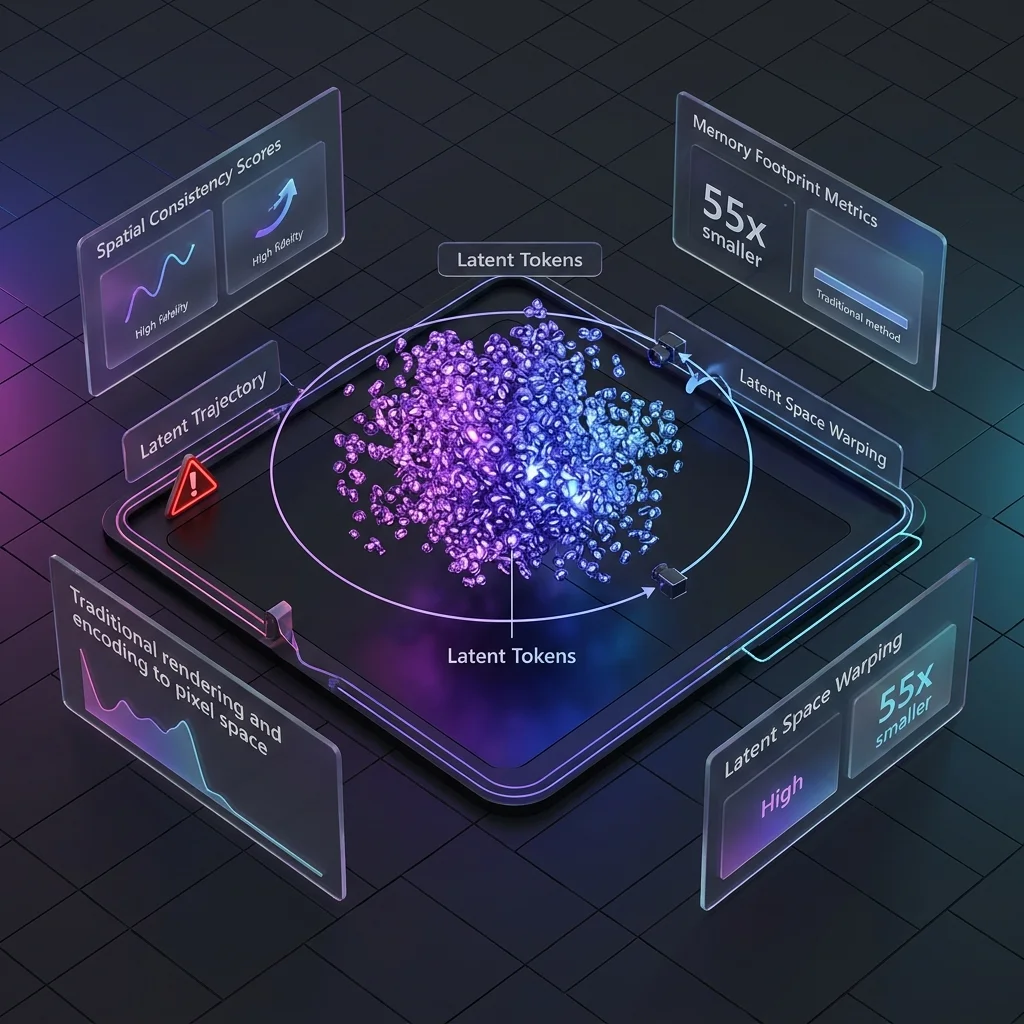
The round trip through pixel space (step 2→3) is the killer. Each render-and-encode cycle is expensive, and the VAE encoding discards fine-grained features that were present in the latent representation of the previous frame. Systems like 3D-VLA and WorldDreamer all share this architecture, and it's the reason long-form video world models are computationally prohibitive.
Mirage, from Microsoft Research in collaboration with Zhejiang University, eliminates the pixel round trip entirely. The result: 10.57× faster generation and 55× less memory than explicit 3D baselines, while achieving state-of-the-art scores on the WorldScore benchmark.
The Architecture: How Mirage Works
Mirage introduces latent spatial memory — a persistent 3D cache that stores scene information directly in the diffusion latent space. The system operates in a three-phase cycle:
Phase 1: Memory Initialization
Given a single input image, Mirage:
- Passes the image through a VAE encoder to produce a 2D latent feature map
- Feeds the same image into a monocular depth estimator (trained jointly with the model) to get per-pixel depth
- Back-projects each latent token from 2D pixel coordinates into 3D using the camera intrinsics and estimated depth
The result is a 3D cloud of latent tokens — each one is a feature vector positioned in 3D space. Critically, the token retains its latent representation. No RGB rendering occurs. This cloud becomes the persistent spatial memory.
Phase 2: Memory Read (Query)
To generate a novel viewpoint, Mirage doesn't render and re-encode. Instead:
- The desired camera pose defines a projection into the 3D cloud
- For each output latent pixel, Mirage casts a 3D ray and bilinearly interpolates the nearest stored latent tokens
- This produces a complete latent feature map for the new viewpoint — entirely in latent space
The single projection at latent resolution replaces the costly rasterize-and-encode round trip that prior methods require.
Phase 3: Memory Update
As the model generates chunks of video, it writes updated static scene content back into the latent cache. This keeps the memory fresh as the camera explores the scene. The diffusion denoiser then takes the warped latent map and produces the final frame.
The Architectural Flow
Input Frame
    │
    ├──→ VAE Encoder ──→ Latent Token Map (2D)
    │
    └──→ Depth Estimator ──→ Per-pixel Depth
                │
                ▼
        3D Latent Cloud (Persistent Spatial Memory)
                │
                ▼  (for each novel camera pose)
        Latent-Space Warping (single projection)
                │
                ▼
        Warped Latent Map (no RGB round trip)
                │
                ▼
        Diffusion Denoiser ──→ Output Frame
Contrast with the prior approach:
Input Frame → VAE Encoder → Latent Map
                                  │
                                  ▼
                        Explicit 3D Point Cloud (RGB)
                                  │
                    ┌─────────────┴─────────────┐
                    │  Render to RGB (costly)    │
                    │  VAE Encode again (lossy)  │
                    └─────────────┬─────────────┘
                                  ▼
                        Latent Map (after round trip)
                                  │
                                  ▼
                        Diffusion Denoiser → Output Frame
The round trip through rendering and re-encoding is both expensive (you pay for the render and the VAE encode per frame) and lossy (VAE compression discards details).
What Makes It Fast
The speedup comes from two sources:
1. Eliminating the render-encode pipeline. Prior approaches must render the RGB point cloud (a rasterization operation) and then pass it through the VAE encoder. Mirage replaces this with a single latent-resolution warping operation — a lightweight bilinear interpolation over the cached latent cloud.
2. Keeping features in their native representation. The VAE latent space is the diffusion model's native operating environment. By staying in this space, Mirage avoids the information loss of repeated encode-decode cycles. The features remain richer, and the model doesn't need to regenerate detail that was discarded by compression.
The paper reports:
- 10.57× end-to-end speedup over explicit 3D point cloud baselines
- 55× reduction in memory footprint (storing latent tokens vs. RGB point clouds is inherently more compact)
- Strong reconstruction quality on the RealEstate10K dataset
- State-of-the-art Average Score on the WorldScore benchmark, outperforming the memory-augmented Spatia baseline and all foundation video generators that lack persistent spatial representation
WorldScore measures world consistency — whether generated video maintains spatial coherence as the camera moves. This is exactly the problem Mirage was designed to solve.
How It Differs from Existing Approaches
vs. Diffusion Video Models (Sora, Runway Gen-3, Kling)
Standard diffusion video models generate frames autoregressively or through cascaded denoising of spatiotemporal volumes. They have no explicit 3D representation — spatial consistency emerges (or fails to emerge) from the training data. When the camera pans, objects frequently morph, disappear, or reappear with different geometry. Mirage's latent spatial memory provides an explicit geometric prior that guarantees 3D consistency across views.
vs. Autoregressive Frame Prediction
Autoregressive models predict the next frame from the previous one(s). Any error accumulates. If the model misplaces an object in frame 5, frames 6-30 compound that error. Mirage's persistent cache means the model always has access to the original 3D scene structure — errors don't propagate geometrically.
vs. Explicit 3D Point Cloud Methods (3D-VLA, WorldDreamer)
These are Mirage's direct predecessors. Both build 3D point clouds but in RGB space. The improvement isn't conceptual — it's representational. By keeping the cache in latent space, Mirage makes the same idea 10× faster and 55× smaller while improving quality. This is the distinction that matters for deployment.
Implications for Agent Perception Pipelines
For developers building autonomous agents that need to understand or navigate 3D environments, Mirage's architecture suggests several design patterns:
1. Latent-Space World Models as Agent Backends
An agent operating in a visual environment needs a world model — a representation of the environment that persists across observations. Mirage demonstrates that this model doesn't need to decode to pixels to maintain geometric fidelity. Agents could maintain a latent spatial memory of their environment, querying it for navigation, object tracking, or next-action planning without rendering images.
2. Efficient Video Understanding
Agents that process video input currently run frames through a vision encoder (e.g., CLIP, SigLIP, DINOv2) frame by frame. Mirage's approach suggests a more efficient pattern: encode once, project into a persistent 3D cache, and update incrementally as new visual information arrives. This mirrors how biological vision systems maintain a scene representation across saccades.
3. Memory-Bounded Simulation
The 55× memory reduction means world models can operate on edge devices or within tight VRAM budgets. An agent on a robot or drone could maintain a spatial understanding of its environment at a fraction of the memory cost of explicit 3D methods.
4. Training Loop Acceleration
For researchers training embodied agents in simulated environments (Habitat, ThreeDWorld, MuJoCo), Mirage's approach could serve as a faster renderer — generating novel views from a latent cache rather than running the full graphics pipeline. This directly accelerates reinforcement learning and imitation learning loops.
Trade-Offs and Limitations
Depth estimation quality is the weak link. Mirage uses a monocular depth estimator trained jointly with the rest of the model. If the depth estimator produces inaccurate geometry, the latent warping will hallucinate or distort. The paper doesn't fully ablate the relationship between depth accuracy and output quality — this matters for real-world deployment where depth distributions may differ from training data.
Long-horizon consistency isn't fully characterized. The paper demonstrates strong performance on WorldScore and RealEstate10K, but these benchmarks involve relatively constrained camera trajectories. How Mirage behaves over extremely long sequences (hundreds of frames) with complex scene dynamics (moving objects, lighting changes) is an open question.
Static scene assumption. Mirage's current formulation focuses on static scene content. The write-back phase updates the cache as new static content is revealed, but moving objects and dynamic scene changes aren't the primary use case. Video world models that need to handle moving characters or physics will need additional mechanisms on top of the latent cache.
The Bottom Line
Mirage's contribution is elegantly simple: keep the 3D cache in the same representation as the generator. Once stated, it's obvious — but every prior system shipped the data through pixel space unnecessarily. The 10× speedup and 55× memory reduction are what happen when you remove a round trip that should never have been there.
For agent developers, the lesson extends beyond video generation: when you're building a pipeline that repeatedly encodes and decodes intermediate representations, ask whether the round trip is actually necessary. The answer may be hiding a free 10× improvement.
References
- Paper: Latent Spatial Memory for Video World Models (arXiv:2606.09828, June 2026)
- Project Page: aka.ms/latent-spatial-memory
- Code: github.com/microsoft/LatentSpatialMemory
- Authors: Weijie Wang, Haoyu Zhao, Yifan Yang, Feng Chen, Zeyu Zhang, Yefei He, Zicheng Duan, Donny Y. Chen, Yuqing Yang, Bohan Zhuang (Microsoft Research + Zhejiang University)
- The Decoder: Microsoft Research's Mirage gives video generation a persistent spatial memory
Related Articles & Deep Dives
 #reverse-engineering
Reverse Engineer Anything (REA): How to Prompt the MCP
REA is an MIT-licensed MCP server that lets coding agents reverse engineer apps, games, and binaries locally. Install, three workflows, and the legal lines.
 #evoke
Evoke Is Statistical Retrieval in Postgres — One Index for Keywords and Meaning
A new Apache-2.0 Postgres extension puts semantic search inside the keyword index. No embedding pipeline, no vector index, no score-merge step — a 30M-parameter model runs on CPUs inside the database and matches a 0.6B dense encoder within 0.004 recall. The RAG plumbing you've been maintaining might just be deletable.
 #deepseek
DeepSeek Harness: Everything Is a Plugin
DeepSeek Harness (dsh) is DeepSeek's MIT-licensed agent runtime where everything is a plugin — the four presets, setup, and what it means for benchmark trust.