Thursday, June 18, 2026
x86 AI Compute Extensions (ACE) — What the New Spec Means for AI Inference
Posted by
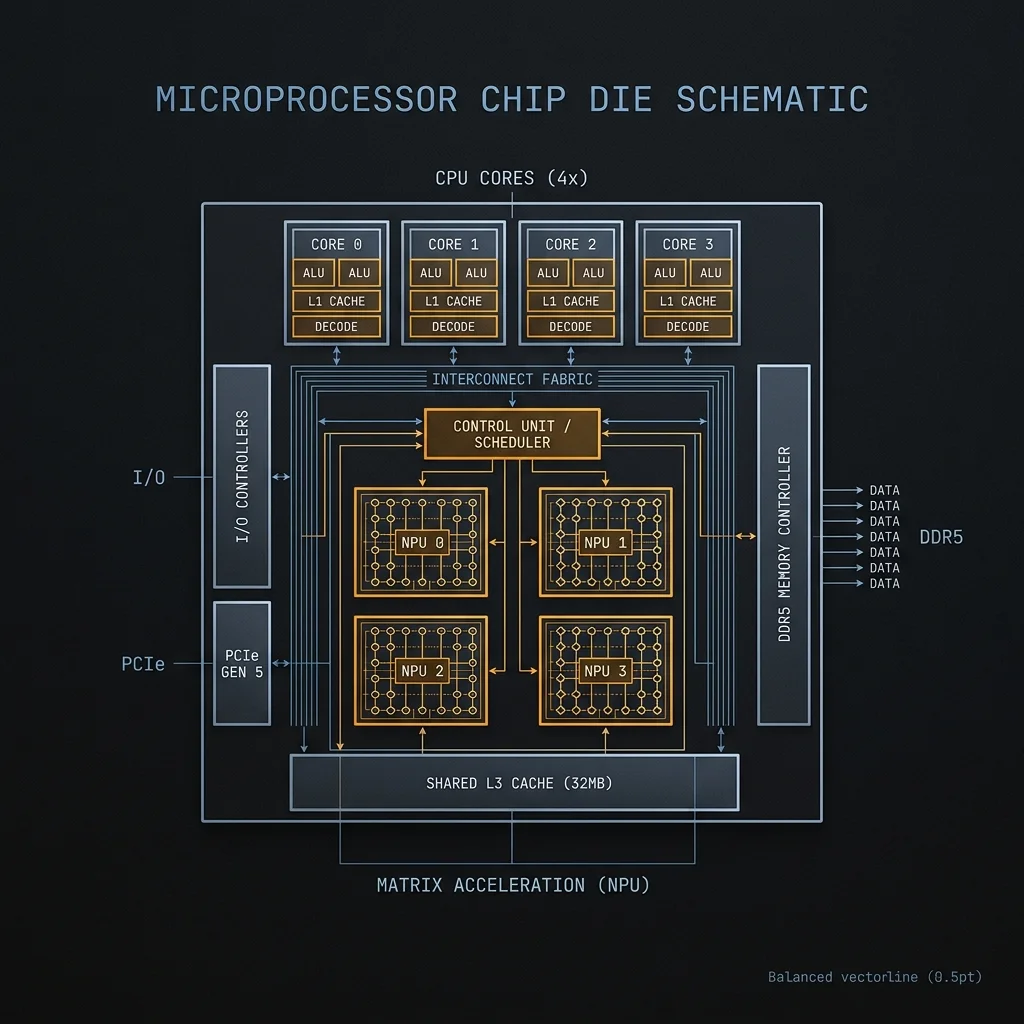
In April 2026, AMD and Intel published the AI Compute Extensions (ACE) specification — a joint proposal for standardized matrix acceleration on x86 CPUs. For the first time, the two dominant x86 vendors agreed on a common instruction set extension for AI workloads, marking a rare alignment between longtime rivals.
Here's what ACE does under the hood, how it stacks up against NVIDIA's PTX and ARM's SVE/SME, and what it means for developers running AI inference on commodity hardware.
What ACE Is
ACE is an instruction set extension to x86 that adds dedicated matrix multiplication capabilities to CPUs. It's designed as a supplement to AVX10, not a replacement. The core innovation is an outer-product-based matrix accelerator that operates alongside the existing vector unit.
The specification was co-authored by engineers from both AMD and Intel under the recently formed x86 Ecosystem Advisory Group (EAG), an industry consortium launched in October 2024. The full spec is available as a 5-page whitepaper co-signed by eight AMD engineers (Stuart Biles, Brian Thompto, Michael Estlick, Eric Schwarz, Thomas Fox, Gabriel Loh, Marius Evers, Michael Clark) and three Intel engineers (Alexander Heinecke, Pradeep Dubey, Ido Ouziel).
ACE reveals itself to software as a new palette under the existing AMX (Advanced Matrix Extensions) accelerator framework, which means operating system support and context-switching infrastructure that already exists for AMX can be reused.
The Mechanics
The technical approach is different from traditional SIMD matrix multiplication:
- AVX10 does vector multiply-accumulate (VMLA): one operation consumes two input vectors and accumulates into a third vector. Compute density is limited by how many multiply-accumulate operations you can issue per cycle.
- ACE does outer products: it consumes two input vectors from AVX10 registers and accumulates the result into a dedicated tile register — a 2D accumulator that holds an entire matrix block.
This matters because an outer product turns a single vector×vector operation into a full matrix update. The whitepaper claims ACE delivers a 16× compute density advantage over an equivalent AVX10 multiply-accumulate operation using the same number of input vectors.
ACE by the numbers (from the whitepaper)
| Metric | Value |
|---|---|
| Tile registers | 8 |
| Vector guarantee | 512-bit (AVX10 baseline) |
| Compute density vs AVX10 VMLA | 16× |
| Number of input vectors per op | Same as AVX10 |
| Blocked register kernel (4×2) | 8 OPs / 6 vector loads = 0.75 loads per OP |
| Single-kernel (1×1) | 1 OP / 2 vector loads = 2 loads per OP |
The 4×2 blocked register kernel — a common pattern for GEMM operations — achieves 0.75 vector loads per outer product, significantly reducing memory bandwidth pressure compared to the scalar approach.
Data Format Support
ACE supports native matrix multiplication for the data formats that matter in 2026's AI landscape:
- INT8 — 8-bit integer, the workhorse for quantized LLM inference
- OCP FP8 — 8-bit floating point per the Open Compute Project standard
- OCP MXFP8 — 8-bit microscaling format with shared exponents
- OCP MXINT8 — 8-bit microscaling integer format
- BF16 — 16-bit bfloat16 for training and high-precision inference
It also includes dedicated hardware format conversion operations for OCP MX data types (FP4, FP6, FP8), allowing optimized conversion to native compute types. The inline OCP MX block scaling support uses 8 groups of 16 8-bit block scale values — sufficient to support all 8 ACE tile registers in blocked register kernels.
How ACE Compares to NVIDIA PTX and ARM SVE/SME
This is where the strategic picture comes into focus. Each architecture has taken a different path to matrix acceleration.
NVIDIA PTX: The GPU Baseline
NVIDIA's PTX is a virtual ISA that sits between high-level CUDA code and the hardware instruction set. It's the abstraction layer that gives NVIDIA forward compatibility: CUDA code compiles to PTX, and the driver compiles PTX to the specific GPU's native ISA.
PTX is fundamentally a GPU programming model — it assumes a massively parallel execution environment with thousands of threads, a hierarchy of shared memory, and specialized tensor cores for matrix operations. Tensor Core operations in PTX deliver vastly higher throughput than what any CPU can achieve — an H100 Tensor Core can do over 1,000 TFLOPS on FP8.
ACE is not competing with PTX on raw throughput. It's competing on accessibility and latency. With ACE, matrix multiplication happens on the CPU itself, in the same address space as the rest of your application. There's no PCIe transfer, no driver stack, no CUDA runtime. For the vast majority of AI inference workloads — particularly at the edge, in CI/CD pipelines, and in latency-sensitive serving — that overhead is the bottleneck, not the compute.
ARM SVE/SME: The Direct Competitor
ARM's Scalable Vector Extension (SVE) and Scalable Matrix Extension (SME) are the closest architectural analogs to ACE.
- SVE/SVE2 is ARM's answer to AVX — vector-length-agnostic SIMD with predication. It lets implementations choose their vector width (128 to 2048 bits) while keeping binary compatibility.
- SME adds tile-based matrix operations on top of SVE, with a "streaming" mode that dedicates more hardware resources to matrix compute. It includes outer-product and matrix-multiply-accumulate instructions similar to ACE.
The architectural parallels are striking:
| Feature | x86 ACE | ARM SME |
|---|---|---|
| Foundation ISA | AVX10 + AMX | SVE/SVE2 |
| Matrix operation | Outer product | Outer product + MMA |
| Tile registers | 8 | 8 |
| Vector-tile coupling | AVX10 registers → tile | ZA (streaming) registers |
| Block scaling | OCP MX inline | BFloat block scaling |
| Precision support | INT8, FP8, MX, BF16 | INT8, FP16, BF16 |
The key difference is ecosystem maturity. SME has been shipping in ARM Neoverse V-series cores since 2023 and is deployed in AWS Graviton4 and other server-class ARM CPUs. ACE is a specification — hardware won't arrive for a generation or two.
"Changes to the instruction set can take a generation or two to filter through the product lines of both companies." — Network World, quoting industry observers on ACE's timeline
What These Comparisons Miss
The most interesting comparison isn't technical — it's strategic. ACE represents the first time AMD and Intel have agreed on a unified matrix acceleration ISA. Historically, x86 vector extensions were competitive battlegrounds: Intel had AVX-512, AMD had its own implementation with different features and support levels. Developers had to target the lowest common denominator or ship separate code paths.
ACE changes this. Both vendors are committed to supporting the same instruction set, which means:
- Software can target one ISA for matrix operations across all x86 CPUs
- Library authors can optimize once instead of maintaining Intel and AMD code paths
- Cloud providers get uniform capability across their AMD and Intel instance fleets
This is exactly the argument ARM has been making with SVE's vector-length-agnostic design — write once, run anywhere. ACE brings that same model to x86.
What ACE Means for AI Inference
The CPU Inference Renaissance
Most AI inference today runs on GPUs, but there's a growing class of workloads where CPU inference makes more sense:
- Low-throughput, latency-sensitive serving: A single user query doesn't need 1,000 TFLOPS; it needs consistent sub-100ms response times without the overhead of GPU context switching
- CI/CD pipelines: Running model evaluations, embedding generation, or test-time compute on developer machines during builds
- Edge and on-premise deployments: Not every deployment has a GPU available, especially in constrained or regulated environments
- Batch inference at moderate scale: Many enterprise workloads process thousands of queries, not millions — GPU utilization can be embarrassingly low
ACE makes all of these scenarios more viable. A 16× compute density improvement on BF16 matrix multiplication means a dual-socket server CPU could handle workloads that previously required a T4 or L4 GPU.
The Software Enablement Path
ACE's impact depends entirely on software adoption. The whitepaper lists initial integration targets:
- Deep learning and HPC libraries: lower-precision GEMMs, LLM primitives
- NumPy and SciPy: transparent acceleration of matrix operations
- PyTorch and TensorFlow: quantized inference on CPU via INT8/BF16 compute paths
For inference frameworks, this likely means that torch.compile and TensorFlow XLA can target ACE tiles for quantized matrix multiplication with minimal user-facing changes. The existing ONNX Runtime and llama.cpp code paths would need kernel rewrites, but the payoffs — CPU-native LLM inference without a GPU — are significant.
A Note on Timing
No product with ACE support has been announced. The earliest implementations will likely appear in:
- AMD Zen 7 — rumored to include ACE as part of the core's ISA, following AMD's pattern of adding AVX10 and ACE support
- Intel future Xeon — the successor to Granite Rapids, aligning with Intel's roadmap for unified extensions
The whitepaper itself is a spec proposal, not a product announcement. But the fact that both vendors co-published it — with named engineers from both teams — signals serious commitment. This isn't research; it's foundational infrastructure.
Pitfalls and Cautions
-
The 16× claim is compute density, not throughput. The 16× improvement is operations per cycle for a single ACE outer product vs. a single AVX10 VMLA. Real-world speedups depend on memory bandwidth, kernel efficiency, and workload characteristics. Expect 2-5× in practice for well-optimized workloads, not 16×.
-
No hardware for 1-2 years. Instruction set extensions take a full chip design cycle to implement. Even with both vendors committed, ACE won't ship in production hardware until late 2027 at the earliest.
-
AVX10 is the prerequisite. ACE sits on top of AVX10. Systems without AVX10 support (which includes older Intel and pre-Zen-5 AMD CPUs) won't run ACE code at all. Developers targeting broad compatibility will need fallback paths for years.
-
Software enablement is pre-production. The whitepaper lists PyTorch and TensorFlow as targets, but actual integration work is early-stage. ACE will initially require explicit kernel selection — don't expect
model.cpu().to("bf16")to automatically use ACE tiles on day one. -
Not a GPU replacement. ACE makes CPU inference better, not competitive with high-end GPUs. A cluster of H100s is not threatened by ACE. But for the long tail of inference workloads running on commodity hardware, it's a significant step forward.
The Bottom Line
ACE is the most important x86 instruction set extension for AI since Intel introduced AVX-512. By standardizing matrix acceleration across AMD and Intel CPUs, it eliminates a fragmentation problem that has held back CPU-based AI inference for years.
For developers deploying AI on commodity hardware — CI pipelines, enterprise inference, edge devices — ACE means that the CPU you buy in 2028 will handle matrix workloads at a fraction of the cost and complexity of a GPU. For NVIDIA and ARM, it means x86 is finally getting serious about AI compute at the instruction set level.
The spec is out. The hardware is coming. The software stack is being built. If you're making hardware decisions for inference infrastructure, this is worth understanding now — even though you won't be able to deploy it tomorrow.
Related Articles & Deep Dives
 #world-models
Odyssey ML Raises $310M from Amazon, Nvidia, and AMD to Build 3D World Models
Odyssey ML raised a $310M Series B at a $1.45B valuation to accelerate world simulation AI. Amazon, Nvidia, AMD, GV, and CIA-linked IQT are backing it. A technical breakdown of what world models are, how Odyssey's Explorer and interactive video technology works, and why hyperscalers are placing bets on physical AI.
 #anthropic
Anthropic Anti-Distillation Defenses and Agent-Scale Source Control
Anthropic cut distiller harvests by 90-99% and rebuilt source control for agent scale. What both mean for anyone building on Claude's API today.
 #chatgpt
ChatGPT Computer Use in Chrome: How to Prompt the Browser Agent
ChatGPT can now use your Chrome tabs. Learn the prompt structure that works for browser agents: task framing, stop conditions, and 8 copy-paste prompts.