Monday, August 10, 2026
Claude Sonnet 5 Is Here — Frontier Performance for Agents at Scale
Posted by

Anthropic's Claude Sonnet 5 launched at the end of June — the mid-tier model that closes most of the gap to Opus on coding and agent work, at a fraction of the price. It's the workhorse release of the current Anthropic lineup, and it matters more to most developers than Opus 5 does.
Where Sonnet 5 Sits
The current Anthropic tier structure:
| Model | Positioning | Best for |
|---|---|---|
| Opus 5 | Top-tier, long-running agents | Hardest problems, deep agentic work |
| Sonnet 5 | Frontier performance at scale | Day-to-day coding, agents, professional work |
| Fable 5 | Specialized | Anthropic's jailbreak/evals tier |
| Haiku | Fast/cheap | High-volume, low-complexity |
Sonnet 5's positioning, per Anthropic: frontier performance across coding, agents, and professional work at scale — with the economics to run it as your default model rather than an occasional upgrade.
What This Means in Practice
It's the cost-performance default. For most agentic coding, Sonnet 5 is the sweet spot — near-frontier quality with pricing that lets you run long autonomous loops without watching the meter. Opus 5 is for the subset of tasks that genuinely need its reasoning depth.
It pairs with the prompting shift. Sonnet 5 (like Opus 5) responds best to goal-first, simplified prompting. The simplified prompting guidance applies across the new generation: state the outcome, add constraints, hand over the how. Skills, CLAUDE.md, and MCP config should be audited the same way for Sonnet 5.
It's the model for agent scale. If you're running multi-agent setups — subagents, parallel review, test loops — Sonnet 5 is the rational default. Route Opus 5 to the highest-value nodes and let Sonnet 5 carry the volume.
What This Means for the Site
The Claude coverage here has been model-agnostic, but the 2026 generation makes the tiers worth understanding:
- Claude Skills guide — package procedure for the whole Sonnet 5 generation
- Prompting Claude Code — CLAUDE.md patterns tuned for current models
- DeepSeek V4 with Claude Code — if you want the harness with different economics
Source: Anthropic's Sonnet 5 announcement. Related: Claude Opus 5 wants simpler prompts.
Related Articles & Deep Dives
 #claude-code
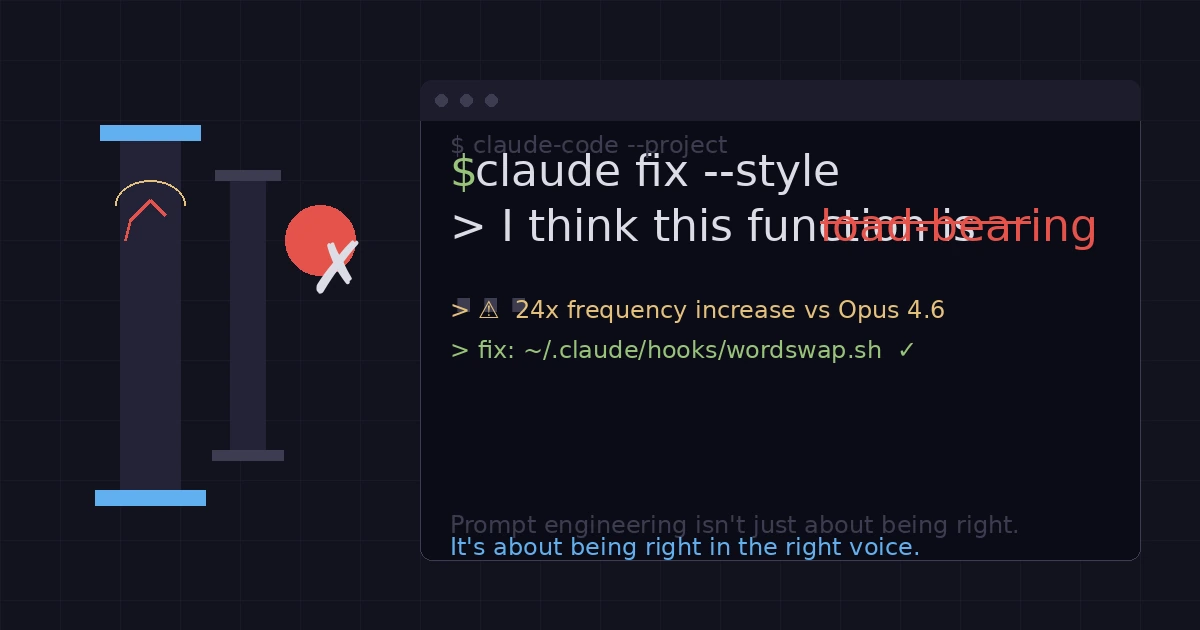
How to Stop Claude from Saying 'Load-Bearing' — and What It Teaches Us About Prompt Engineering
Claude Code's obsession with the word 'load-bearing' has become a developer meme. The fix reveals something important about controlling AI style.
 #anthropic
Claude Speaks Differently in Every Language — Anthropic Study Reveals How Language Shapes AI Values
Anthropic's largest-ever values study analyzes 309,815 conversations across 20 languages and finds Claude responds with more warmth in Hindi, more rigor in English, more candor in Dutch. The four value axes, what they mean for multilingual AI, and why Anthropic can't yet explain the differences.
 #claude
"Better Models, Worse Tools" — Armin Ronacher Exposes a Tool-Calling Regression in Modern Claude
Armin Ronacher (creator of Flask, Jinja2, Rye) documents a maddening regression: Claude Opus 4.8 and Sonnet 5 are smarter than their predecessors but reliably worse at calling tools correctly. The culprit may be Claude Code's own forgiving harness. Here's what happened, why it matters, and what developers should do about it.