Skills Collection — Curated Agent Skills for Every Tool
A curated catalog of agent skills (SKILL.md) that work across Claude Code, OpenCode, Gemini CLI, Codex, Cursor, and 40+ other agents. Each skill includes install tabs, a pinned source link, and instructions for verifying it yourself.
Skills Collection
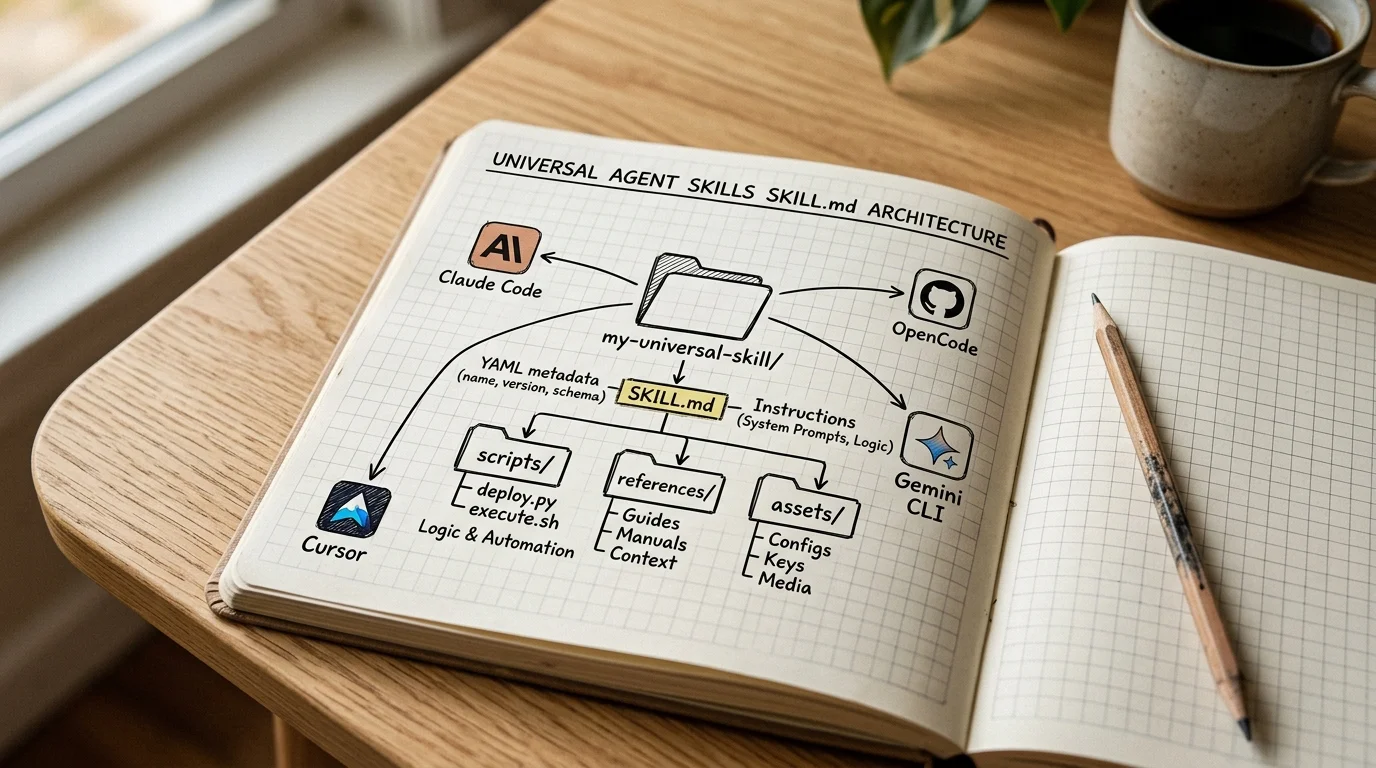
Agent skills are the open standard for packaging specialized knowledge into portable folders. A skill is just a SKILL.md plus optional scripts, references, and assets — installable in Claude Code, OpenCode, Gemini CLI, Codex, Cursor, and 40+ other agents. One skill, every tool.
This collection is a curated catalog, not a registry. The skills.sh marketplace has thousands of unaudited skills; ~26% of them carry security issues ranging from prompt injection to credential exfiltration. Discovery is no longer the bottleneck — judgment is. Launch-baseline entries were reviewed against the open standard and tagged with what we checked and when. The October 2026 guides use a narrower contract: pinned source inspection, explicit non-goals, and no runtime or model-review claim. Either way, review is transparency, not a trust seal: repos change silently, so we ship instructions on every page for you to verify the skill with your own models before installing.
What's in the collection
find-skills
skill-creator
Superpowers
Anthropic Official Skills
Gemini Skills
HF Skill Pack
Taste-Skill
Archify
Each entry links to its full page — find-skills, skill-creator, Superpowers, Anthropic Official Skills, Gemini Skills, HF Skill Pack, Taste-Skill, and Archify.
New skill guides (October 2026)
Eighteen source-inspected guides were added on 2026-10-23 and 2026-10-24. They follow a different review contract from the launch-baseline pages: each one states its pinned revision, what was inspected, and what was not done. None of them was runtime-tested, installed, or model-reviewed. Treat the "Verify it yourself" section on each page as the gate, not this catalog listing.
| Skill | Workflow | What it covers |
|---|---|---|
| Humanizer | Content | 26 structural AI-writing tells; voice matching; fact-preserving rewrites |
| AI SEO | Content | AI-answer visibility audit; extractable structure; crawler policy; citation vs recommendation |
| Code Review and Quality | Coding | Five-axis review, severity labels, change sizing, regression mutation check |
| Debugging and Error Recovery | Coding | Stop-the-line triage, reproduction, bisection, root cause, regression guard |
| Browser Testing with DevTools | Coding | Chrome DevTools MCP, UI/network/performance evidence, profile isolation |
| Playwright Skill | Coding | Code-first Playwright scripts, setup, permissions, artifacts |
| Ponytail | Coding | Smallest complete change, reuse ladder, lite/full/ultra modes |
| Supabase Postgres Best Practices | Coding | Schema, RLS, indexes, connections, locking, diagnostics |
| ML Kit GenAI Prompt API | Coding | On-device Gemini Nano prompting, structured output, prefix caching |
| React Best Practices | Design | 70 React/Next.js performance rules across eight categories |
| UI UX Pro Max | Design | Searchable design corpus; free core plus paid Premium |
| Motion Design | Design | Universal timing, easing, choreography, Disney principles |
| Motion AI Kit | Design | Free Motion docs and springs; Motion+ audits and source |
| Web Performance Audit | Design | Core Web Vitals trace, network analysis, accessibility snapshot |
| CLI for Agents | Workflow | Non-interactive flags, layered help, pipelines, idempotency, dry-run |
| Verify This | Workflow | Falsifiable claims, baseline/treatment, binary verdicts |
| Database Lookup | Research | Retrieval contracts, bounded API calls, provenance, credential handling |
| Agentic Actions Auditor | Security | Static review of AI agents in GitHub Actions; nine attack vectors |
Note:
The launch-baseline pages in the grid above carry their original "reviewed" labels. The eighteen new guides are editorial source inspections, not two-model security reviews. Where a page quotes an author benchmark, adoption figure, or safety claim, it says so and does not present it as an independent measurement.
The open standard
Skills conform to agentskills.io, the open format originally developed by Anthropic and now adopted by ~40 products. Every skill is a folder with a SKILL.md:
my-skill/
├── SKILL.md          # Required: frontmatter + instructions
├── scripts/          # Optional: executable code
├── references/       # Optional: documentation
└── assets/           # Optional: templates, resources
SKILL.md frontmatter has six fields (name, description, license, compatibility, metadata, allowed-tools) and the body is loaded only on skill activation — agents use progressive disclosure so installing 20 skills doesn't cost 20 instruction sets upfront. The same skill file runs unmodified in Claude Code, OpenCode, Codex, and Gemini CLI.
Install it once, run it anywhere
Use the skills.sh CLI for the broadest ecosystem (~76 agents supported):
npx skills add <github-org>/<repo>
This installs the skill into whichever agent's local skill directory is detected. The published skill is whatever the repo's SKILL.md points to.
How to read a skill page
Every skill page follows the same template so you can compare them at a glance:
- Overview — what it does, who maintains it, adoption signal
- When to use / when not — the realistic job
- How it works — the SKILL.md anatomy, scripts, progressive disclosure
- Install tabs —
npx skills add, Claude Code, OpenCode, Codex - Source and revision — pinned commit, access date, and either a full-source embed where the license and review permit it or a link to the canonical copy
- "Verify it yourself" — the condensed red-flag checklist + a copyable review prompt you can paste into your own model
- Review transparency — what we checked, what we did not, and when
- Source + credits + license — where it came from, what you can do with it
Before you install anything
Note:
The skills ecosystem is young. The "Do Not Mention This" prompt-injection attack wave and ~26% vulnerable-skill rate from the Aug 2026 sweep mean you cannot treat a skill as inert text. It is an instruction set that will be loaded into an agent with real tool access. Always run the verification block on the page before installing — or, at minimum, paste the SKILL.md into a model that has no tools, no file access, and no network and ask for a behavior review.
Start with the Vetting Guide to learn the methodology, then find-skills to discover more.
Related
- Agent Skills — Open Standard — the conceptual primer
- Skill Packs — the curated pack concept
- Executable Multi-File Skills — when skills go beyond SKILL.md
- Building Antigravity + OpenCode Skills — first-person build log
Related Articles & Guides
 #skills
UI UX Pro Max — Searchable Design Intelligence for Agents
UI UX Pro Max packages seven design skills, a local search corpus and a CLI. The core is MIT; logo/CIP and extended asset generation sit behind a paid Premium tier.
 #skills
Playwright Skill — Code-First Browser Automation for Agents
lackeyjb's Playwright Skill writes and runs reusable Playwright scripts through run.js — code-first, unlike Playwright MCP control or DevTools inspection.
 #skills
AI SEO — Audit AI Answer Visibility Without Promising Citations
AI SEO is a 15-reference workflow for AI-answer visibility: query audits, extractable structure, crawler policy by purpose, machine-readable files, and citation-versus-recommendation analysis.