Monday, July 6, 2026
Cloudflare Just Rewired the Web's Relationship With AI Bots — Here's What Changes
Posted by
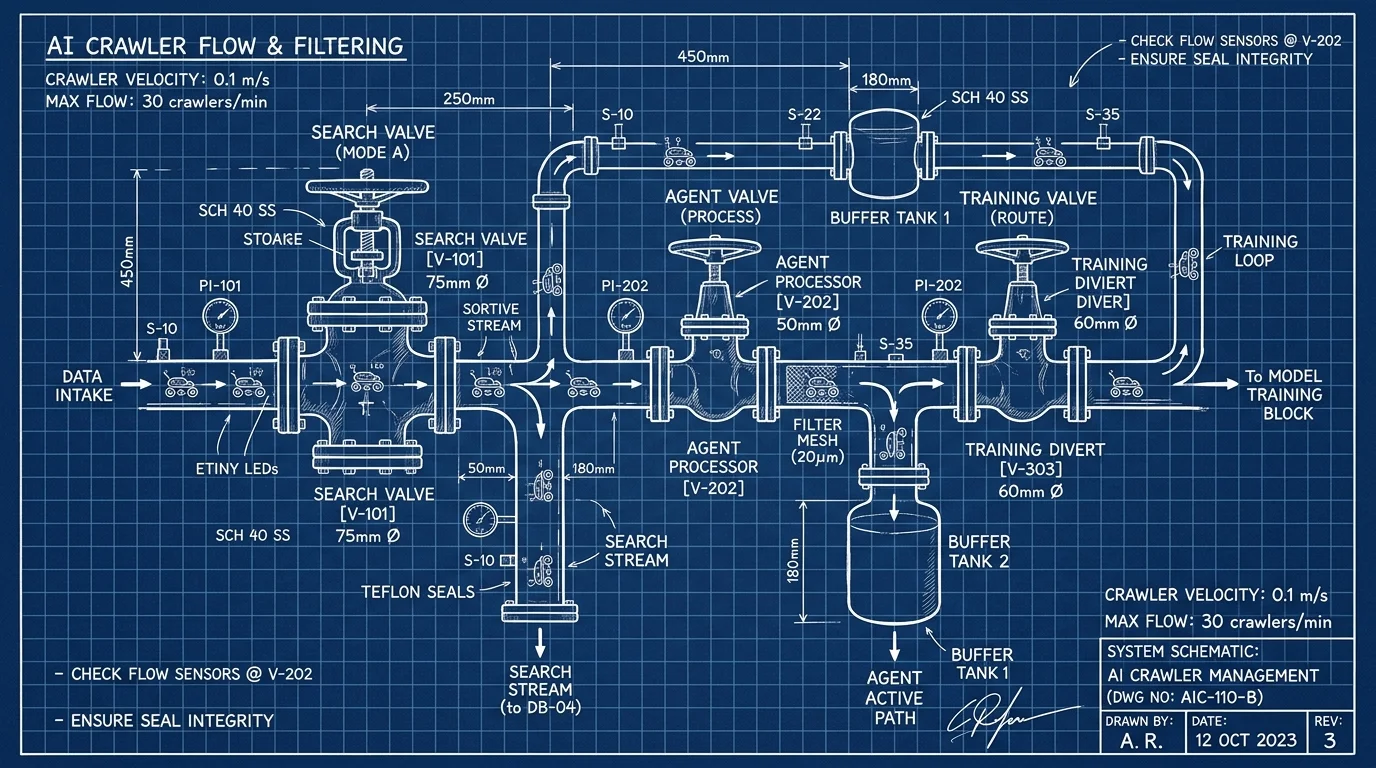
On July 1, Cloudflare blew up the old AI bot block-and-forget model and replaced it with something far more surgical. Instead of a single toggle that says "block all AI bots," site owners now get three independent switches — one each for Search, Agent, and Training crawlers — plus a September 15 deadline that forces bot operators to separate their crawlers by purpose or get blocked by default.
This is the most consequential change to how AI interacts with the open web since the robots.txt debate started. And if you're building AI agents that browse the web, this directly affects your stack.
The Faustian Bargain That's About to End
Here's the problem Cloudflare identified over the past year. When the company launched its one-click "Block AI Bots" toggle in July 2024, it solved one problem but created another. Site owners who wanted to block OpenAI's GPTBot from training on their content also blocked Googlebot — meaning they disappeared from search results. Prince called it a "Faustian bargain" in Cloudflare's announcement post: show up in search and let AI train on you, or block everything and lose discoverability.
The numbers made the problem acute. Cloudflare's network data shows:
- Automated bots now generate 57.5% of all web requests
- 52% of crawler requests are for AI training, up from 22% in Spring 2025
- For heavily crawled publishers, human traffic has dropped 40% in under a year
The old approach was a sledgehammer. The new approach is a set of scalpels.
The Three Categories: Search, Agent, Training
Cloudflare now classifies bots by what they're doing on your site, not what label they carry. Every Cloudflare customer — including free-tier — can independently set each category to Allow, Block, or (new) Block on Ad Pages.
Search crawlers index content to answer queries later. These are the traditional search engine bots — they expect the 30-year social contract of referring traffic back to the source. Googlebot, BingBot, AppleBot in their search-crawling mode fall here.
Agent crawlers act in real time on behalf of a specific human. When ChatGPT browses a page because a user asked it to, or when Claude runs through a website in the browser, that's Agent traffic. A human is waiting on the other end. Cloudflare's view is that this is a fundamentally different use case from bulk training.
Training crawlers collect content to train or fine-tune AI models. The data is permanently absorbed into the model's architecture — no referral traffic, no compensation, no ongoing value returned to the publisher. This is the category Cloudflare describes as the "clearest case of value extraction."
The logic behind "Block on Ad Pages" is pragmatic: an advertisement is a signal that the site owner meant for a human to land there. If a bot consumes the page without the ad being seen or clicked, it's effectively stealing the monetization opportunity.
The September 15 Deadline That Changes Everything
Here's where it gets real. On September 15, 2026, new defaults kick in across Cloudflare's network. Training and Agent bots will be blocked by default on pages that display ads. Search remains allowed.
The critical detail: default enforcement follows the most restrictive applicable rule. This means multi-purpose crawlers like Googlebot, Applebot, and BingBot — which combine Search + Training in a single user-agent — will be blocked on ad pages if Training is blocked.
Google has argued that Google-Extended (its separate robots.txt directive for AI training) gives sites the control they need. Cloudflare's counter-argument: a separate opt-out in robots.txt is advisory, not structural. The same bot that runs through your site for search indexing also carries the data back for model training. Cloudflare's position is that these crawlers should be separate processes with separate identities, not combined under a banner where site owners can't block one without blocking the other.
Cloudflare has stated its goal explicitly: reduce mixed-use crawler traffic to zero by mid-2027.
Existing customers who enabled the legacy "Block AI Bots" toggle will find their rules automatically updated to the new system. They have until September 15 to opt out through Security Settings if they want to override the defaults.
BotBase: Seeing Who's Actually Crawling You
For enterprise customers, Cloudflare launched BotBase — a searchable database of every bot the company tracks, built directly into the dashboard. For the first time, site owners can see how each bot is classified, what category it claims, and how it uses content — whether it just links to pages or reproduces them in full.
This matters because the opacity of AI crawling has been a persistent problem. Publishers have known their content was being consumed, but attributing traffic to specific bots and understanding their behavior required digging through logs and reverse-engineering user-agent strings. BotBase turns it into a queryable dashboard.
BotBase also changes how "verified" status works. Previously, any verified bot was automatically allowed through. Going forward, verification means the bot honestly represents itself and doesn't abuse access — but its category determines whether it gets through. A properly identified Training bot with a verified badge still gets blocked if the site owner blocks Training crawlers.
The Monetization Layer: x402 and Pay Per Use
Cloudflare also opened a waitlist for its Monetization Gateway — a system where AI agents can pay site owners on the spot for access, using the HTTP 402 status code that's been dormant in the spec since 1997.
The mechanism is worth understanding because it's the first real-world deployment of programmatic micropayments at web scale:
- An AI agent requests a protected resource on a Cloudflare-backed site
- Cloudflare's edge returns an HTTP 402 response with a machine-readable price manifest (cost in USDC, accepted blockchain — Base or Solana — destination wallet, timeout in milliseconds)
- The client pays on-chain and attaches the cryptographic proof to a follow-up request
- Cloudflare verifies the proof and returns the resource
The protocol, x402, is now under neutral Linux Foundation stewardship with backing from Coinbase, Stripe, AWS, Google, Microsoft, and Visa. Coinbase CEO Brian Armstrong recently noted that x402 has already processed 160 million autonomous transactions. AWS CloudFront integrated the same protocol on June 15.
The old Pay Per Crawl system is being rebranded to Pay Per Use, with launch partners including Ceramic.ai and others.
Cloudflare's data on the crawl-to-referral economics is the context that makes this make sense. On their network in June 2025, OpenAI crawled 1,700 pages for every single referral visit sent back. Anthropic's ratio was 73,000:1. Those numbers don't describe a healthy ecosystem. They describe an extraction loop.
What This Means for AI Agents
If you're building AI agents that browse the web, this is the story you need to internalize.
Your agent bot needs its own identity. If your system crawls through sites using a shared infrastructure pool or routes through a general-purpose browser, Cloudflare's new system will classify that traffic. If it looks like it's doing bulk training, it gets blocked — even if it's actually serving a live user request. The three-category system means you need to make sure your Agent traffic looks like agent traffic, not training traffic.
The Forwarded header is your friend. Cloudflare is promoting RFC 7239's Forwarded header for intermediaries:
Forwarded: for="yourapp";use="reference"
If your agent operates through a platform or proxy, getting the classification right depends on how the chain of trust is established. Cloudflare has stated that bots that don't carry proper identification will face increasingly restrictive treatment.
Expect more HTTP 402 responses in your agent's future. If you're building shopping agents, research assistants, or any automation that reads publisher content, you'll need to handle the 402 flow. That means maintaining a wallet, handling cryptographic proof verification, and deciding which paywalls your agent auto-accepts.
robots.txt isn't the enforcement layer anymore. Cloudflare has been pushing Content Signals as an extension to robots.txt with a new use parameter:
User-agent: *
Content-Signal: search=yes,ai-train=no,use=reference
Allow: /
All managed robots.txt customers will automatically get use=reference added. Bot operators that reproduce content in full lose their verified status. The enforcement happens at Cloudflare's edge, not as an advisory robots.txt directive.
The Big Picture
This is the first time a major internet infrastructure provider has moved beyond the "block or allow" binary. Cloudflare routes roughly 20% of web traffic through its network — when the edge enforces a behavioral classification system, it changes the incentive structure for every bot operator.
The September 15 deadline is the hard date to watch. That's when the new defaults activate and multi-purpose crawlers start getting blocked on ad-supported pages. If Google, Apple, and Microsoft haven't separated their search crawlers from their training crawlers by then, a significant portion of the web will stop serving their bots on monetized pages.
The robots.txt era treated bots as a single dimension: allowed or blocked, with some path-level nuance. Cloudflare's new system adds purpose and compensation as first-class dimensions. That's a structural shift, not a policy tweak.
We're entering the era where bots need to identify themselves honestly, declare their purpose, and potentially pay for access — all enforced at the edge instead of by convention. The web's social contract with crawlers just got rewritten.
This is a developing story. Cloudflare's announcement is live at blog.cloudflare.com/content-independence-day-ai-options. New defaults activate September 15, 2026. The BotBase feature is rolling out now to Enterprise Bot Management customers. The Monetization Gateway waitlist is open now.
Related Articles & Deep Dives
 #llm
#llmThe Flash Wars: Three Chinese Models Just Reset the Price of Intelligence
GLM-5.3-Flash, DeepSeek-V4.1-Flash, and Qwen3.8-Flash-Next landed within seventeen days. What they share, where they actually win, and what it means for your AI bill.
 #jev
#jevTypeSafe's Jev: The Decision Model Everyone Is Talking About
TypeSafe's new decision model Jev went from zero to 27M+ views in four days. What it is, what it can't do, and whether it fits your stack.
 #agent-skills
Malicious Agent Skills & Supply Chain Attacks: Securing the SKILL.md Ecosystem
How third-party AI agent skills introduce hidden RCE, environment variable exfiltration, and prompt injection — and how to sandbox and audit SKILL.md packages.