Tuesday, August 18, 2026
Gemini 3.7 Flash: The Workhorse Gets Smarter and Cheaper
Posted by

Google released Gemini 3.7 Flash on August 13 — just three weeks after Gemini 3.6 Flash, in what Google describes as a direct response to developer feedback. It's positioned as the most intelligent workhorse model yet for coding and agents, and it ships at an introductory price of half the original 3.6 Flash cost.
What's New
3.7 Flash delivers substantial gains over 3.6 Flash on the benchmarks that matter for agent work:
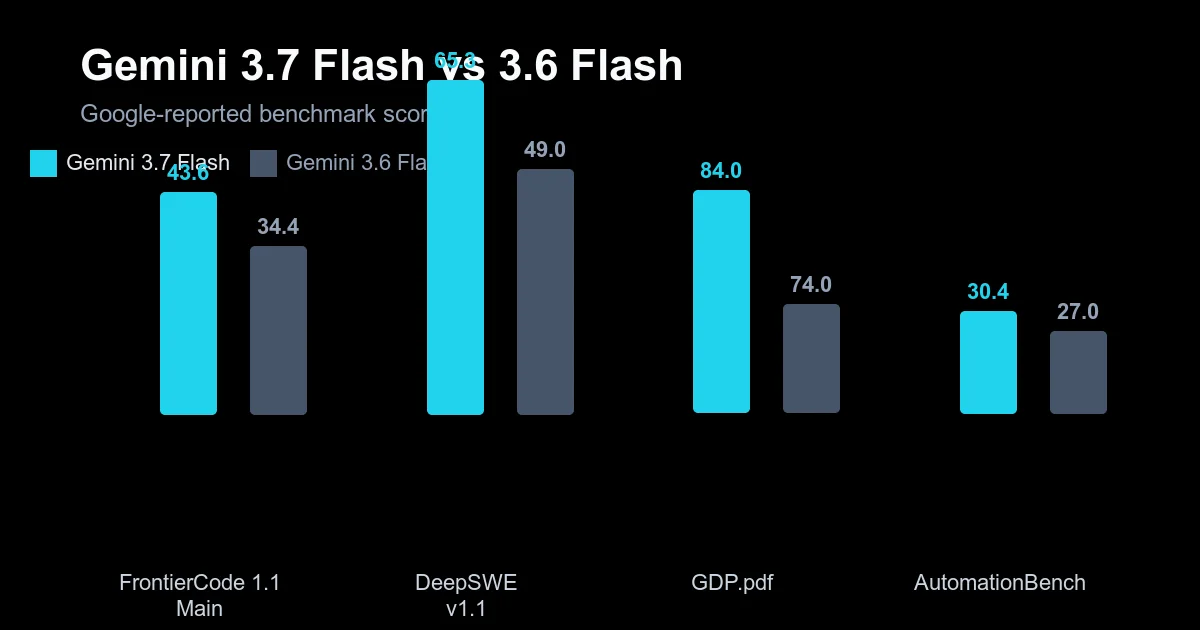
| Benchmark | Gemini 3.7 Flash | Gemini 3.6 Flash |
|---|---|---|
| FrontierCode 1.1 Main | 43.6% | 34.4% |
| DeepSWE v1.1 | 65.3% | 49.0% |
| GDP.pdf | 84.0% | 74.0% |
| AutomationBench | 30.4% | 27.0% |
FrontierCode (first-pass production code) and DeepSWE (long-horizon software engineering) are the coding-agent numbers. The GDP.pdf jump is about processing complex documents — knowledge work. AutomationBench is real-world business workflows. The pattern across all four: 3.7 Flash is meaningfully better on exactly the workloads that make up a modern agent pipeline — write code, fix it over a long horizon, process documents, drive tools.
The model card adds the practical specs: 1,048,576-token context, 65,536 max output tokens, model ID gemini-3.7-flash.
Beyond the numbers, Google emphasizes behavior: the model better adapts to roadblocks, clarifies intent when it's unsure, and follows instructions with higher fidelity. It thinks more diligently, putting more effort into multi-step planning and tool calls — which the benchmark table translates to "fewer retries and less manual oversight."
One change to note: the minimal thinking option from 3.6 Flash is gone in 3.7 — the floor is now lower thinking effort rather than none. If you relied on minimal for high-throughput, low-cost workloads, you'll need to re-tune: the model now always reasons to some degree, and the plan is to budget for it.
The Price
The headline is the economics:
- Introductory (through Dec 31, 2026): $0.75 / 1M input tokens, $3.75 / 1M output — half the original 3.6 Flash rate
- From Jan 1, 2027: $1.50 / 1M input, $7.50 / 1M output — the standard rate, published at launch, doubling on schedule
- Context caching: $0.075 / 1M input tokens during the intro window, $0.15 after — worth watching for agent loops that repeatedly retrieve the same context
At $0.75/$3.75, 3.7 Flash undercuts most of the agent-friendly workhorse tier while beating its own predecessor on the benchmarks. For comparison, the same intro table puts it well under Claude Sonnet 5 ($2.00/$10.00) and GPT-5.6 Terra ($2.00/$12.00) on the model card's comparison. That combination — better DeepSWE and FrontierCode at half the cost — is aimed squarely at teams running high-volume agent pipelines.
Two implications worth acting on:
- The intro window is a real window. Pricing doubles on January 1, 2027, no speculation involved. If you're trialing 3.7 Flash for production agents, the cost model you should be evaluating is the post-January one, not the launch one.
- Cache economics are the lever. Agent loops that keep a stable system prompt and task context will ride the $0.075 cache-hit rate hard; sessions that churn their context won't. (The Copilot production study quantified just how much cache stability matters for agent workloads.)
The cache math is worth making concrete. Take an agent session that holds a 200K-token context and makes 50 calls that hit that stable prefix. Uncached, at intro pricing that's 200K × 50 × $0.75/1M ≈ $7.50 just for input. With a cache hit on the stable prefix at $0.075/1M, the same 50 calls cost ≈ $0.75 — a 10× difference that widens after January, when the standard-rate spread ($1.50 vs $0.15) applies. A long-lived agent that churns its context on every turn is paying the uncached rate no matter how cheap the headline price is; a session designed around a stable prefix is the difference between pennies and dollars on the same workload.
Where You'll See It
- Gemini Spark — Google's 24/7 personal agent (AI Pro/Ultra subscribers) now runs on 3.7 Flash, improving tool use across Google Workspace apps
- Developers — available through the Gemini API, Google AI Studio, Android Studio, Google's Antigravity coding agent, and Gemini Enterprise
- Partners — Google is pairing the launch with temporary partner discounts (e.g., Devin through late August) and a temporary OpenRouter reduction
What Hasn't Changed
For everything 3.7 Flash improves, its positioning stays intact: this is the workhorse tier, not the frontier tier. It's built for speed and cost — low latency, high throughput, and the price point above. When a task needs the deepest reasoning (research-grade math, novel algorithm design, HLE-class problems), the premium tier is still where that lives. What 3.7 Flash changes is the boundary: workloads that used to require the premium tier's reliability now run fine on Flash, and workloads that ran on premium for cost reasons now have an obvious alternative.
The multimodal input story carries over too — document and image understanding, which power part of the GDP.pdf jump, remain a Flash line strength.
Should You Switch?
The answer depends on what you're running today:
- On 3.6 Flash: the price for the same work is roughly half, and the benchmark deltas are large enough that most teams will see real completion-rate gains. The
minimal-thinking removal is the one thing to re-test before migrating. - On a premium-tier agent model (Claude Sonnet 5, GPT-5.6 Terra): 3.7 Flash is cheaper, and on the coding benchmarks it's competitive or better on some. The honest test is your own task set — FrontierCode and DeepSWE are strong proxies but not your repo. Run the evaluation on your workload before you move anything.
- Evaluating new agent workloads: model the post-January pricing, not the intro pricing, and design for context caching — the cache-hit economics are where long-lived agent sessions win or lose.
The Takeaway
3.7 Flash is the strongest "cheap agent model" on paper right now. If you're evaluating models for agent-heavy workloads — subagents, batch coding, knowledge work — the FrontierCode + DeepSWE + AutomationBench combination at $0.75/$3.75 makes it a serious candidate against the premium tier, and the context-cache pricing makes it especially interesting for long-lived agent sessions.
Two things to verify before you commit: these are Google's numbers, so run your own eval on your own task set, exactly as you'd benchmark any other agent model. And if you're coming from 3.6 Flash, budget for the minimal thinking removal — and for the January price change — when you build the cost model.
Related Articles & Deep Dives
 #deepseek
DeepSeek Harness: Everything Is a Plugin
DeepSeek Harness (dsh) is DeepSeek's MIT-licensed agent runtime where everything is a plugin — the four presets, setup, and what it means for benchmark trust.
 #gemini
Gemini 3.5 Pro Is Delayed Again — What It Says About Google DeepMind's Release Cadence
Gemini 3.5 Pro was reportedly set to launch August 10 — it's not shipping this month. Why the delay is becoming a pattern, and what it means for developers planning on Gemini.
 #gemini
Gems Are Retiring October 20 — Google Is Moving Gemini to Skills
Google is retiring Gems on Gemini by October 20, 2026. Users are asked to recreate their Gems as Skills — confirming Skills is becoming the cross-platform agent standard.