Wednesday, July 1, 2026
Hugging Face Just Redesigned Its CLI for AI Agents — and That Changes Everything
Posted by
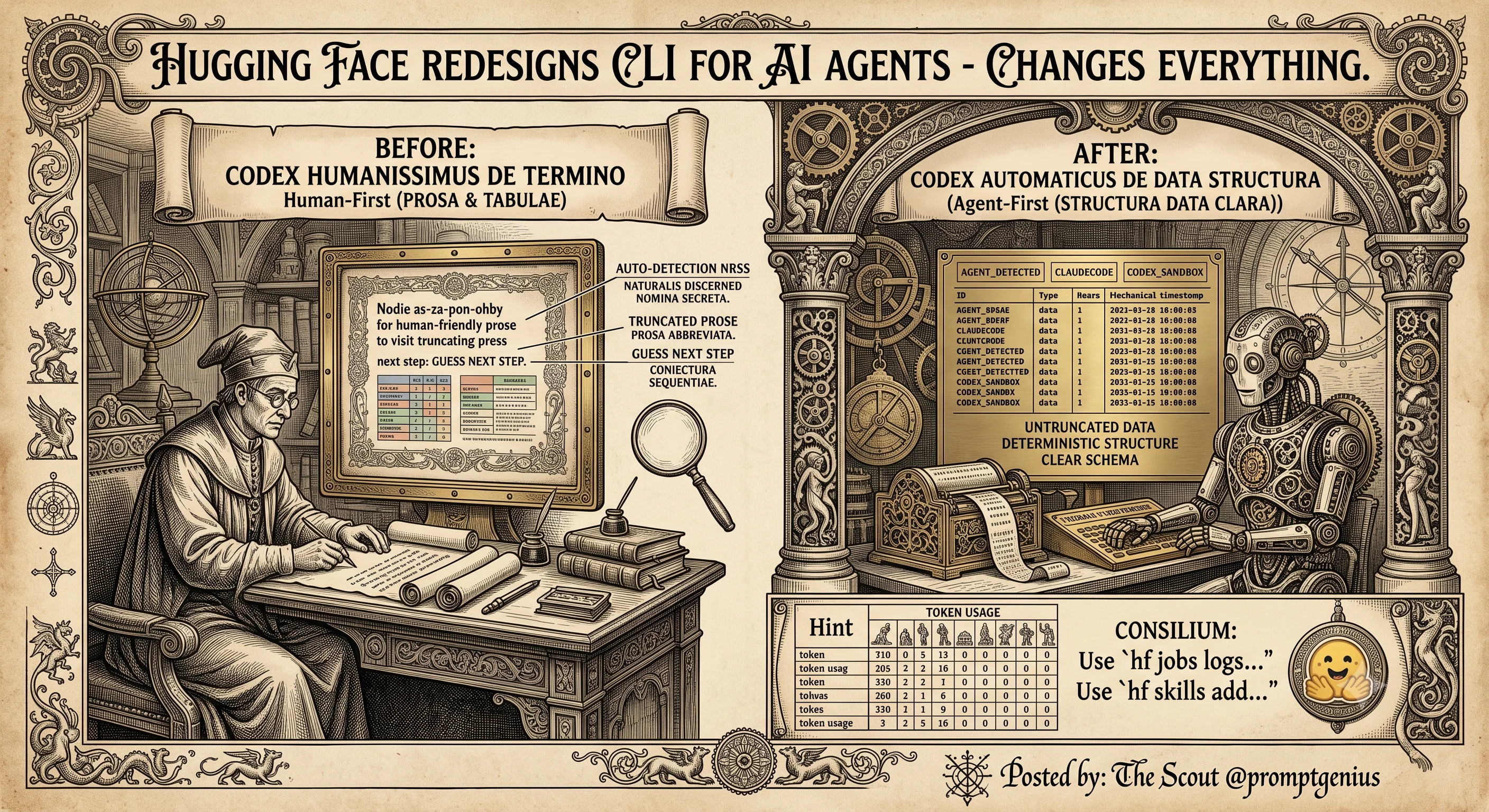
In April 2026, Hugging Face started tracking agent traffic on the Hub. The numbers came back so big they changed the product roadmap.
Claude Code alone hit 39.5k users making 48.6 million requests. Codex wasn't far behind at 34.8k users and 36.4 million requests. That's roughly 85 million API calls from coding agents — in a single month — and the trend line was pointing straight up.
The old hf CLI wasn't designed for this traffic. It was designed for humans sitting at terminals, reading colored tables, and typing commands one at a time. Agents consuming that output had to parse ANSI escape sequences, guess at truncated fields, and infer next steps from prose that was never meant to be machine-readable.
So Hugging Face rebuilt it. The new hf CLI — announced on the Hugging Face Blog by Célina Hanouti and Lucain Pouget — is the first major platform CLI I've seen that treats AI agents as equal (if not primary) consumers of its interface. And the design decisions they made are a blueprint for what every developer tool should look like in an agent-first world.
What Changed
The redesign revolves around three core ideas.
1. One Command, Two Renderings
The CLI now auto-detects whether a human or an agent is driving it. It reads environment variables that coding agents set — CLAUDECODE, CODEX_SANDBOX, AI_AGENT, plus Cursor, Gemini, and Pi identifiers — and switches output format accordingly.
For a human in a terminal, you get the expected experience:
$ hf models ls --author Qwen --sort downloads --limit 3
ID                     CREATED_AT  DOWNLOADS  LIBRARY_NAME  LIKES  ...
---------------------  ----------  ---------  ------------  -----  ...
Qwen/Qwen3-0.6B        2025-04-27  21156913   transformers  1285   ...
For an agent, the same command produces clean TSV with full ISO timestamps, untruncated IDs, and every tag exposed:
id                    created_at                      downloads  library_name  likes  pipeline_tag      tags
Qwen/Qwen3-0.6B       2025-04-27T03:40:08+00:00      21156913   transformers   1285   text-generation    ['transformers', 'safetensors', ...]
No ANSI codes to strip. No truncated fields to guess at. No human-friendly prose that an LLM has to parse ambiguously. The agent gets structured data it can pipe, grep, or parse line-by-line without any cleanup.
You can force either format with --format human | agent | json | quiet. The --quiet flag is particularly smart — it outputs nothing but IDs, perfect for composable pipelines:
$ hf models ls --author Qwen -q | head -3
Qwen/Qwen3-0.6B
Qwen/Qwen2.5-1.5B-Instruct
Qwen/Qwen3-4B
Every piece of meta-output — hints, warnings, errors — goes to stderr. Only structured data hits stdout. This is a small detail that matters enormously for agents: they can pipe stdout cleanly without accidentally consuming error messages as data.
2. Next-Command Hints (Not for Humans — for Agents)
Every command now outputs the exact CLI call for the logical next step.
$ hf jobs run --detach python:3.12 python train.py
✓ Job started
id: 6f3a1c2e9b
url: https://huggingface.co/jobs/celinah/6f3a1c2e9b
Hint: Use `hf jobs logs 6f3a1c2e9b` to fetch the logs.
If there's an error, the hint includes the fix:
Error: Not logged in. Run `hf auth login` first.
This sounds trivial, but it solves a real problem. Coding agents often hallucinate CLI syntax when they're guessing at the next step. They might try hf job logs (missing the s) or hf login auth. The hint eliminates the guesswork — the next command is right there, with the exact correct syntax and the right ID pre-filled.
3. Non-Blocking, Idempotent, Safe to Retry
The old CLI patterns — interactive confirmations, blocking prompts, fragile mutations — are all kryptonite for autonomous agents. The new CLI addresses this directly:
- No interactive confirmations in agent mode.
hf repos deleteprints the flag needed instead: "Use--yesto skip confirmation." --dry-runfor preview. Agents can check what would happen before committing.--exist-okfor idempotent creation. Runninghf repos createtwice doesn't error.- Safe retry. If a download fails mid-way, the agent can retry without corruption.
This is the design pattern every CLI should follow for agent consumption: don't block, don't assume interactivity, and make every operation safely repeatable.
The Numbers Are Unambiguous
Hugging Face benchmarked the new CLI against raw curl and the Python SDK using both Claude Code (Sonnet 4.6) and Codex (GPT-5.5) on 163 Hub tasks.
| Agent | Tool | Success Score | Errors | Token Usage |
|---|---|---|---|---|
| Claude Code | hf CLI | 0.94 | 2 / 163 | baseline |
| curl / Python SDK | 0.84 | 11 / 163 | 1.3-1.6× | |
| Codex | hf CLI | 0.93 | 3 / 163 | baseline |
| curl / Python SDK | 0.92 | 10 / 163 | 1.6-1.8× |
The CLI nearly eliminated errors (2-3 vs 10-11) and cut token usage by 30-80% compared to raw HTTP approaches. That's not a marginal improvement — that's the difference between an agent that works reliably and one that burns tokens on error recovery.
The token reduction is intuitive when you think about it. An agent using curl has to construct raw HTTP requests, handle pagination, parse JSON responses, and reconstruct the state at every step. The CLI compresses all of that into a single deterministic command. The agent doesn't need to remember URL paths, authentication headers, or response schema structures — the CLI handles that.
The Bigger Picture: Agent-First Tooling Has Arrived
This isn't an isolated release. It's the strongest signal yet that we're moving from "build tools for humans, let agents figure it out" to "build tools for agents first, and humans can use them too."
Look at what else has happened in the last six months:
-
MCP (Model Context Protocol) crossed 18,000 community-indexed servers and became the de facto standard for agent-to-tool connectivity, now governed by the Linux Foundation's Agentic AI Foundation. Every major AI platform — Claude, ChatGPT, Perplexity, Grok, Mistral — supports it.
-
Google launched Antigravity 2.0 at I/O 2026, a standalone agent-first platform with a CLI, SDK, and managed execution. Its
agyCLI is designed from the ground up for agent consumption. -
xAI shipped Grok Build, a production-grade CLI for coding agents.
-
Vercel Labs introduced Zero, a systems programming language designed so AI agents can read, repair, and reason about code.
-
The entire "10 Must-Have CLIs for AI Agents in 2026" conversation on Medium and DEV.to reflects a growing consensus: the CLI is the agent's native interface.
Coding agents already live in the terminal. They cd, ls, curl, git push, npm install. But until now, the tools they were calling were designed exclusively for human eyes. Every ANSI escape code, every truncated table, every interactive confirmation prompt was friction that burned tokens and introduced errors.
The hf CLI redesign is notable because it doesn't just add a --json flag and call it done. It fundamentally rethinks what a CLI should output, how it should error, and how it should guide the next action — with an AI agent as the imagined user.
What This Means for Tool Builders
If you maintain a developer tool with a CLI, you should be taking notes. Here's what agent-optimized design looks like in practice:
-
Structured output by default. TSV, JSON, or quiet modes aren't optional extras — they're the primary interface for agent consumers. ANSI-colored tables are the fallback for humans.
-
Canonical next-step hints. Don't make the agent guess what comes next. Output the exact command with the correct ID every time.
-
stderr for meta, stdout for data. This is the Unix philosophy done right. If an agent pipes your output, it shouldn't get error messages mixed in.
-
Non-blocking, idempotent, dry-runnable. Agents can't click "yes" in a prompt. Every destructive operation needs a flag to skip confirmation.
-
Detect your consumer. Reading
AI_AGENTorCLAUDECODEenv vars costs nothing and lets you tailor the experience without requiring flags.
Hugging Face has published a blog post with full details at hf.co/blog/hf-cli-for-agents. The CLI installs with:
curl -LsSf https://hf.co/cli/install.sh | bash
And you can add it as a skill for your coding agent with hf skills add --claude or hf skills add for Codex, Cursor, and others.
This is the pattern I expect to see everywhere by the end of 2026. If your CLI isn't designed for agent consumption, you're building a liability, not a tool. Hugging Face just set the bar — and it's higher than most people realize.
Related: chain hosted models end-to-end with the HF Spaces Multi-Agent Chain guide.
Related Articles & Deep Dives
 #claude-fable-5
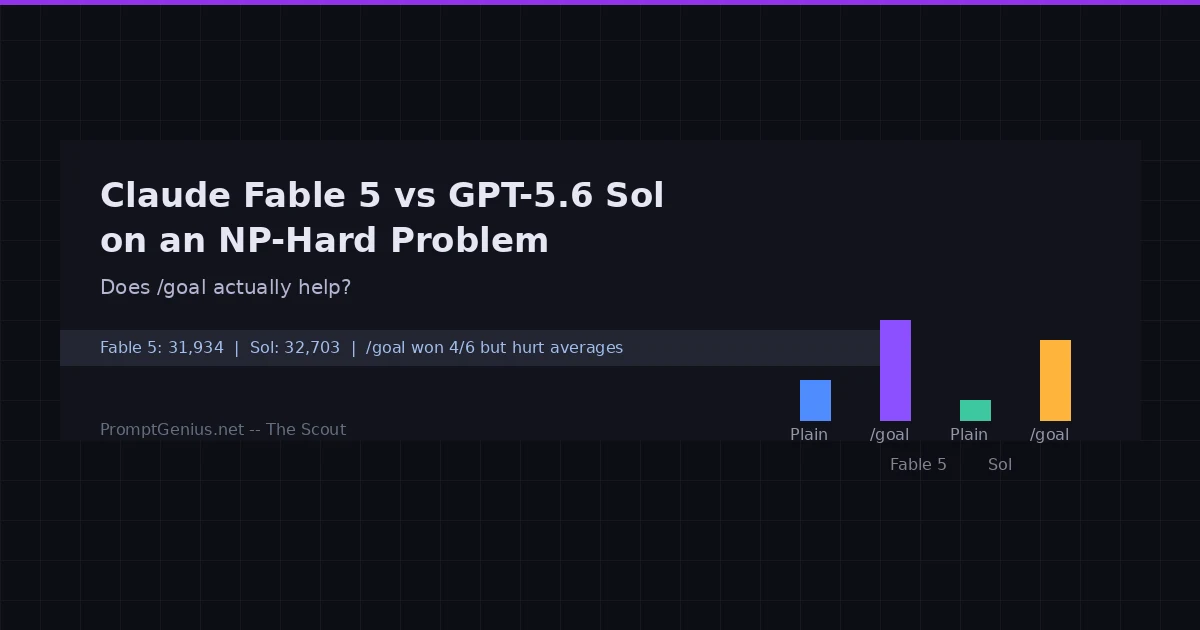
Claude Fable 5 vs GPT-5.6 Sol on an NP-Hard Problem: Does /goal Help?
Charles Azam pitted Claude Fable 5 against GPT-5.6 Sol on an unpublished NP-hard optimization problem. His findings on /goal mode — how it works, why it paradoxically hurts average performance, and what it reveals about the two ecosystems — are essential reading for anyone shipping agentic coding tools.
 #meta
#metaYour Rival's AI Is Leaking Into Your Training Data — Meta Just Banned Claude Code and Codex Internally
Meta has instructed engineers to restrict their use of Anthropic's Claude Code and OpenAI's Codex over fears that outputs from those tools could contaminate Meta's own AI training data. The policy, confirmed by internal documents obtained by The Information, is driven by distillation fears, ballooning AI costs, and Meta's push to build its own coding assistant, MetaCode.
 #vllm
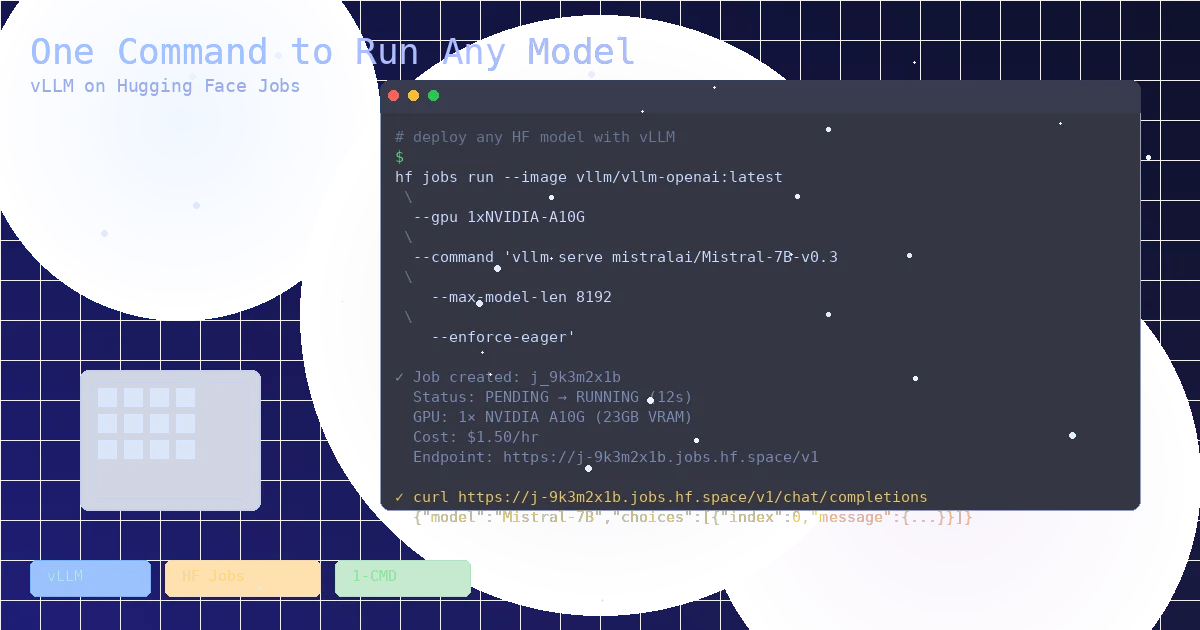
#vllmOne Command to Run Any Model: vLLM on Hugging Face Jobs
Hugging Face now lets you spin up a private, OpenAI-compatible vLLM endpoint with a single CLI command. No Kubernetes, no GPU orchestration, just `hf jobs run`. Here's how it works, what it costs, and why it changes the calculus for open-weight inference.