Friday, July 3, 2026
"It Hasn't Accelerated" — Zuckerberg Admits Meta's AI Agent Push Is Slipping
Posted by
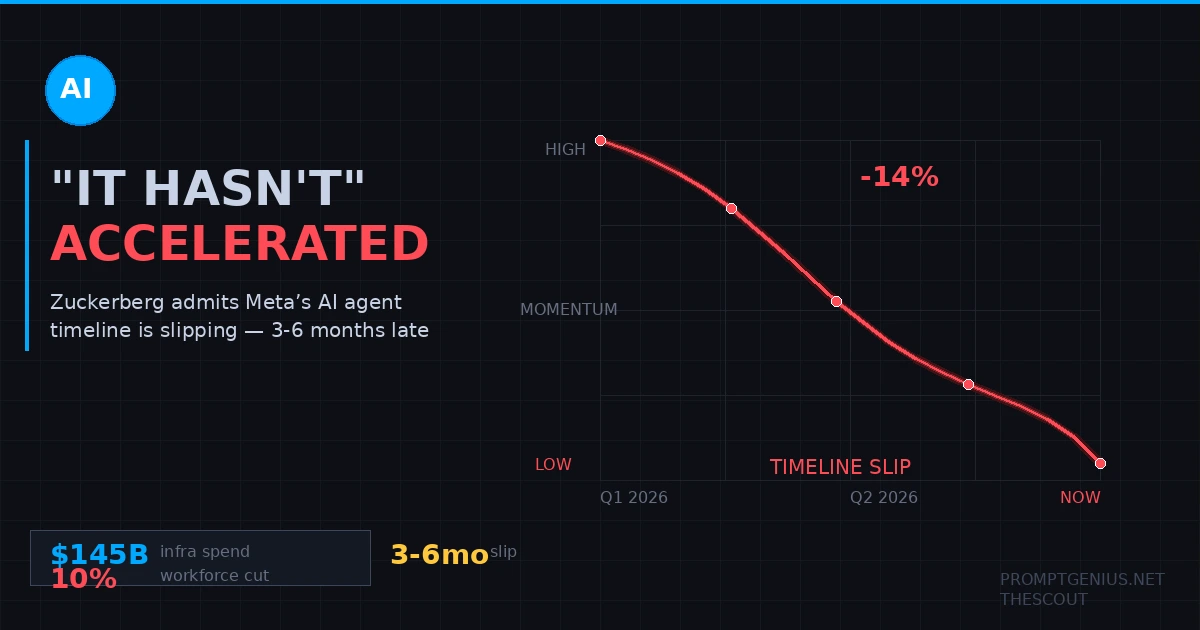
This story broke last night, and it's the most honest thing we've heard from a Big Tech CEO about AI agents in months.
Mark Zuckerberg told Meta employees at an internal town hall on Thursday that AI agent development has not "accelerated in the way that we expected" over the last four months. The recording, obtained by Reuters, captures the CEO of a company that spent $145 billion on AI infrastructure in 2026 alone, laid off 10% of its workforce, and moved 7,000 people into AI teams — admitting the results aren't there yet.
This isn't a Meta problem. This is an industry-wide signal that the gap between "model gets good benchmarks" and "agent works reliably in production" is wider than anyone in the C-suite wants to admit. And Meta, because Zuckerberg was honest enough to say it on tape, is now the canary.
Let me walk through what happened, why it matters, and what comes next.
The Town Hall
Zuckerberg's exact words, per multiple sources who heard the recording:
"The trajectory of the agentic development over at least the last four months hasn't really accelerated in the way that we expected."
He added that the bets tied to Meta's major restructuring — the one that created Meta Superintelligence Labs and put Alexandr Wang in charge — "haven't come to fruition yet."
The context here matters. In January and February, Meta executives were "super optimistic" about tools like Anthropic's Claude Code. They were watching what agents could do in demos and planning sessions, and they built a corporate structure around the assumption that those capabilities would scale linearly.
They were wrong. And Zuckerberg said so, internally, to the people whose jobs depend on it working.
The Numbers Behind the Admission
Let's stack up what Meta has actually deployed:
-
Muse Spark (Avocado): Released April 2026. Solid multimodal reasoning, but benchmark scores behind OpenAI's GPT-4.5 and Anthropic's Claude Opus 4. It powers Meta AI queries and is rolling across WhatsApp, Instagram, Facebook, and Messenger.
-
Watermelon (next model): Still in training. Uses an "order of magnitude more compute" than Avocado. Wang claims it has caught up to OpenAI's GPT-5.5 on key benchmarks — but benchmarks != production agents, and it's not even trained yet.
-
Coding model: "Coming pretty soon." Promised to be on par with Claude Opus. No release date.
-
Agent products: What do users actually get? A smarter chatbot in their social apps. Meta AI can answer questions, generate images, and search the web. But fully autonomous agents — the kind that book travel, manage calendars, complete multi-step tasks across apps — are not deployed at scale anywhere in Meta's ecosystem.
That's the gap. Meta has spent $145 billion on infrastructure this year, laid off 10% of staff, and reorganized the entire company around agents. What they have to show for it is a mid-tier model and the promise that maybe next quarter will be different.
The Wang Contradiction
One of the most interesting details from the town hall coverage: Alexandr Wang, Meta's AI chief, reportedly tried to walk back Zuckerberg's framing.
According to sources, Wang told employees that Zuckerberg was talking about "the progress of the entire industry, not Meta's AI efforts specifically."
This is a classic internal messaging split. The CEO says "we're not moving fast enough." The AI chief says "no no, the whole industry is slow." Both can be true, but the fact that Wang felt the need to distance himself from the CEO's admission tells you how sensitive the topic is internally.
Especially when Wang is simultaneously claiming that Watermelon has caught up to GPT-5.5 on benchmarks. If the model is competitive but the agents aren't shipping, the problem isn't the model — it's everything between the model and the user.
This Is an Industry Pattern, Not a Meta One
Zuckerberg's admission lands in a broader context that AI agent practitioners have been watching all year:
Gartner's 2026 Hype Cycle for Agentic AI — published in April — explicitly states that "most deployments remain narrowly scoped, and fully autonomous agents are not ready for the majority of enterprise use cases." The report shows strong momentum but low maturity. This is the analysts catching up to what builders already knew.
The enterprise agent cost crunch — which we covered here — showed Amazon, Walmart, and Microsoft capping AI usage because the token bills were spiraling. Agents multiply costs because every multi-step task means multiple model calls, each one burning tokens.
The reliability wall — every team building production agents has hit it. Tool calling fails. Context windows overflow. Models hallucinate intermediate steps. Evaluation is expensive and fragile. The difference between a 90% success rate on a benchmark and a 99.9% success rate required for a production deployment is not 9.9% — it's an entirely different engineering problem.
Big Tech is learning what the agent open-source community learned in 2024-2025: making a model smart and making it reliably execute multi-step tasks are two different things.
What This Means for Developers Building on Agents
If you're building AI agents — whether on MCP servers, custom toolchains, or platform APIs — the practical implication is straightforward:
Don't bet your roadmap on timeline predictions from vendor CEOs.
Zuckerberg said 3-6 months for "more tangible results." That's the same time horizon we've heard for "agents will be ready" from every major AI lab since early 2024. It keeps being 3-6 months away. The honest truth is that production agent reliability requires solving problems (tool call recovery, context management, evaluation at scale, cost containment) that don't have clear path-to-solutions yet.
The meta-lesson: model capability and agent reliability are decoupling. Models get better every quarter. Agents get reliably better much more slowly. Smart teams are building their agent architectures to be model-agnostic and expectation-modest — start with narrow, well-defined task loops that can fail gracefully, and expand scope only when you've measured reliability at each step.
What to Watch in the Next 3-6 Months
Three things I'm tracking off the back of this news:
-
Watermelon's actual agent performance when it ships. Benchmark parity with GPT-5.5 is one thing. How does it handle multi-step tool use, recovery from errors, and long-context retention? That will tell us if Meta's infrastructure bet is translating into agent capability or just benchmark score.
-
Meta's cloud business pivot. They're building a compute-for-hire business to sell excess GPU capacity. If the agent timeline slips further, expect them to accelerate the cloud play — the infrastructure is built, and they need a revenue story attached to it. (Meta plans cloud business for excess AI compute)
-
Internal messaging discipline. If Wang keeps publicly correcting Zuckerberg's framing, that tension will leak more — and it tells us the agent problems are deeper than anyone at Meta wants the market to know.
The Bottom Line
Zuckerberg did something rare for a Big Tech CEO: he told the truth internally, and it leaked.
Meta bet the company on AI agents being production-ready on a specific timeline. That timeline has slipped. The restructuring hasn't paid off yet. The $145 billion infrastructure bet is building capacity that needs workloads to justify it.
This isn't a failure — it's the normal process of a technology transitioning from demo-impressive to production-reliable. But the gap between those two states is wider and more expensive than the planning documents anticipated.
The next 3-6 months will tell us whether Meta can close that gap, or whether the entire industry is still further from autonomous agents than any of the earnings calls have let on.
Related Articles & Deep Dives
 #microsoft
"Earn the Right to Exist" — Microsoft Merges Copilot, Adds AutoPilot Agents, and the AI Super App Race Is On
Microsoft is merging consumer and enterprise Copilot into a single app in August, cutting features that didn't work, and introducing AutoPilot agents — always-on background agents that work under their own identity. It's the clearest sign yet that every major AI company is racing toward the same destination: a single app that does everything.
 #llm
#llmThe Flash Wars: Three Chinese Models Just Reset the Price of Intelligence
GLM-5.3-Flash, DeepSeek-V4.1-Flash, and Qwen3.8-Flash-Next landed within seventeen days. What they share, where they actually win, and what it means for your AI bill.
 #jev
#jevTypeSafe's Jev: The Decision Model Everyone Is Talking About
TypeSafe's new decision model Jev went from zero to 27M+ views in four days. What it is, what it can't do, and whether it fits your stack.