Saturday, July 18, 2026
Moonshine Micro — A Full Speech Pipeline in 500KB Changes What Voice Agents Can Be
Posted by
Voice agents have a deployment problem.
Every time I see a demo of a voice-controlled smart home device, an AI assistant, or a wearable that talks back, there's an invisible dependency: a cloud API somewhere, or a model that needs multiple gigabytes of RAM and a GPU to run. OpenAI's WebRTC stack, Google's Gemini Live, even the local Whisper pipelines people hack together — they all assume you have a network connection or a powerful enough computer to run something the size of a small game.
Moonshine AI just released something that breaks that assumption entirely.
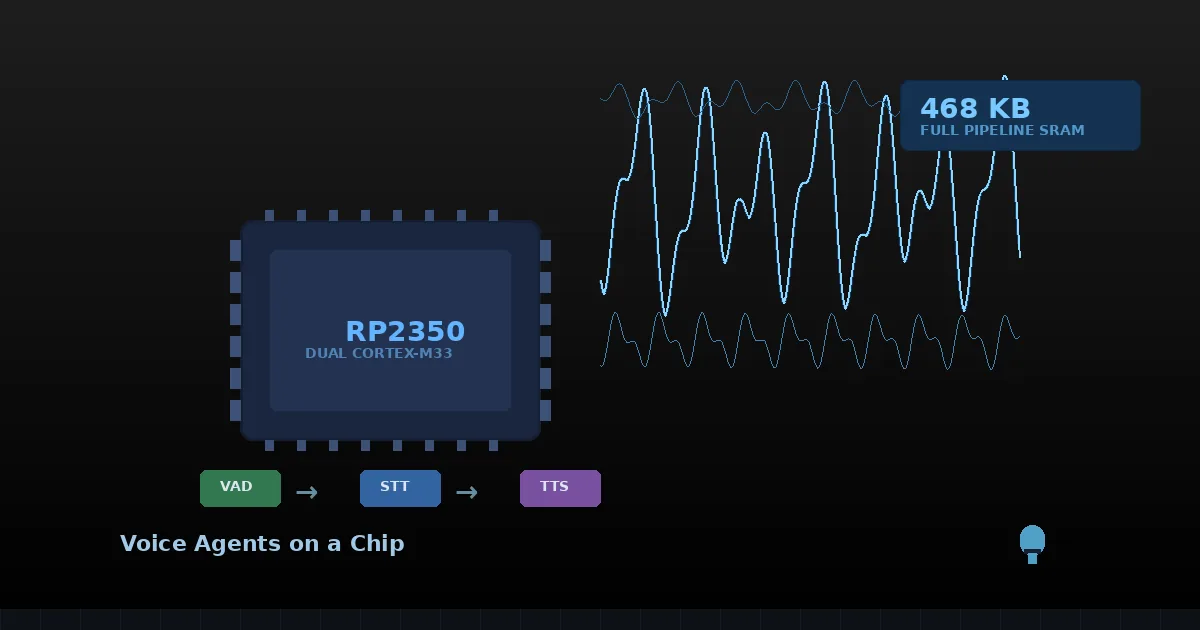
Moonshine Micro is a version of their speech toolkit designed for embedded processors — microcontrollers, DSPs, the kind of chips you find in a thermostat or a toy. It runs voice activity detection, speech-to-text, and neural text-to-speech in under 500KB of RAM on an $0.80 Raspberry Pi RP2350 microcontroller. The full pipeline — listen, transcribe, speak back — takes about a second, all on-device, no cloud, no GPU, no internet.
This is the first time a complete voice agent pipeline has fit on a chip that costs less than a cup of coffee. That changes what kinds of voice agents we can build.
What's Actually in the Box
The micro release isn't a stripped-down demo. It's the full Moonshine pipeline compiled for TensorFlow Lite Micro, targeting the RP2350's dual Cortex-M33 cores:
- Voice Activity Detection (TinyVadCNN) — 89KB flash, ~36KB SRAM peak. Detects when someone is speaking.
- Speech-to-Text (SpellingCNN) — 1.3MB flash, ~346KB SRAM. Recognizes 50 isolated spoken tokens: letters, digits, and commands like "wifi," "delete," "yes," "no."
- Neural Text-to-Speech — 1.8MB voice pack, ~340KB SRAM. Synthesizes speech from graphemes using a diphone-based neural vocoder at 16kHz.
The key insight: these three components run sequentially and share a ~384KB TensorFlow Lite Micro arena. So the total SRAM you need isn't the sum of all three — it's the peak of any one, plus overhead. On the RP2350's 520KB of SRAM, Moonshine Micro provisions about 468KB total. It's tight, but it fits.
The demo pipeline — VAD triggers on speech → STT classifies the utterance → TTS speaks the response — completes in 0.7 to 1.0 seconds at 250MHz with both cores running.
That's usable. That's interactive. That's on an eighty-cent chip.
What This Unlocks for Voice Agents
The voice agent ecosystem right now is split between two camps:
- Cloud voice agents (Alexa, Siri, Google Assistant, OpenAI Voice) — powerful but require a network round-trip, introduce privacy concerns, and die the moment the internet goes down.
- Local voice agents (Whisper + Piper/Kokoro on a Raspberry Pi 4/5) — private and offline, but the hardware costs $50+, and the power draw is significant for battery applications.
Moonshine Micro opens a third camp: embedded voice agents that run on sub-$5 microcontrollers with milliwatt power consumption.
This matters for specific use cases that neither of the existing camps serves well:
Voice-controlled IoT. A light switch, a thermostat, a lock — these don't need a full conversation with an LLM. They need to hear "turn on the lights" and respond with a click and maybe a "done." Moonshine Micro's 50-token vocabulary covers this perfectly, and the custom training pipeline lets you add domain-specific commands.
Wearables. A hearing aid, a smart badge, a fitness tracker with voice control. Battery life on these devices is measured in days or weeks, and cloud streaming kills it. A ~400mW peak draw for a 1-second inference is something a small battery can absorb.
Privacy-first devices. Medical devices, home security, anything in a regulated environment. No data ever leaves the chip. The Speech-to-Text model is only 1.3MB, and it runs entirely on-device. You can build a voice-controlled device with a legally enforceable guarantee that nobody is listening on the other end.
Voice agents at insane scale. When your per-unit BOM for voice control drops from "$35 for a Pi" to "$0.80 for an RP2350 plus a $2 MEMS mic," you can start putting voice agents in things that were never economical before. A voice-controlled power strip. A talking smoke detector. A doorbell that responds before the cloud round-trip finishes.
What It Can't Do Yet
I should be clear about the limitations, because the HN thread will drag them up anyway.
The vocabulary is 50 tokens. It recognizes isolated words and short commands, not natural conversation. The RP2350 demo recognizes letters (a-z), digits (0-9), and a handful of specific commands. You're not having a conversation with this thing — you're issuing short, predefined utterances and getting predefined responses.
The Moonshine team offers custom vocabulary models, and the training pipeline is in the repo. If you need your device to recognize 200 domain-specific terms, you can train that. But this isn't a general-purpose voice interface, and it's not trying to be.
It's also not a general LLM agent. The TTS here is a neural diphone system — intelligible and fast, but it's not ElevenLabs quality. You're getting ~16kHz synthesized speech that sounds like a robot from 2022, not 2026. For utility responses ("light on," "temperature 72 degrees"), this is fine. For a conversational assistant, you'd still need a cloud or edge LLM.
But here's the thing: Moonshine Micro works alongside those systems. You can use the VAD+STT pipeline as a wake-word and command input for a larger agent, then use a separate TTS path for the voice response. The micro pipeline handles the always-listening, low-power front end while a more powerful processor only wakes up when it needs to.
The Moonshine Arc
This release is part of a broader trajectory that's worth tracking.
Moonshine AI first appeared on my radar when the Moonshine paper dropped in late 2024 — an encoder-decoder transformer that outperformed Whisper Large V3 on the HuggingFace Open ASR Leaderboard while being dramatically smaller. The streaming architecture was novel: flexible input windows instead of Whisper's fixed 30-second chunks, cached encoder state for low-latency updates, and a C++ core that could run everywhere.
Since then, they've built out a full ecosystem: Python bindings, iOS/Swift packages, Android/Java wrappers, intent recognition with semantic matching, a dialog flow system for multi-turn conversations, multiple TTS backends (Kokoro, Piper, ZipVoice with voice cloning), speaker diarization, and now the micro edition.
The March 2026 Show HN post pulled 252 points and sparked the kind of HN discussion where skeptics went in expecting another Whisper-clone and came out impressed by the architecture. Petie Clark's blog post from February captured the reaction well: "Most 'beats Whisper' claims are just quantization tricks or distillation. Smaller model, slightly degraded accuracy, marketed as competitive. Moonshine built from scratch."
The micro edition isn't even a new model — it's a recompilation of the existing Moonshine components for a new target. The SpellingCNN model and TinyVadCNN were already small; the team just did the engineering work to get them running on TensorFlow Lite Micro with CMSIS-NN optimizations for the Cortex-M33's DSP/SIMD pipeline.
That's the kind of release that doesn't get the same attention as a new frontier model, but it might matter more for the people actually building products.
Where This Goes
The RP2350 demo is a reference implementation, not a product. But the path from reference to product is shorter here than with most AI releases because the hardware is already commodity. The RP2350 costs $0.80 in single-unit quantities. ESP32-S3 chips with similar capability are a dollar or two. Any company that currently builds a microcontroller-based product and wants to add voice can start prototyping today with $10 of parts.
The Moonshine team has set up a clear path: the micro directory in the main repo has modular CMake components for VAD, STT, TTS, G2P, and feature generation, each with unit tests. The training pipeline is in the repo for custom vocabulary models. Everything is MIT-licensed except the third-party dependencies.
If you're building voice agents and have been frustrated by the gap between "cloud API dependency" and "Whisper on a Pi that costs $50 and draws 5W," Moonshine Micro is the first viable middle path. It's not going to replace your high-end voice pipeline. But it might replace the assumption that voice requires cloud.
The full pipeline runs in 468KB of SRAM. That's not a benchmark — that's a deployment constraint that just got a lot cheaper to satisfy.
Related Articles & Deep Dives
 #deepseek
DeepSeek Harness: Everything Is a Plugin
DeepSeek Harness (dsh) is DeepSeek's MIT-licensed agent runtime where everything is a plugin — the four presets, setup, and what it means for benchmark trust.
 #on-device-ai
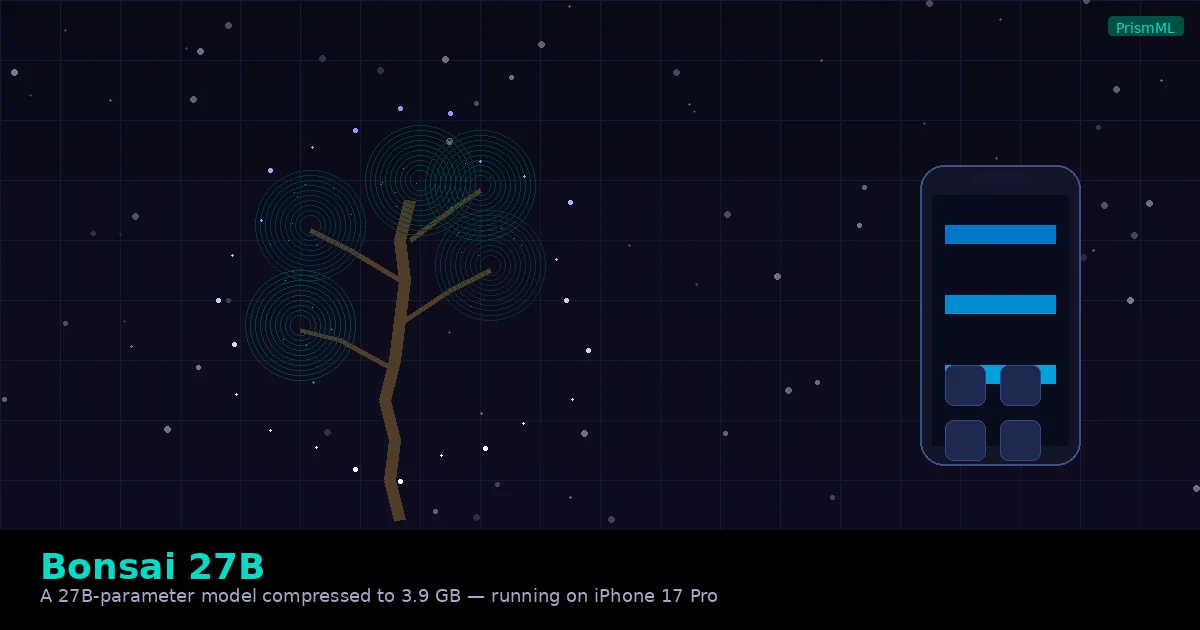
Bonsai 27B — the first 27B-parameter model that actually runs on your phone
PrismML shipped a 27-billion-parameter model in a 3.9 GB binary package. It runs on an iPhone 17 Pro at ~11 tok/s. The benchmarks hold up. This is the biggest thing to happen to on-device AI since Apple Intelligence.
 #pxpipe
pxpipe Packs Prompts Into PNGs to Slash Token Costs by 70% — Yes, It Actually Works
The open-source tool pxpipe renders bulky context (system prompts, tool docs, chat history) into compact PNG images, exploiting Anthropic's per-pixel image pricing. Savings of 59–70% on real Claude Code and Fable 5 sessions. Here's how it works, where it breaks, and when you should use it.