Tuesday, August 18, 2026
Qwen3.8-27B: Local Coding Agents, and the Overthinking Problem
Posted by
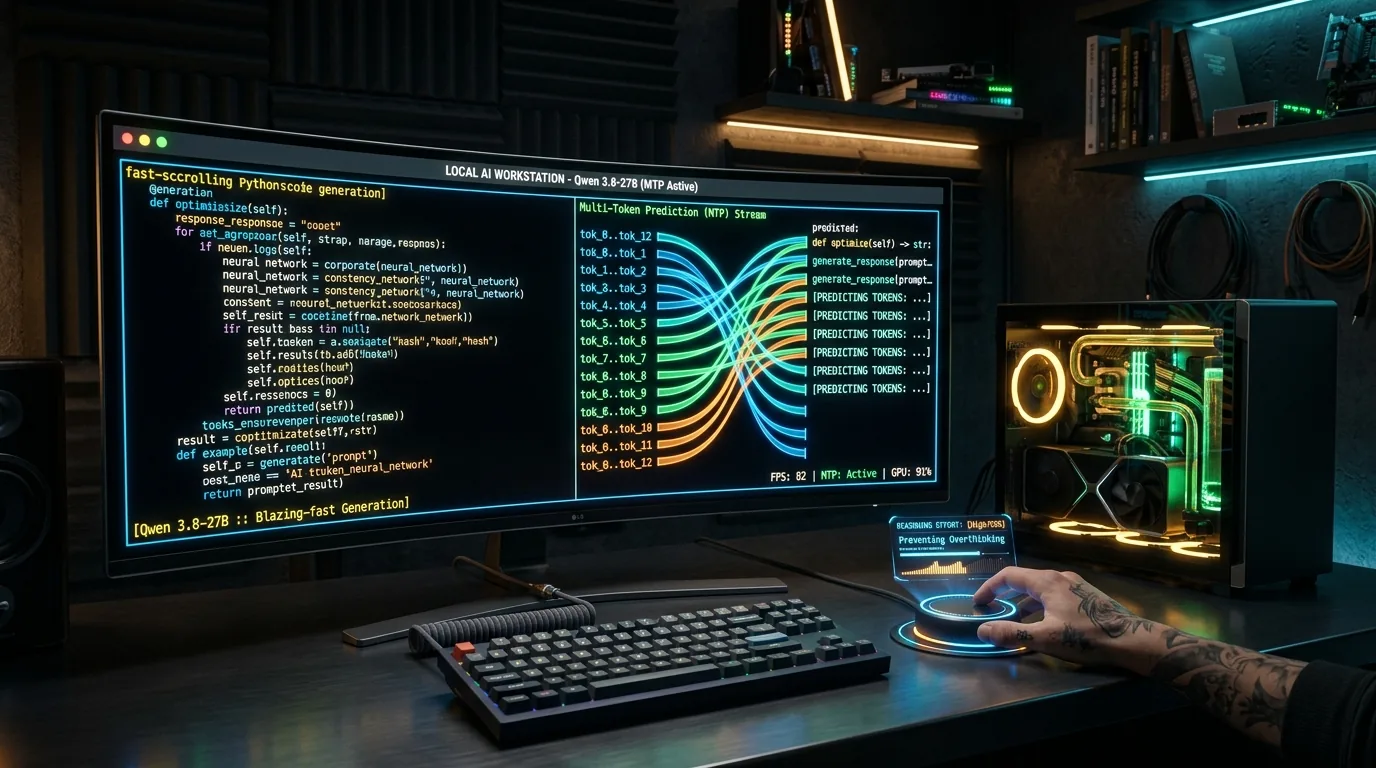
The biggest model story of the past week wasn't a frontier cloud model. On Friday, Alibaba's Qwen lab released Qwen3.8-27B — a 27-billion-parameter dense model under an enterprise-friendly Apache 2.0 license that fits in a 17GB file and can drive a coding-agent loop. It racked up 3 million Hugging Face downloads in its first three days and became the platform's #1 trending model within 48 hours.
The model is genuinely impressive. It's also, by default, running in the wrong configuration. Here's the full picture.
What It Is
Qwen3.8-27B is the compact, deployable member of the Qwen3.8 generation:
- 27B dense parameters (not MoE) — runs on consumer hardware, and after quantization, on a laptop
- Vision-native: image and video understanding, documents included
- 262,144-token context natively, extensible to 1M via YaRN
- Multi-Token Prediction (MTP) — a cheaper mechanism guesses several tokens ahead so the main model just verifies them
- Configurable reasoning via
reasoning_effort
It's compatible with vLLM, SGLang, and TokenSpeed, and Alibaba is shipping a managed Qwen Cloud version with a 1M default context later.
The Numbers — and the Caveat
Third-party evaluator Artificial Analysis scores it 52 on its Intelligence Index — the same score as OpenAI's GPT-5.6 Luna at max reasoning, a cloud-only proprietary model, and up 14 points from Qwen3.6-27B at identical architecture. On the Agentic Index it scores 51, beating Claude Opus 4.8 on maximum reasoning — a frontier model Anthropic released less than three months ago.
Alibaba's own comparison table against Claude Opus 4.6 Max (the model card's comparator) is genuinely remarkable for a 17GB download — and genuinely mixed:
| Benchmark | Qwen3.8-27B | Opus 4.6 Max |
|---|---|---|
| SWE-bench Pro | 61.7 | 53.4 |
| LiveCodeBench v6 | 90.3 | 88.8 |
| Terminal-Bench 2.1 | 73.0 | 78.2 |
| GPQA Diamond | 89.2 | 91.3 |
| Humanity's Last Exam | 30.8 | 40.0 |
| OSWorld-Verified | 84.3 | 72.7 |
Qwen wins the coding and vision rows; Opus keeps the hardest-reasoning rows. But before you quote any of this, apply the provenance test:
- SWE-bench Pro is the weakest link. Qwen's 61.7 came from a "refined" version of the benchmark where Qwen corrected problematic tasks — while the 53.4 is Opus's official score on the standard set. Not apples-to-apples.
- The model card ran SWE-bench Pro and QwenSWEBench inside the Claude Code harness — worth remembering before comparing a model scored on a different scaffold.
- Nothing here is independently verified. No Artificial Analysis index run, no LMArena run, as of the first week.
Treat the scores as strong claims, not settled facts — the release materials make that caveat easy to miss.
The Overthinking Problem
Qwen's documentation says the model defaults to reasoning_effort: xhigh. If you run it that way, it thinks about everything — including problems that don't need thinking at all. Simon Willison, testing the GGUF in LM Studio, asked for a pelican-on-a-bicycle SVG and got 21 minutes of generation using 22,276 reasoning tokens at the default setting; asked to "draw an SVG of a circle," the model produced an unrequested animated geometric study. In a chat window that's a quirk; in an agent loop it's fatal — Claude Code round-trips to the model dozens of times per task, and a model that meditates for minutes per turn is a broken agent.
reasoning_effort options (Qwen3.8):
- xhigh (default)  — injects "think carefully", slow and token-hungry
- medium           — injects nothing; the model's native behavior
- low              — efficient, fast, cheap
One detail changes how you think about this: the effort levels aren't architectural switches. They're one-sentence system-prompt additions the model was post-trained to respond to — xhigh injects a "think carefully" line, while medium injects nothing and is the model's native behavior.
Set low or medium first. The model is excellent at low effort for ordinary work, and you can dial effort up per-task for genuinely hard problems. For agent loops, medium is the sweet spot (cuts the wait by about a third for no measurable quality cost), and a reasoning budget around 5,000 tokens stops runaway thinking. Keep preserve_thinking on so the reasoning the model does do carries across agent turns instead of being re-derived. Treat the default as a bug in your workflow, not a feature.
Speed, and the MTP Tweak
The second catch is speed. Dense models need memory bandwidth, and Qwen3.8-27B is a dense model: roughly 15–30 tokens/second in LM Studio on an M-series Mac or a DGX Spark. That's fine for interactive coding but slower than hosted APIs.
The fix is built into the model. Because Qwen3.8 supports Multi-Token Prediction, running the server with an MTP draft model gives a dramatic speculative-decoding speedup:
- Georgi Gerganov's llama.cpp benchmark on a DGX Spark: a server using
--spec-type draft-mtpoutperformed the default LM Studio GGUF by around 72% - On an RTX 5090 at Q4_K_M, a 45-setting deep dive measured the MTP head at up to 1.81× (125–134 t/s vs 74 t/s stock) — and speculative decoding is lossless by construction, since a drafted token is kept only if the full model would have produced it
- The sweet spot is n=2–3 draft tokens; n=4+ starts to slow down. The draft head costs ~680MB at n=1, ~150MB per level after
# llama.cpp server with MTP draft (check your build's flags)
llama-server -m Qwen3.8-27B.Q4_K_M.gguf --spec-type draft-mtp --spec-draft-n-max 2 ...
Quantization and Memory
The 17GB Q4_K_M quant is the standard choice for a 24GB card. The ladder, roughly: UD-Q3_K_XL (13.4GB) fits 16GB cards, Q4_K_M (17.1GB) is the sweet spot, Q8_0 (29GB) is near-full fidelity, and BF16 (54.7GB) is the reference. Add ~0.9GB for the vision projector and headroom for KV cache — at 64KB per token, 8K context is about half a gig, 32K is 2GB, and the full 262K is 16GB on its own. Raise LM Studio's 8,192-token default context — at xhigh it gets consumed entirely by the thinking phase.
Two serving gotchas: Ollama enables MTP by default (n=4) but swaps the model's Jinja template for chatml, which means reasoning_effort can't be set through Ollama at all. And llama.cpp's --reasoning-effort also accepts minimal/high/max — but the chat template defines only low/medium/xhigh, so the server starts fine and then errors on every request with anything else.
Can It Actually Drive a Coding Agent?
On paper, yes: long context, strong code generation, and reliable tool calling are all there. A 17GB model that can read a repository, call tools, and fix bugs locally is the privacy-and-cost case — your code never leaves your machine, and there are no API bills. The practical limits are the ones above: you want to run it at low/medium reasoning for the loop, and you need a machine with the memory bandwidth to keep up. A single 24GB GPU (3090/4090) is the practical floor for a pleasant loop; 15–30 t/s on a Mac is workable, not snappy.
Self-Host or Cloud?
The local model isn't the only way to run Qwen3.8-27B. Alibaba's Qwen Cloud offers a managed version with a 1M default context, and the model ID is available through hosted inference endpoints that handle scaling for you. The tradeoff is the same one that motivates the entire local-agent movement: hosted means your code and context transit an API — the privacy and cost-control argument for the 17GB GGUF disappears. The hybrid pattern is what most teams actually ship: local for routine loops (private repos, prototyping), cloud for the occasional burst that the local hardware can't sustain. Both share the same reasoning_effort configuration, so a settings decision made locally carries to the hosted API.
The Takeaway
Qwen3.8-27B is the strongest argument yet that a reasonably specced laptop can run a real agentic coding loop in full privacy. Two settings matter more than anything else: drop reasoning effort to medium or low so it stops overthinking, and enable MTP so it stops being slow. Do both and you've got a frontier-adjacent agent that fits in 17GB.
For the full agentic benchmark picture on the Qwen and DeepSeek flagships, see our frontier benchmark analysis.
Related Articles & Deep Dives
 #deepseek
Frontier Agent Benchmarks: DeepSeek V4 vs Qwen 3.8
DeepSeek V4 vs Qwen3.8-Max across agentic benchmarks: verified scores, vendor-reported caveats, pricing, and which model fits your workload.
 #llm
#llmThe Flash Wars: Three Chinese Models Just Reset the Price of Intelligence
GLM-5.3-Flash, DeepSeek-V4.1-Flash, and Qwen3.8-Flash-Next landed within seventeen days. What they share, where they actually win, and what it means for your AI bill.
 #deepseek
DeepSeek Harness: Everything Is a Plugin
DeepSeek Harness (dsh) is DeepSeek's MIT-licensed agent runtime where everything is a plugin — the four presets, setup, and what it means for benchmark trust.