Sunday, November 22, 2026
Gemini 4 Neon vs Hydrogen: Which Tier, What It Costs
Posted by
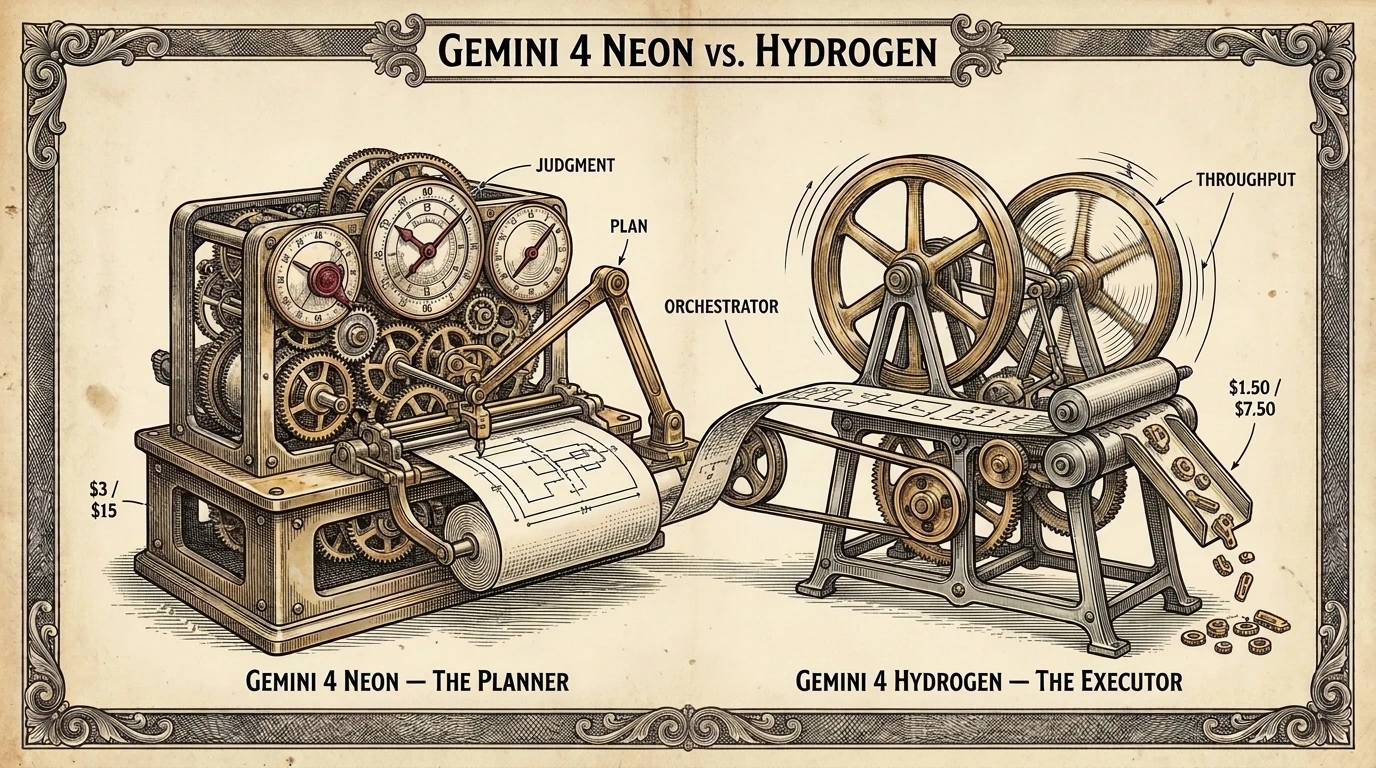
Google shipped Gemini 4 Hydrogen on November 12, 2026, and Gemini 4 Neon six days later. Same family, same context window, same tools, same thinking levels. Not the same tier: Neon costs exactly double per token and buys a measurable amount of judgment.
Use Neon where the step needs judgment — planning, multi-file debugging, dense documents, analysis. Use Hydrogen where the step needs throughput — edits, test runs, package work, chat, batch. In Antigravity, Orchestrator already runs that split inside one session.
Drop the generation frame. Neon is newer and dearer, so the lazy read is "newer model, bigger model." It is neither Hydrogen's successor nor the top of the family. Gemini 4 has four models: Google's API docs still call Gemini 4 Carbon its "most capable reasoning model", Gemini 4 Argon is the "efficient" frontier model that shipped September 30, and Neon sits below Carbon and above Hydrogen by Google's own description. The spec sheets are nearly identical: same window, same tools, same thinking levels. The differences are price, free-tier access, one Antigravity context cap, and the benchmark gaps below.
Specs side by side
| Gemini 4 Neon | Gemini 4 Hydrogen | |
|---|---|---|
| Released | Nov 18, 2026 | Nov 12, 2026 |
| API model ID | gemini-4-neon | gemini-4-hydrogen |
| Standard input / cached / output | $3.00 / $0.15 / $15.00 | $1.50 / $0.075 / $7.50 |
| Batch and Flex input / output | $1.50 / $7.50 | $0.75 / $3.75 |
| Long-context tier | None; flat to 1M | None; flat to 1M |
| Context window (unified) | 1,048,576 | 1,048,576 |
| Max output | 65,536 sync; up to 1,048,576 with long decode | Same |
| Thinking levels | low, medium, high, xhigh; API default high, Antigravity default Medium | Same |
| Input / output | Text, image, video, audio, PDF / text | Same |
| Free API tier | No | Yes |
| Availability | Paid API; AI Studio on AI Pro/Ultra; Gemini app on Pro/Ultra; Antigravity on Pro/Ultra/Enterprise; Vertex AI for verified enterprises in select regions | Free and paid API; AI Studio on all plans; Gemini app and Search for all users; Antigravity on Pro/Ultra/Enterprise; Vertex AI |
Sources: the Neon and Hydrogen model pages, the pricing page and Choosing a model, read 2026-11-21. Vertex availability and the enterprise-region limit come from the Neon and Hydrogen Vertex pages. Neither model has a long-context price step; Hydrogen's launch post calls the $1.50 rate flat across the whole window. Neither model publishes a knowledge cutoff.
Benchmarks, vendor-reported
Google published both launch posts within a week and neither reports a head-to-head against its sibling. The table is what each post chose to claim; sources are the Neon and Hydrogen posts, read 2026-11-21.
| Claim | Neon | Hydrogen |
|---|---|---|
| AA Intelligence Index, Google's figure | 61 at xhigh, "#3 overall" | 51 at default high, 54 at xhigh |
| HLE-Diamond | 71.3% | 58.8% |
| Terminal-Bench 4.1 | 65.2% | 57% |
| FrontierCode 2.0 | 46.2% at default high | Not stated |
| Multimodal Knowledge Agent | Not stated | 53.4% |
| Vals Tax Agent Bench | "#1" | "#1", 52.3% |
Two claims do not survive contact with the live leaderboards. Both posts say their model is #1 on Vals' Tax Agent Bench; the Vals Index currently has Neon at 54.9% and Hydrogen at 52.3%, so only Neon's claim holds. The same board has Neon at 56.3% on Legal Research against Hydrogen's 53.8%, which makes Hydrogen's "ties for #1" line stale. Google's AA rank claims are launch-day snapshots; the scores reproduce, the ranks do not.
Benchmarks, independent
Artificial Analysis measured both on Intelligence Index v5.0.1 (AA-Briefcase v1.1, AutomationBench-AA, Terminal-Bench 4.0, FrontierCode-AA 2.0, AA-Omniscience v1.1, GDP.pdf, HLE-Diamond, CritPt v2 hard subset, Terminal-Bench-Science 0.1). Figures from the comparison page, read 2026-11-21, at xhigh unless labelled.
| Evaluation | Neon | Hydrogen | Gap |
|---|---|---|---|
AA Intelligence Index, xhigh | 61 | 54 | −7 |
AA Intelligence Index, default high | 60 | 51 | −9 |
| Terminal-Bench 4.0 | 63.6% | 53.5% | −10.1 |
| FrontierCode-AA 2.0 | 44.4% | 39.0% | −5.4 |
| Terminal-Bench-Science 0.1 | 70.0% | 49.5% | −20.5 |
| HLE-Diamond | 71.3% | 58.8% | −12.5 |
| CritPt v2 (hard subset) | 60.5% | 66.0% | +5.5 |
| GDP.pdf (all-pass) | 28.0% | 27.6% | −0.4 |
GDP.pdf (all-pass), default high | 33.4% | 30.0% | −3.4 |
| AA-Briefcase v1.1 (Elo) | 1699 | 1568 | −131 |
Cost per Index task, xhigh / high | $6.44 / $3.74 | $3.16 / $1.87 | −51% / −50% |
| Output speed | 106 tok/s | 153 tok/s | +44% |
Time to first answer token, default high | 40.7s | 22.1s | −46% |
Index / cost / time per task: Neon medium vs Hydrogen xhigh | 55 / $1.90 / 8.6 min | 54 / $3.16 / 16.9 min | Neon wins all three |
The headline numbers flatter Hydrogen. At default high the gap is nine index points, not seven — Google's 61 and 54 are both xhigh numbers, while both models default to high. Hydrogen wins exactly one evaluation, CritPt, by 5.5 points; GDP.pdf is a tie; everything else is Neon, with the science and terminal gaps the largest.
A second independent harness tells a different cost story. The Vals Index is version 2.2, updated 2026-11-19, read 2026-11-21:
| Vals Index v2.2 | Neon | Hydrogen |
|---|---|---|
| Overall accuracy | 70.87% | 68.49% |
| Code Migration v1.1 | 75.8% | 82.7% |
| Legal Research | 56.3% | 53.8% |
| Tax Agent Bench | 54.9% | 52.3% |
| Cost / tokens per test | $7.40 / 15.15M | $9.84 / 41.19M |
Hydrogen wins Code Migration by 6.9 points. More importantly, it costs 33% more per completed test than Neon despite costing half as much per token, because it used 2.7 times the tokens. Artificial Analysis found the opposite: half the cost per Index task. The harnesses disagree on direction, which is the strongest argument on this page for measuring your own workload.
Which one should you use
| Job | Pick | Why |
|---|---|---|
| Coding agents in Antigravity | Orchestrator: Neon planning, Hydrogen executing | The documented default pairing; run standalone, Neon leads Hydrogen 63.6% to 53.5% on Terminal-Bench 4.0 and 44.4% to 39.0% on FrontierCode |
| Long documents and dense PDFs | Neon | AA-Briefcase 1699 vs 1568, and GDP.pdf 33.4% vs 30.0% at default high; at xhigh GDP.pdf is a 0.4-point tie |
| Chat and everyday drafting | Hydrogen | Half the token price, 153 vs 106 tok/s, and the first token in about half the time at high (22.1s vs 40.7s) |
| High-volume API | Hydrogen | $1.50/$7.50 against $3/$15, plus a free tier Neon does not have |
| Cost-sensitive batch | Hydrogen | $0.75/$3.75 against $1.50/$7.50; check tokens per task first, because the harnesses disagree on whether the half-price rate survives real work |
Start on Hydrogen and escalate, but escalate across models, not up Hydrogen's effort dial. Hydrogen at xhigh scores 54 for $3.16 and 16.9 minutes a task; Neon at medium scores 55 for $1.90 and 8.6 minutes. Once a job needs more than Hydrogen at high, Neon at medium is better, cheaper and faster.
Where Carbon and Argon fit
Carbon became broadly available on November 10. It is the family's frontier model: Google's pricing page calls it "our most capable reasoning model", and the Neon-in-Antigravity post and Choosing a model keep it for "your deepest long-horizon projects". Neon's own launch post makes the opposite case, comparing Neon favourably with Carbon on cost and speed.
Argon (gemini-4-argon) is a separate model, not an earlier name for Carbon. It shipped September 30 as Google's efficient frontier reasoning model, and it is still on the API. Carbon and Argon share one price: $2.00/$10.00 through November 30, then $4.00/$20.00 (pricing), against Neon's $3.00/$15.00 and Hydrogen's $1.50/$7.50. That inverts the order: Neon costs 50% more than either today and 25% less from December 1, so the answer changes on a calendar date.
Which of the four you can pick depends on your plan. In Antigravity, Carbon is Ultra and Enterprise only; on Google AI Pro, Argon is the frontier option.
How Antigravity pairs them
Orchestrator is one model-selector option that runs two models in one conversation. The planner explores the codebase, writes a plan and reviews progress; the executor searches, edits, runs builds and tests, and hands control back when something the plan did not settle goes wrong. Per the Antigravity docs, Neon is the default planner on AI Pro and Ultra, Hydrogen is the default executor, and both roles are configurable in Settings.
That default is new. Until Neon shipped on November 18, Orchestrator on AI Pro ran Argon as the planner, listed as Orchestrator (Argon). Both entries are still in the model selector, so check which one a session is using.
- Orchestrator is the recommended default for feature work, bug fixes, refactoring and multi-file debugging. Picking either model directly is for work where every step needs the same judgment, or where the task is pure execution.
- Enterprise cannot pick Neon as planner. In Gemini Enterprise, Orchestrator runs Carbon at
Highwith Hydrogen atHighand nothing else. Neon planning is a consumer-plan feature. - Antigravity defaults to Medium, not
high. The benchmark tables above use the API default ofhighorxhigh; Antigravity sessions start lower unless you change the level. - Antigravity caps Neon at 512K tokens, not the 1,048,576 the API allows. Check before you paste a large repo into one session; Google does not explain the difference.
- The pairing has no published numbers. Google's 24%-less-quota and 19%-faster figures on Terminal-Bench 4.1 come from Carbon paired with Hydrogen, not Neon. Neon plus Hydrogen ships with a recommendation and no benchmark.
- Watch executor token use. On Vals, Hydrogen used 2.7 times Neon's tokens per test. Whether that holds inside Orchestrator is unmeasured; check your usage before assuming the executor is the cheap half.
Hands-on test
On November 24, 2026, we ran the coding and reasoning prompts once per model in Antigravity CLI (agy -p) at medium effort. Each coding run started from an identical copy of a small Node orders API with four baseline tests. The long-context and writing prompts are follow-up exercises.
1. Coding. The task tests backward compatibility during a pagination migration.
Add cursor-based pagination to /api/orders.
Keep offset pagination behind a query flag for one release.
Add tests for first page, last page, invalid cursor, deleted-row cursor.
Do not change existing response fields.
Report files changed, the test command, and every assumption.
| Model | Elapsed time | Tests passed | offset in default cursor responses |
|---|---|---|---|
| Neon | 119.1 s | 9/9 | Returns 0 on the first page and null on later pages |
| Hydrogen | 69.9 s | 8/8 | Omits the field |
Both implementations defaulted to cursor pagination and kept offset mode behind the requested flag. Hydrogen finished about 49 seconds sooner. Its tests passed even though it dropped an existing response field. Neon kept the field, but returning null on later pages still changed its type. Test counts are from each model's own suite.
2. Reasoning. A bounded estimation with a checkable structure.
Estimate the annual electrical energy, in GWh, used by data centres in a country of about 10 million people.
Show the decomposition, every assumption with its source or justification, a low/base/high range, and the assumption that moves the answer most. Do not use web search.
Neon estimated 1,300 GWh per year with a range of 75–12,000 GWh. It cross-checked a per-capita estimate against a capacity estimate. Hydrogen estimated 1,445 GWh per year with a range of 650–3,701 GWh, working from assumed data-centre capacity. Both based their central scenario on a developed-country footprint. The inputs were unverified.
3. Long context. Attach a document you know well: a contract, a spec, a 60-page report. Run in AI Studio.
From the attached document produce:
1. A one-page summary for a reader who has not seen it.
2. Every internal contradiction, citing both sides.
3. Every claim that needs a fact the document does not supply.
4. The five passages most likely to be quoted out of context.
Cite sections; flag ambiguity instead of resolving it.
4. Writing. Same source, different audience, to expose tone and compression.
Rewrite the attached launch note as a 350-word internal memo for a sceptical engineering team.
Lead with what changed for them. Keep every number and unit. Cut adjectives that carry no information. End with two decisions due this week.
Limitations of this comparison
- One run per prompt per model. The coding fixture used 30 in-memory orders. Elapsed times include CLI startup, hooks and network time. Orchestrator, long-context and writing were outside the hands-on runs.
- The two harnesses disagree on cost direction. Artificial Analysis puts Hydrogen at half Neon's cost per task; Vals puts it 33% higher. Token accounting differs, and neither matches your workload.
- Index version matters. v5.0.1 is the instrument here. Do not mix a v5.0 score into this table without checking the evaluation set, the same trap as our DeepSeek V4.1 Flash check.
- Vendor and independent scores are not the same runs. Google's HLE-Diamond figures match AA's
xhighnumbers exactly, but Google reports Terminal-Bench 4.1 while AA runs 4.0. - Neither model publishes a knowledge cutoff, a latency SLA or a price outside the Gemini API and Vertex. Third-party clouds are unverified here.
How this was checked:
Both launch posts, the Neon-in-Antigravity and Hydrogen-in-Antigravity posts, the Carbon availability post, the Gemini API model, pricing and model-selection pages, the Vertex model pages and the Antigravity Orchestrator docs were read on 2026-11-21. Specs, prices and availability come from those pages. Independent scores come from Artificial Analysis Intelligence Index v5.0.1 and Vals Index v2.2, both read 2026-11-21. The hands-on observations come from the Antigravity CLI runs on 2026-11-24.
Related
- GPT-6.2 Astra vs Sol — the same tier question, one vendor over
- Migration Guide: Gemini CLI to Antigravity CLI — where Orchestrator fits in a move off Gemini CLI
- Antigravity CLI — the terminal surface for both models
- Gemini CLI — the terminal agent Antigravity CLI replaced
Related Articles & Deep Dives
 #openai
GPT-6.2 Astra vs Sol: Tier Picks and the 6.1 Upgrade
Astra is 4x Sol's token price and 5 points higher on Artificial Analysis. Specs, vendor vs independent benchmarks, and whether to leave GPT-6.1.
 #deepseek
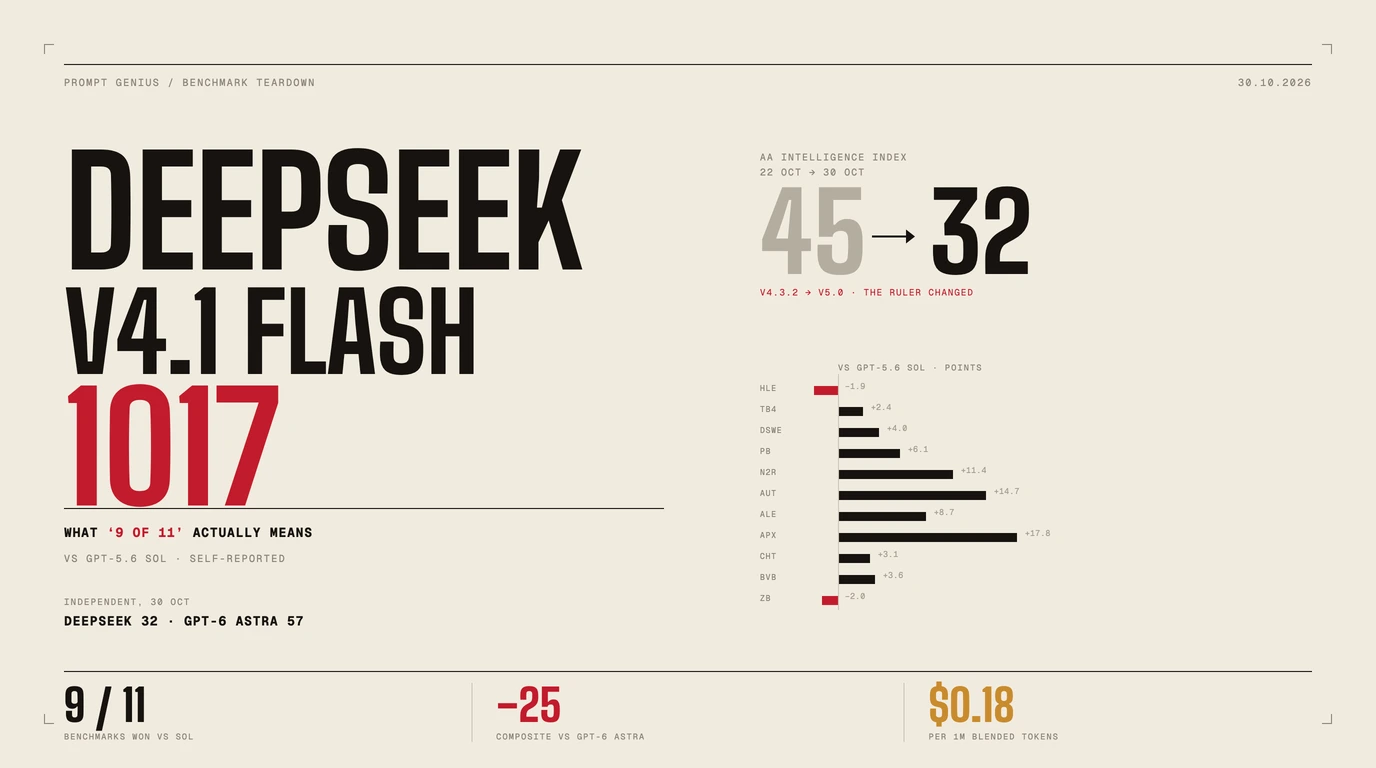
DeepSeek V4.1 Flash 1017: What '9 of 11' Actually Means
DeepSeek reports nine benchmark wins over GPT-5.6 Sol. Independent tests show close agentic scores but a 25-point index gap against GPT-6 Astra.
 #gemini
Gemini 3.5 Pro Is Delayed Again — What It Says About Google DeepMind's Release Cadence
Gemini 3.5 Pro was reportedly set to launch August 10 — it's not shipping this month. Why the delay is becoming a pattern, and what it means for developers planning on Gemini.