Sunday, November 22, 2026
GPT-6.2 Astra vs Sol: Tier Picks and the 6.1 Upgrade
Posted by
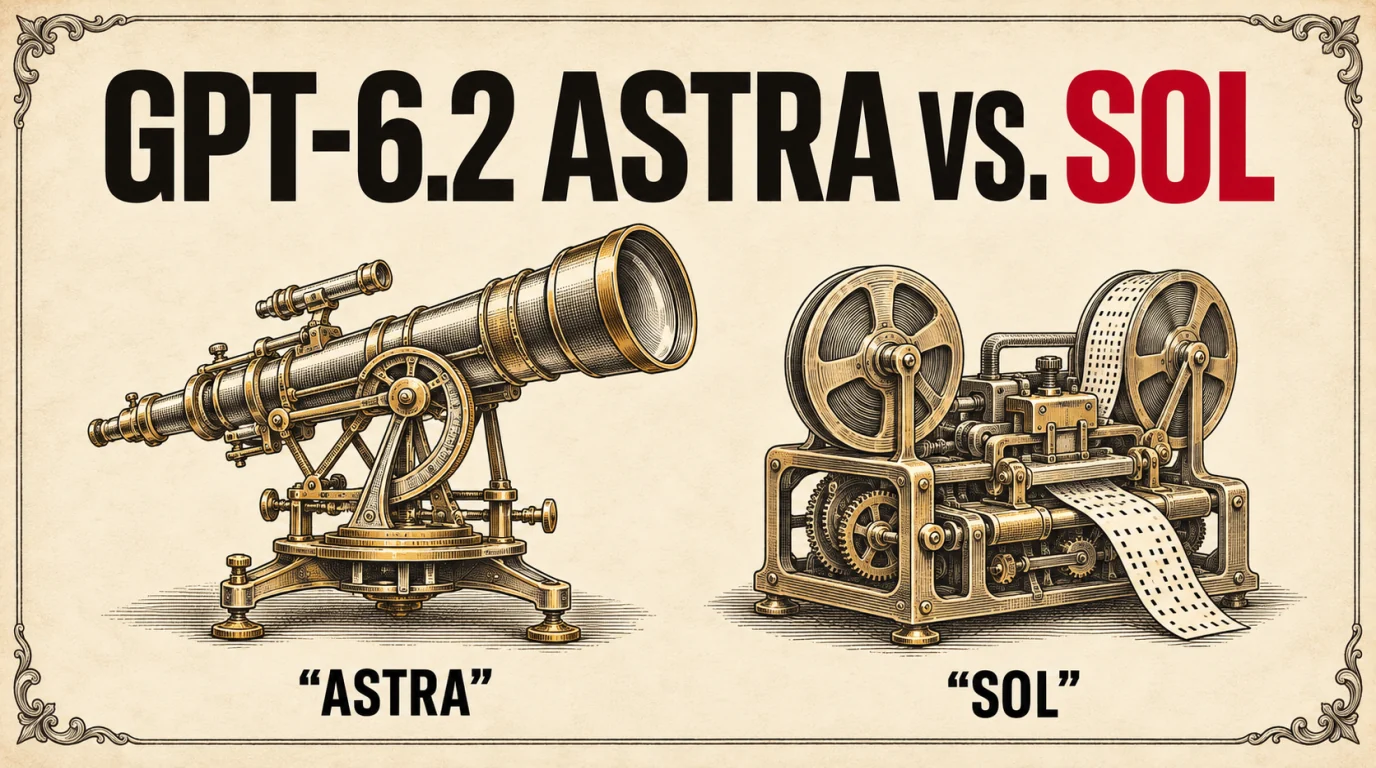
OpenAI shipped GPT-6.2 Astra and GPT-6.2 Sol on November 17, 2026. They share a context window, an output limit and a reasoning-effort menu; they do not share a price. Astra costs four times as much per token and scores five points higher on Artificial Analysis's composite index.
Use Sol for coding agents in Codex, chat, high-volume API work and anything where a one-point coding gap does not matter. Reach for Astra for hard science, legal and long-horizon deliverables, where independent gaps reach ten points. Sol is the default; Astra is the escalation.
Specs side by side
| GPT-6.2 Astra | GPT-6.2 Sol | |
|---|---|---|
| API model ID | gpt-6.2-astra | gpt-6.2-sol |
| Standard input / cached / output, ≤272K | $8.00 / $0.40 / $40.00 | $2.00 / $0.10 / $10.00 |
| Long-context input / output, 272K+ | $16.00 / $60.00 | $4.00 / $15.00 |
| Batch input / output | $4.00 / $20.00 | $1.00 / $5.00 |
| Context window | 1,050,000 | 1,050,000 |
| Max input / output tokens | 922,000 / 128,000 | 922,000 / 128,000 |
| Knowledge cutoff | 2026-05-18 | 2026-06-01 |
| Input / output | Text, image / text | Text, image / text |
| Reasoning effort | low, medium, high, xhigh, max; none rejected | Same |
| Availability | Plus, Pro, Enterprise, Edu in ChatGPT Work and Codex; API; Google Cloud private preview | Same |
Sources: the Astra and Sol model pages and the pricing page, read 2026-11-22. Tool calling requires the Responses API on both. OpenAI publishes no latency figures.
Benchmarks, vendor-reported
OpenAI's launch post reports deltas against other models rather than absolute scores, so most claims cannot be reconstructed from the post alone.
| Claim | Astra | Sol |
|---|---|---|
| Agents' Last Exam | +5.2 over GPT-6 Astra at under one-third the cost; +5.5 over Claude Fable 5.2 at 5% of the cost | Not stated |
| Terminal-Bench-Science 0.1 | +9 points over GPT-6 Astra at under one-third the cost | Not stated |
| FrontierCode 2.0 (Cognition) | Baseline, both at max | Within 0.5 points at about one-fifth the cost |
| LifeVal | Not stated | Outscores GPT-6 Astra at about one-seventh the cost |
| Harvey LAB-AA v1.1 (legal) | More than double Fable 5.2's pass rate at about one-sixth the cost | Not stated |
OpenAI also claims a "new high" on the Vals Science Index with no score attached, and 62.5% all-five-attempts on AA-AnalystAgent. The table mixes OpenAI's own runs with partner benchmarks; none is an independent re-run. Read the table as the comparisons OpenAI chose to publish, not a complete scorecard.
Benchmarks, independent
Artificial Analysis measured both on Intelligence Index v5.0.1: AA-Briefcase v1.1, AutomationBench-AA, Terminal-Bench 4.0, FrontierCode-AA 2.0, AA-Omniscience v1.1, GDP.pdf, HLE-Diamond, CritPt v2 (hard subset) and Terminal-Bench-Science 0.1. Figures read 2026-11-22, max reasoning effort.
| Evaluation | Astra | Sol | Gap |
|---|---|---|---|
| AA Intelligence Index | 62 | 57 | −5 |
| AutomationBench-AA | 77.2% | 71.3% | −5.9 |
| Terminal-Bench 4.0 | 64.1% | 60.1% | −4.0 |
| FrontierCode-AA 2.0 | 45.4% | 44.4% | −1.0 |
| GDP.pdf (all-pass) | 29.8% | 30.0% | +0.2 |
| HLE-Diamond | 72.2% | 64.0% | −8.2 |
| CritPt v2 (hard subset) | 71.5% | 62.5% | −9.0 |
| Terminal-Bench-Science 0.1 | 78.1% | 67.6% | −10.5 |
| Cost per Index task | $4.00 | $1.01 | −75% |
| Time per Index task | 15.1 min | 10.1 min | −33% |
| Output speed / first answer token | 45 tok/s / 179.17s | 66 tok/s / 83.60s | +47% / −53% |
Sources: the Astra and Sol pages and the release comparison, read 2026-11-22.
FrontierCode, the coding-agent evaluation closest to Codex work, is a one-point gap; OpenAI's partner-run version says 0.5. GDP.pdf is a tie, with Sol marginally ahead. Science and knowledge are where the money buys something: 8 to 10.5 points on HLE-Diamond, CritPt and Terminal-Bench-Science. The five-point ordering holds at every effort level: at medium 57 to 53, at high 60 to 55.
Which one should you use
| Job | Pick | Why |
|---|---|---|
| Coding agents in Codex | Sol | 1.0-point FrontierCode gap at a quarter of the token price, and 66 vs 45 tok/s |
| Long documents and PDFs | Sol, escalate on failure | GDP.pdf is a tie; Astra's edge appears on the hardest documents, not the average one |
| Chat and everyday drafting | Sol | Sol outscores GPT-6 Astra on OpenAI's LifeVal at a fraction of the cost |
| High-volume or batch API | Sol | $2/$10 against $8/$40; $1/$5 against $4/$20 in Batch |
| Hard science, legal and long-horizon work | Astra | 10.5-point Terminal-Bench-Science gap, 9-point CritPt gap and 8.2-point HLE-Diamond gap over Sol |
Start on Sol at high and keep Astra for tasks that fail. The effort dial matters as much as the tier: Sol at max (57) is five index points behind Astra at max (62), and dropping Astra from max to medium costs the same five points.
6.2 against 6.1: what actually changed
There is no GPT-6.1 Astra. OpenAI shipped GPT-6 Astra on September 3 and GPT-6.1 Sol on September 29; the Astra line skipped 6.1. So "6.2 vs 6.1" is a Sol question. All columns use v5.0.1 figures read on 2026-11-22.
| GPT-6 Astra | GPT-6.2 Astra | GPT-6.1 Sol | GPT-6.2 Sol | |
|---|---|---|---|---|
| Standard input / output | $10 / $50 | $8 / $40 | $2 / $10 | $2 / $10 |
| AA Index, max | 57 | 62 | 55 | 57 |
| AA Index at medium / high | 52 / 55 | 57 / 60 | 46 / 50 | 53 / 55 |
| Cost per Index task | $6.24 | $4.00 | $1.27 | $1.01 |
| Time per Index task | 20.8 min | 15.1 min | 25.0 min | 10.1 min |
The Sol upgrade is the stronger one. GPT-6.2 Sol at high effort matches GPT-6.1 Sol at max: 55 on the index, at $0.56 per Index task instead of $1.27, and 5.3 minutes instead of 25.0. The high-effort cost and time come from the per-effort breakdown on Artificial Analysis's GPT-6.2 Sol page; the 6.1 figures are its max-effort numbers from the table above. Same headline price, materially less work per answer. For Astra, the gain is five index points at 20% lower token prices and 36% lower cost per task.
What else changed, per OpenAI's documentation:
- Prefix edits now drop reasoning. Editing earlier history, changing models mid-thread or changing the end user discards reasoning items; quality can fall and token use rise.
instructionsis appended afterinput. Stable developer instructions belong in adevelopermessage at the start ofinputto stay cache-eligible.- Flex is gone. Neither model supports
service_tier: flex; background completion windows (30% off for two hours, 40% for eight) replace it. - No
noneeffort, no sampling knobs.temperature,top_pand logprobs are unsupported, as on GPT-6 Astra. - No dated snapshot. Each model page lists a single ID, so you cannot pin a build.
Switch IDs now? For Sol, yes: same price, higher scores, 2.5× faster task time. Budget a day for the prefix and instructions changes. For Astra, switch for the five points or the lower price; there is no compatibility reason to rush.
Hands-on test
On November 24, 2026, we ran the coding and reasoning prompts once per model in Codex CLI (codex exec) at high effort. Each coding run started from an identical copy of a small Node orders API with four baseline tests. Both models received the same instruction to implement the task directly to override the local environment's default delegation behavior. The long-context and writing prompts are follow-up exercises.
1. Coding. The task tests backward compatibility during a pagination migration.
Add cursor-based pagination to /api/orders.
Keep offset pagination behind a query flag for one release.
Add tests for first page, last page, invalid cursor, deleted-row cursor.
Do not change existing response fields.
Report files changed, the test command, and every assumption.
| Model | Elapsed time | Tests passed | Implementation detail |
|---|---|---|---|
| Astra | 78.2 s | 8/8 | Reused listOrders with an after key |
| Sol | 105.9 s | 8/8 | Required an ord_ prefix followed by digits in cursor IDs |
Both implementations kept offset in the default responses and added the four requested tests. Astra finished about 28 seconds sooner. Sol's cursor check also tied pagination to the fixture's ID format, so a future ID format change would require revisiting it. Test counts are from each model's own suite.
2. Reasoning. A bounded estimation with a checkable structure.
Estimate the annual electrical energy, in GWh, used by data centres in a country of about 10 million people.
Show the decomposition, every assumption with its source or justification, a low/base/high range, and the assumption that moves the answer most. Do not use web search.
Astra estimated 510 GWh per year with a range of 100–3,500 GWh. Sol estimated 512.5 GWh per year with a range of about 99–2,168 GWh. Both calibrated their central scenario against a global per-capita estimate. Their different assumptions about the amount of data-centre capacity the country might host produced wider differences at the ends of the range. The inputs were unverified.
3. Long context. Attach a document you know well: a contract, a spec, a 60-page report.
From the attached document produce:
1. A one-page summary for a reader who has not seen it.
2. Every internal contradiction, citing both sides.
3. Every claim that needs a fact the document does not supply.
4. The five passages most likely to be quoted out of context.
Cite sections; flag ambiguity instead of resolving it.
4. Writing. Same source, different audience, to expose tone and compression.
Rewrite the attached launch note as a 350-word internal memo for a sceptical engineering team.
Lead with what changed for them. Keep every number and unit. Cut adjectives that carry no information. End with two decisions due this week.
Limitations of this comparison
- One run per prompt per model. The coding fixture used 30 in-memory orders. Elapsed times include CLI startup, local hooks and network time. ChatGPT, long-context and writing were outside the hands-on runs.
- One independent harness. Artificial Analysis is the only evaluator found with both models on one index version; a composite is not your workload.
- Index version matters. v5.0.1 is the instrument here. Do not compare a v5.0 score without checking the evaluation set, a smaller version of the problem in our DeepSeek V4.1 Flash check.
- Cost per task is not your bill. AA's token mix and cache assumptions differ from yours, and production rate limits and refusals were not tested.
- Prices and promos move. Ultrafast is 3× Standard only through February 28, 2027. Background discounts are a public beta.
- Cloud coverage is thin. The 6.2 pages list a Google Cloud private preview only; 6.1 Sol also listed Amazon Bedrock.
How this was checked:
The launch post, GPT-6.1 announcement, model pages and pricing pages were read on 2026-11-22. Migration notes come from the GPT-6.2 guide and the November 17 API changelog. Independent scores come from Artificial Analysis Intelligence Index v5.0.1, read 2026-11-22, including the GPT-6 Astra and GPT-6.1 Sol pages. The hands-on observations come from the Codex CLI runs on 2026-11-24.
Related
- How to Prompt GPT-6 Astra Pro's Parallel Agents — prompting the previous Astra generation
- Codex CLI: OpenAI's Terminal Coding Agent — where Sol does most of its work
- DeepSeek V4.1 Flash 1017: What "9 of 11" Actually Means — the same index-version trap
Related Articles & Deep Dives
 #gemini
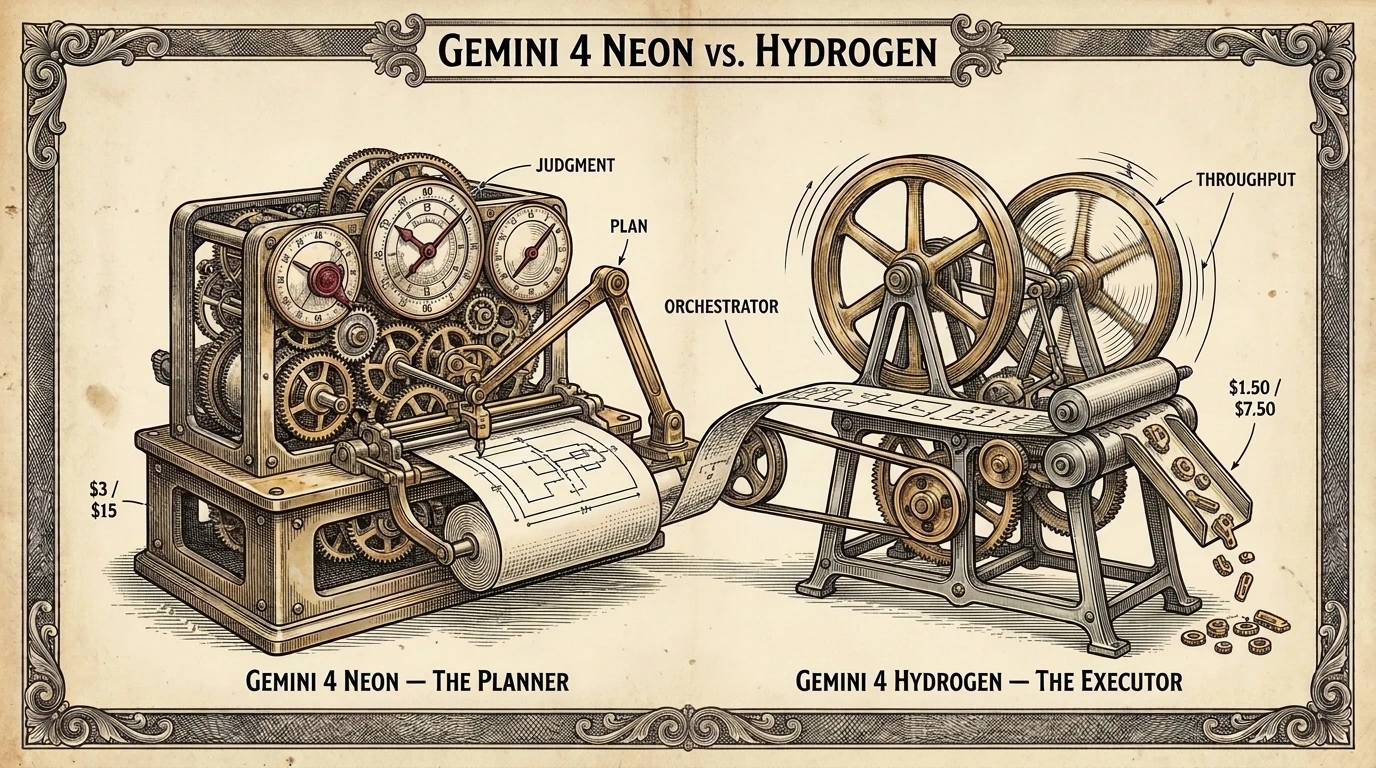
Gemini 4 Neon vs Hydrogen: Which Tier, What It Costs
Neon costs twice Hydrogen per token and scores 9 points higher at default effort. Specs, both price sheets, and how Antigravity's Orchestrator pairs them.
 #swe-bench
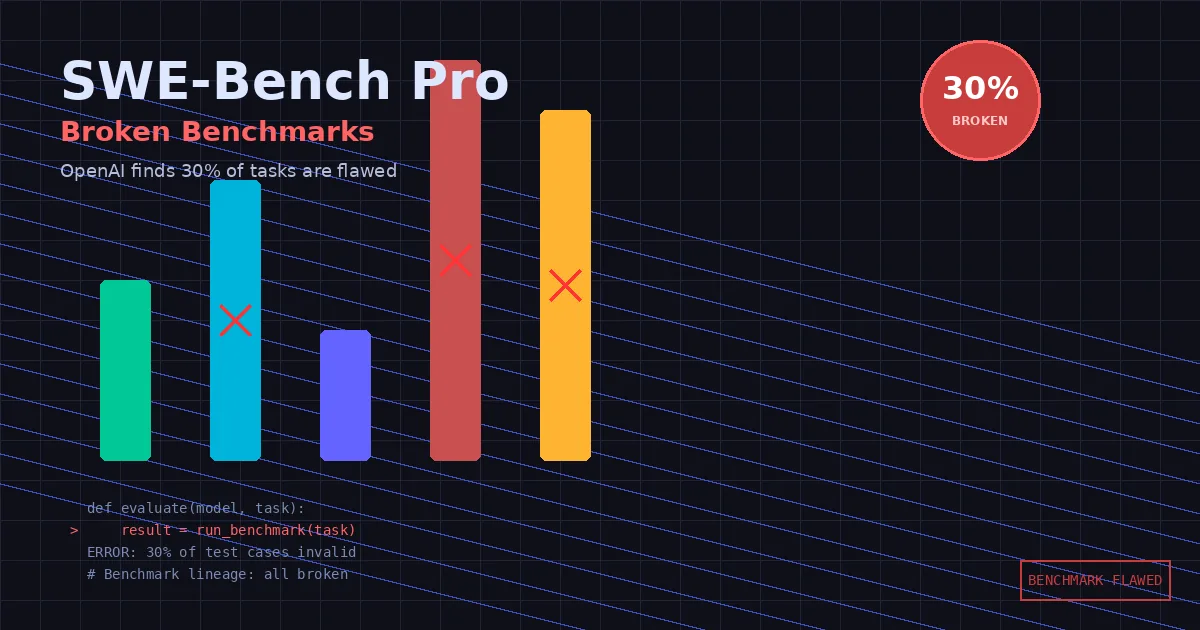
SWE-Bench Pro Is Broken — OpenAI Finds 30% of Tasks Are Flawed and Retracts Endorsement
OpenAI audited SWE-Bench Pro, the widely-used coding benchmark that was supposed to replace the already-broken SWE-Bench Verified, and found ~30% of tasks are broken. Here's what broke, why the lineage of broken benchmarks is a crisis for AI evaluation, and what replaces it.
 #deepseek
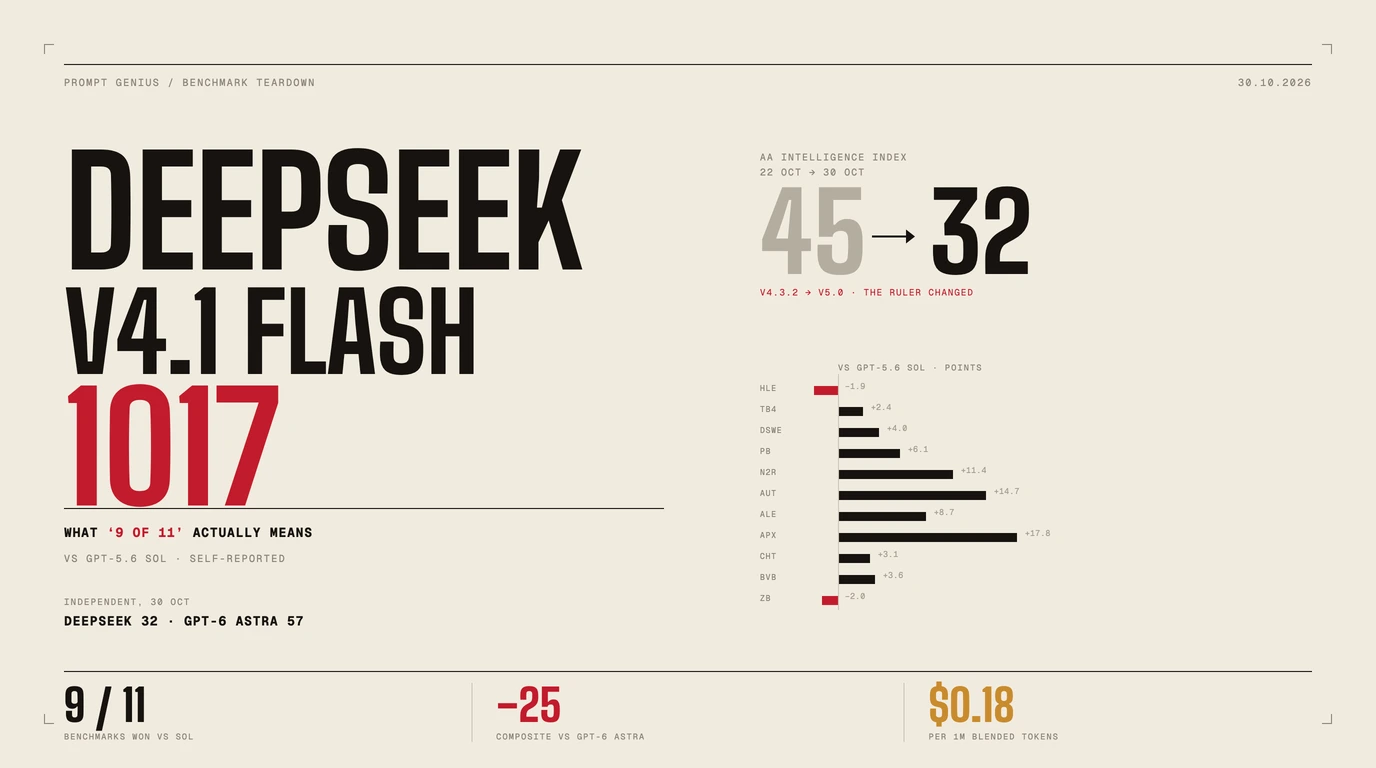
DeepSeek V4.1 Flash 1017: What '9 of 11' Actually Means
DeepSeek reports nine benchmark wins over GPT-5.6 Sol. Independent tests show close agentic scores but a 25-point index gap against GPT-6 Astra.