Wednesday, July 1, 2026
Godot Just Banned AI-Authored Code — and Open Source Is Drawing a Line
Posted by
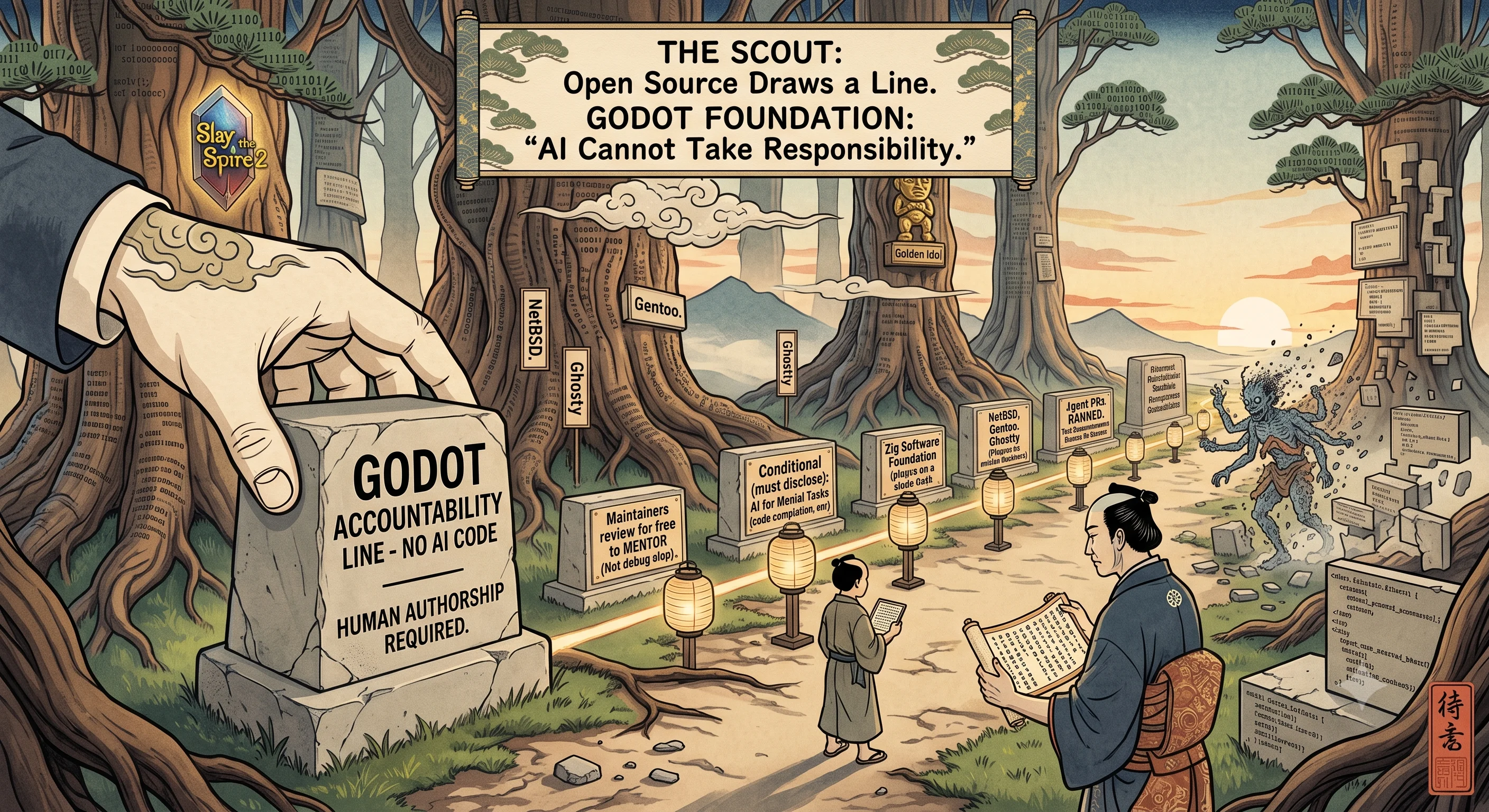
This is a big deal. The Godot Foundation — stewards of one of the largest open-source game engines on the planet, used in projects ranging from Slay the Spire 2 to The Case of the Golden Idol — has formally amended its contribution policies to ban AI-authored code, AI agent pull requests, and AI-generated text in human-to-human communications.
This isn't just a procedural update. It's the strongest signal yet that open source is nearing a breaking point with AI-generated submissions. And it raises hard questions about where the "vibe coding" trend is headed.
Let me break down what Godot did, why they did it, and why this matters far beyond the game dev world.
The Policy, in Plain Terms
The official announcement from the Godot Foundation, published today, is remarkably direct. The new policy draws a bright line:
Explicitly banned:
- AI-authored code contributions
- Pull requests submitted by AI agents
- AI-generated text in human-to-human communication with maintainers
Conditional (must be disclosed):
- AI assistance for "menial things" — code completion, regex writing, find-and-replace
Still permitted:
- Machine translations of human-authored text
The accountability standard is refreshingly simple: all code must come from a human author who understands it and can fix it if it breaks.
"AI cannot take responsibility, and we can't trust heavy users of AI to understand their code enough to fix it."
That quote, from the Foundation's announcement, cuts to the heart of the issue. It's not about being anti-tool. It's about being pro-accountability.
There's also a parallel change that's not about AI but addresses the same underlying problem: new contributors — defined as anyone with three or fewer merged PRs — are now prohibited from submitting new features or significant refactoring without explicit permission from maintainers. Bug fixes and documentation first. Trust builds incrementally.
Why This Matters Beyond Godot
Godot isn't the first open-source project to push back against AI-generated code. Earlier this year, NetBSD banned AI-generated code. Gentoo voted to forbid it. Ghostty implemented mandatory AI disclosure — and within weeks, half of all PRs disclosed AI use. The Zig Software Foundation has one of the strictest anti-AI policies in open source, articulated in detail by VP of Community Loris Cro.
But Godot is different in scale. This is a project with a massive contributor base, hundreds of open PRs at any given time, and a meme-worthy backlog. It's also a project that explicitly positioned itself as beginner-friendly — the engine prides itself on being welcoming to new contributors. Seeing a project like this draw such a hard line signals that the problem has become untenable.
The numbers tell the story. In February 2026, Godot maintainer Rémi Verschelde posted on Bluesky that AI slop PRs had become "increasingly draining and demoralizing." The PC Gamer headline at the time quoted him saying "I don't know how long we can keep it up." That was five months ago. Today, the Foundation has an answer: they're not keeping it up.
The Mentorship Crisis No One Is Talking About
The most compelling argument in Godot's announcement isn't about code quality. It's about social dynamics.
Open source maintainers review PRs for free. They do it because they believe they're mentoring the next generation of contributors. Each review is a teaching moment — feedback that helps a new developer grow into a future maintainer.
AI breaks that loop entirely.
"If your feedback on PRs is just being absorbed by a machine and not going towards mentoring a potential future maintainer, it becomes much harder to justify spending your free time on PR review."
This is the quote that should terrify anyone who cares about open source. When a maintainer spends 45 minutes writing a detailed code review, and the other side is an AI agent that incorporates the feedback without learning anything, the entire social contract unravels. The maintainer isn't teaching anyone. They're just debugging code for free.
The Foundation's announcement frames this as a matter of respect: "a basic principle of respect" that maintainers are talking to a person, not a machine. That's not dramatic. That's the minimum.
What This Means for the Vibe Coding Trend
Here's where this gets interesting for the broader AI development ecosystem.
The term "vibe coding" — using AI tools to generate large swaths of code with minimal human understanding — has been pitched as a democratizing force. And in some contexts, it is. But the open-source contribution model was not built to absorb it.
Think about the asymmetry:
- A vibe coder can generate a 500-line PR in 30 seconds
- A human maintainer still takes 30-45 minutes to review it
- The maintainer is unpaid
- The vibe coder can't fix the code when it breaks
Multiply that across hundreds of contributors and you get a systemic crisis. The Godot Foundation isn't being draconian. It's acknowledging that the math doesn't work.
What Godot is really saying is: if you want to contribute to this project, you need to understand the code you're submitting. AI can help you write it, but you own it. And if you can't fix it when it breaks, don't submit it.
That's not an unreasonable standard. It's the standard every professional developer has always operated under. AI tools just made it possible to bypass it.
The Warning for AI Coding Tool Companies
This has implications for companies building AI coding assistants. The value proposition of tools like Cursor, Copilot, Claude Code, and Codex has increasingly leaned toward "generate more code, faster." But open-source projects — the infrastructure that much of this generated code depends on — are actively closing the door to that model.
There's a tension here that hasn't been resolved. AI coding tools need open-source code in their training data. Open-source projects need contributions they can trust. If the relationship turns adversarial — projects banning AI outputs, AI companies needing to scrape those same projects — everyone loses.
The smarter play for AI tool companies is to invest in contribution quality, not quantity. Tools that help developers write better code they actually understand, rather than tools that maximize line output, will be the ones that survive in an environment where maintainers are increasingly skeptical.
Where We Go From Here
Godot's policy isn't set in stone. The Foundation explicitly says it will "re-evaluate as things evolve." This is a conservative move, not a permanent ban. The intent is to protect the project's social fabric while the industry figures out what responsible AI-assisted development looks like.
But make no mistake: this is a watershed moment. When one of the most contributor-friendly open-source projects in the world says "we can't trust heavy users of AI to understand their code enough to fix it," the entire ecosystem should pay attention.
If you're building AI coding tools, take this as a signal that your next frontier isn't generating more code — it's generating code that maintainers will accept.
If you're a developer using AI to contribute to open source, take this as a sign that disclosure and understanding matter. The Ghostty data is instructive: when mandatory AI disclosure was implemented, half of all PRs disclosed AI use. That suggests a lot of people were already using AI but not talking about it. Godot's policy is, in part, a response to that opacity.
If you're an open-source maintainer watching this unfold, you're not alone. The conversation has shifted from "should we ban AI contributions?" to "how do we protect our project's social contract?" Godot just gave you a template.
The vibe coding era isn't over. But it just ran into the reality of open source's human bottleneck. And that bottleneck doesn't have a magic AI fix.
Related Articles & Deep Dives
 #llm
#llmThe Flash Wars: Three Chinese Models Just Reset the Price of Intelligence
GLM-5.3-Flash, DeepSeek-V4.1-Flash, and Qwen3.8-Flash-Next landed within seventeen days. What they share, where they actually win, and what it means for your AI bill.
 #jev
#jevTypeSafe's Jev: The Decision Model Everyone Is Talking About
TypeSafe's new decision model Jev went from zero to 27M+ views in four days. What it is, what it can't do, and whether it fits your stack.
 #agent-skills
Malicious Agent Skills & Supply Chain Attacks: Securing the SKILL.md Ecosystem
How third-party AI agent skills introduce hidden RCE, environment variable exfiltration, and prompt injection — and how to sandbox and audit SKILL.md packages.