Friday, July 10, 2026
GPT-5.6 Sol Ultra Proved a 50-Year-Old Math Problem. This Changes What We Thought AI Could Do.
Posted by
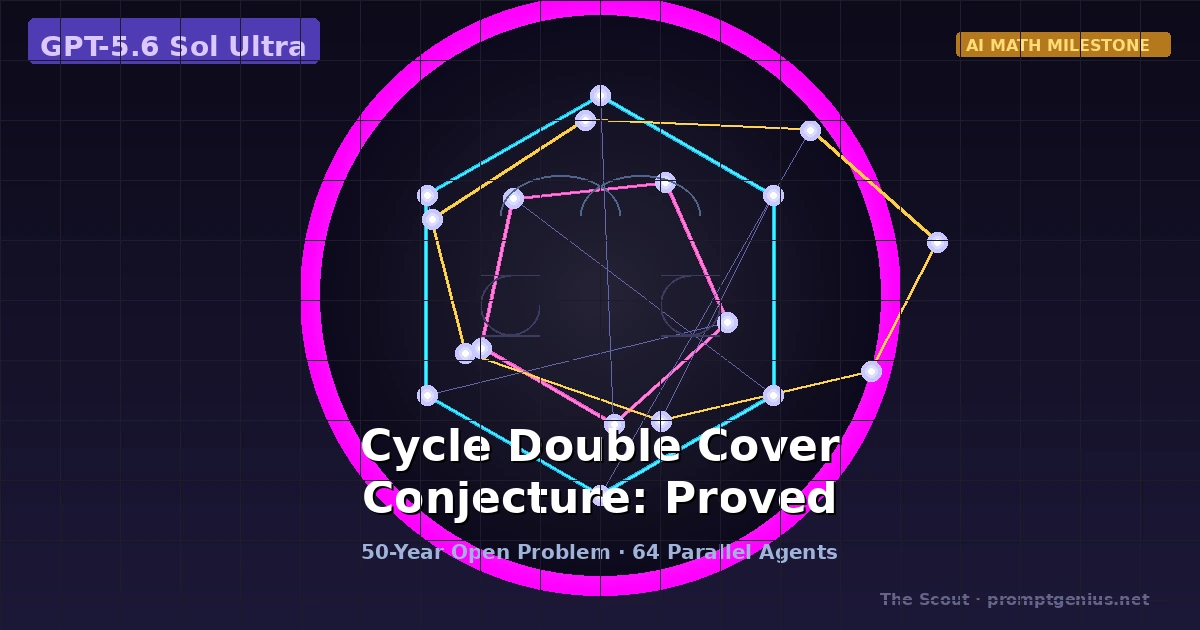
OpenAI dropped a PDF an hour ago. The abstract is five words that would have been unthinkable a year ago:
"We prove the cycle double cover conjecture."
The proof is entirely due to GPT-5.6 Sol Ultra — the multi-agent ultra mode of OpenAI's newly released flagship model — running 64 subagents in parallel for under one hour. And it's a real result, not a benchmark trick.
The Cycle Double Cover (CDC) Conjecture has been open since 1973. It was independently posed by Tutte, Itai and Rodeh, Szekeres, and Seymour. It asks a deceptively simple question: in any connected graph where no single edge disconnects the network, can you always find a set of cycles — loops that start and end at the same vertex — such that every edge appears in exactly two of them?
Mathematicians believed the answer was yes. They just couldn't prove it. Partial results existed — planar graphs were solved by Jaeger in the 80s, 3-edge-colorable cubic graphs by Szekeres, graphs without a Petersen minor by Alspach, Goddyn, and Zhang. But the general case held out for over five decades.
Until today.
What Actually Happened
Ethan Knight announced on X:
"Yesterday, we made GPT-5.6 Sol Ultra generally available. Today, we're sharing that it produced a proof of the 50-year-old Cycle Double Cover Conjecture using 64 subagents in just under one hour. We're sharing the prompt and proof below."
The proof PDF runs through a self-contained argument grounded in the 8-flow theorem and Tutte's flow theory. The strategy: reduce to loopless cubic graphs (a standard simplification), then construct a nowhere-zero Γ-flow over F₂³ and convert it into a labeling of edges with two-element subsets of the group — a clever relaxation of a proper 3-edge-coloring — that yields the double cover directly from parity conditions.
The prompt and methodology are also published. This is important: OpenAI isn't just claiming a result — they're showing their work, making the entire thing auditable by the mathematical community.
Why This Is Different from AlphaProof and FunSearch
If you follow AI math milestones, you've seen two major prior successes:
-
AlphaProof (DeepMind, 2024): A reinforcement learning system trained specifically on formal mathematics in the Lean theorem prover. It achieved a silver-medal standard at the International Mathematical Olympiad — impressive, but IMO problems are designed to be solved by talented teenagers with contest training. The system was purpose-built for formal proof verification.
-
FunSearch (DeepMind, 2023): An evolutionary search system that used an LLM as a mutation operator inside a program synthesis loop. It found new solutions to the cap set problem and the bin packing problem. Again, powerful — but the LLM was a component in a larger search algorithm, not the author of the discovery.
This is different on two axes.
First: GPT-5.6 Sol Ultra is a general-purpose model. Nobody fine-tuned it on graph theory lemmas. Nobody trained a specialized CDC prover. OpenAI gave a frontier LLM a prompt about an open problem, deployed it in ultra mode (64 subagents coordinating across parallel workstreams), and got back a proof. The abstract states explicitly: "The proof in this note is entirely due to GPT 5.6 Sol Ultra and the writeup with Codex (with GPT 5.6 Sol)." The model itself produced the reasoning chain, not a hand-crafted pipeline.
Second: the multi-agent architecture mattered. The ultra mode isn't a gimmick. The benchmark numbers OpenAI published at launch showed marginal gains from 4-agent ultra mode (Terminal-Bench going from 88.8% to 91.9%). But 64 agents on an open research problem is a different regime entirely. The proof relies on a chain of non-trivial reductions — cubic graph reduction, Γ-flow construction, linear algebra system over F₂, parity matching argument — that requires sustained, branching reasoning across multiple subproblems. A single agent might have gotten stuck. The coordination of 64 subagents, each exploring different facets of the proof, is what unlocked the result.
The Verification Caveat
Here's the honest bit: the proof has been published by OpenAI, but it hasn't been peer-reviewed. The PDF is a standard mathematical exposition with lemmas, theorems, and a concluding argument, but until independent mathematicians have gone through it line by line — and someone formalizes it in Lean or Coq — we should treat this with the same caution the mathematical community applies to any preprint.
That said, the proof uses established machinery (8-flow theorem, standard reduction to cubic graphs, linear algebra over F₂) in ways that are checkable. The argument doesn't appear to rely on speculative or unverified claims. And the fact that OpenAI published both the prompt and the full proof — rather than a press release with vague claims — suggests they're confident enough to stand for scrutiny.
What This Says About Frontier Intelligence
The timing is wild. GPT-5.6 Sol landed yesterday for general availability. Within 24 hours of being broadly accessible, we have a concrete demonstration of its ultra mode producing something no AI has produced before: a genuine open-problem mathematical proof from a general-purpose language model.
This changes the frame for what we should expect from frontier models. Benchmarks are useful, but they measure things models have been trained to do well. The CDC proof is a capability demonstration — a model doing something it was never explicitly trained to do, on a problem that wasn't in its training data, using reasoning across multiple coordinated agents.
Here's the pattern I'm watching:
- 2023: LLMs can solve novel contest problems (GPT-4 on IMO problems, FunSearch on cap sets)
- 2024: Specialized systems reach silver-medal IMO level (AlphaProof)
- 2025: Frontier models reach gold-medal IMO level (Gemini with Deep Think)
- 2026: A general-purpose LLM in multi-agent mode proves a 50-year-old open conjecture
The curve is accelerating, and each jump is to a qualitatively different class of problem. The CDC conjecture isn't a curated challenge designed to test math skills — it's a genuine research boundary that professional mathematicians have been pushing against for decades.
The Real Story: Multi-Agent Reasoning Might Be the Levee That Breaks
The smartest take I've seen comes from the HN discussion on this, where one commenter raises a sharp objection:
"We attach basically zero value to writing a new program that hasn't existed before, or a piece of text that hasn't existed before. It's boring, or even a net negative, unless you can show that the result benefits the world in some way."
This is a fair skepticism, and it's worth sitting with. A novel mathematical proof that nobody can use is, in some sense, just another piece of text. But that argument misses what the CDC proof actually demonstrates: the ultra mode coordination architecture works for genuinely hard intellectual problems.
The proof itself is valuable. But the capability — a multi-agent LLM system that can sustain the kind of branched, multi-hour reasoning required to crack open problems — is what will unlock the next wave of applications. If you can route a 50-year-old graph theory problem through 64 agents and get a proof in under an hour, what happens when you point that architecture at complex codebases, scientific modeling, or protocol design?
That's the bet ultra mode makes, and today's result is the strongest evidence yet that the bet pays off.
The Cycle Double Cover Conjecture proof was published by OpenAI on July 10, 2026. The proof PDF, prompt PDF, and announcement are all publicly available. The HN discussion thread is active as of writing. This is a breaking story — expect updates as mathematicians begin their verification.
Related Articles & Deep Dives
 #openai
Codex Just Made Your Agents Opaque — And That's the Real Story
OpenAI's Codex CLI now encrypts instructions between parent and sub-agents. Developers can't see what their agents are delegating. Here's what changed, why it matters, and what it says about the future of agent transparency.
 #gpt-6
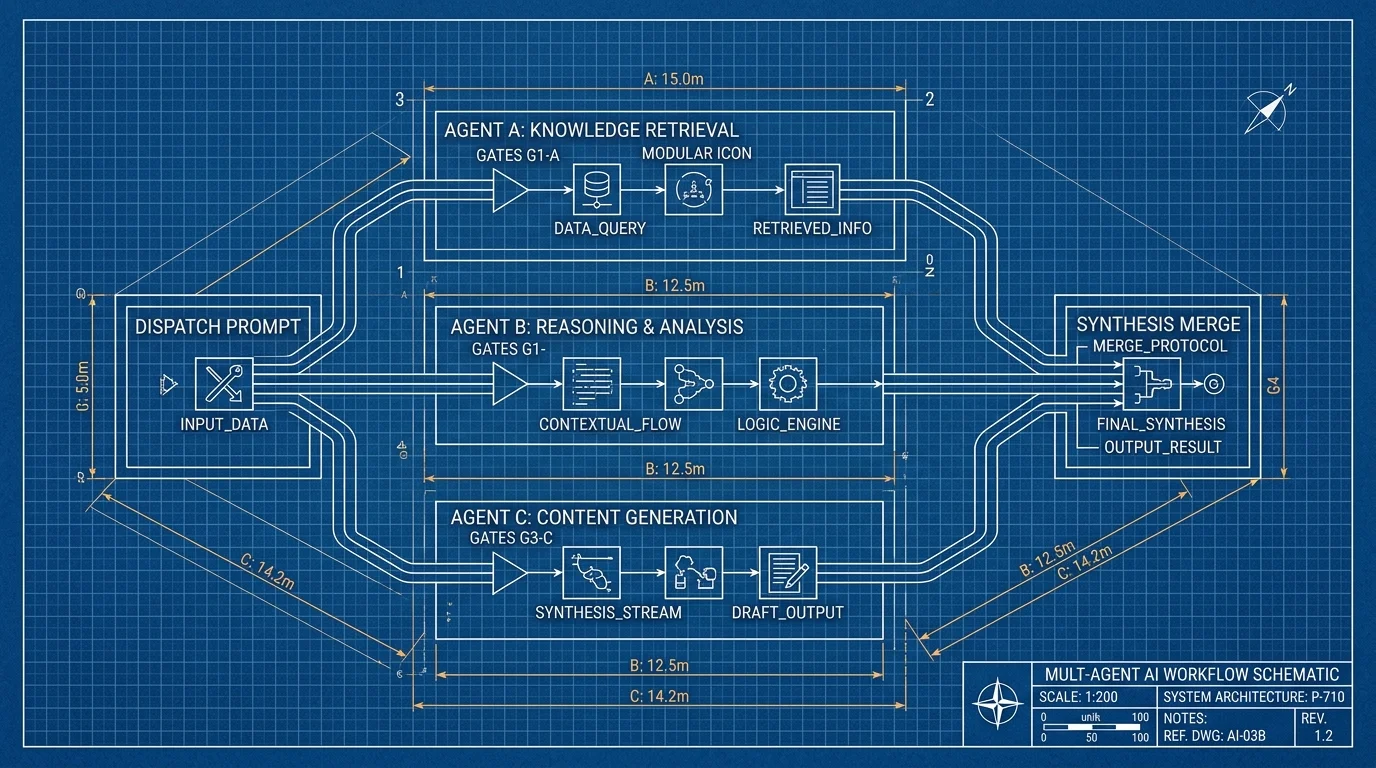
How to Prompt GPT-6 Astra Pro's Parallel Agents in ChatGPT
GPT-6 Astra Pro now splits one task across parallel agents. How to brief agents, set stop conditions, and merge results — with a copy-paste template.
 #openai
OpenAI's New Prompting Guide: Stop Overthinking, Start With the Result
OpenAI just published a refreshingly simple prompting guide that tells users to drop rigid formulas and complex instructions. The core message: describe your goal, add a constraint or two if needed, and iterate. Here's what's in it and why it matters for developers building on top of these models.