Saturday, June 27, 2026
The Diffusion LLM Plot Twist — ByteDance's iLLaDA Matches Qwen2.5 Without Autoregression
Posted by
Diffusion language models are having a moment. Two weeks ago, Google dropped DiffusionGemma and the conversation was all about speed — 1,000 tokens per second, 4x faster than autoregressive, fits on a gaming GPU. The message was clear: diffusion is the future of low-latency local inference.
Then yesterday, a preprint from ByteDance and Renmin University landed that tells a completely different story about what diffusion can do.
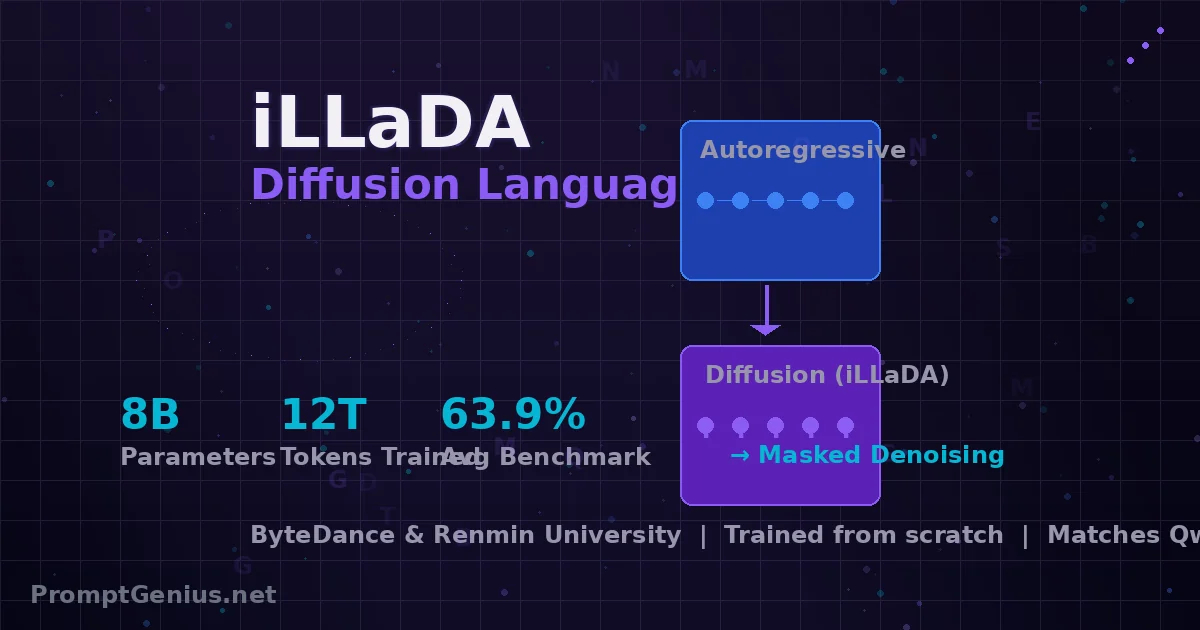
It is called iLLaDA (improved Large Language Diffusion with mAsking). It is an 8-billion-parameter dense model trained from scratch on 12 trillion tokens using a fully bidirectional masked diffusion objective. And at the base-model level, it beats Qwen2.5 7B on average across eight standard benchmarks.
Let me be direct about why this matters: this is the first time a diffusion language model trained from scratch — not fine-tuned from an autoregressive base, not a hybrid — has matched a competitive autoregressive model at an apples-to-apples scale.
If you have been following LLM architecture debates over the last year, you know that is not nothing.
The Benchmark Plot Twist
The headline numbers from the iLLaDA paper are worth staring at:
| Benchmark | iLLaDA 8B (Diffusion) | Qwen2.5 7B (Autoregressive) |
|---|---|---|
| MMLU | 74.8 | 71.9 |
| BBH | 71.3 | 63.9 |
| ARC-Challenge | 60.8 | 51.5 |
| HellaSwag | 76.6 | 79.0 |
| GSM8K | 81.9 | 78.9 |
| MATH | 38.4 | 41.1 |
| HumanEval | 50.0 | 56.7 |
| MBPP | 57.8 | 63.6 |
| Average | 63.9 | 63.3 |
That 63.9 vs 63.3 average is close enough that you could call it a statistical tie. But the pattern matters more than the aggregate.
iLLaDA is dominant on reasoning (BBH: +11.6%) and hard science (ARC-C: +18.1%). It crushes GSM8K by 3 points. This is the opposite of what many expected from diffusion models, which were presumed weak at multi-step reasoning because they do less per-token computation than autoregressive models.
The weak spots are exactly where you would expect: HellaSwag (commonsense reasoning about everyday situations), MBPP (basic Python programming), and to a lesser extent MATH. These are tasks where the autoregressive model's left-to-right sequential conditioning gives it an edge in local coherence and precise token sequencing.
The gap at the instruct level is substantially wider — iLLaDA-Instruct scores 67.1 to Qwen2.5 7B Instruct's 77.1 — which the authors attribute to Qwen2.5's additional reinforcement learning alignment. That is a fair caveat, but it is also the most practically relevant one. Raw base model capability matters less than how the model behaves after fine-tuning.
Two Flavors of Text Diffusion
To understand why iLLaDA matters, you have to put it next to DiffusionGemma. They share the same core idea — replace autoregressive next-token prediction with parallel denoising — but they optimise for completely different things.
| Dimension | DiffusionGemma | iLLaDA |
|---|---|---|
| Size | 26B MoE (3.8B active) | 8B dense |
| Training | Fine-tuned from Gemma 4 backbone | From scratch, 12T tokens |
| Objective | Speed | Quality |
| Generation | 256-token blocks, ~1,000 tok/s | Variable-length blocks, slower |
| License | Apache 2.0 | Research preprint (no license yet) |
| Strongest at | High-throughput, editing, Sudoku | Reasoning, science, multi-step math |
| Weakest at | Quality benchmarks (below Gemma 4) | Code, instruction following |
DiffusionGemma says: "We can make text generation 4x faster by parallelising the decode step, and we are willing to trade benchmark points for it." That is a deployment play — useful for agent loops, bulk classification, and any scenario where token throughput is the bottleneck.
iLLaDA says: "We can train a diffusion model from the ground up that matches the quality of a strong autoregressive model at the same parameter count." That is a research play — it challenges a foundational assumption about how language models should be built.
Both are valid. But they lead to very different predictions about where the field is heading.
What iLLaDA Did Differently
The paper is refreshingly honest about its architectural choices. iLLaDA is not a radical departure from LLaDA (the original ByteDance diffusion LM from late 2025). It is a disciplined scaling exercise with three key changes:
1. 12 trillion tokens of pretraining. The original LLaDA used 2.3T tokens; iLLaDA went to 12T. That is roughly the same scale as LLaMA 3's pretraining corpus. The jump from 2.3T to 12T accounts for most of the performance gain — iLLaDA-Base improved by 21.6 points on BBH and 14.9 on ARC-Challenge over LLaDA.
2. Grouped-query attention. A pragmatic engineering decision that reduces KV-cache memory during inference. GQA lets iLLaDA run more efficiently on existing hardware without sacrificing model quality.
3. Tied embeddings. By tying the input and output embedding matrices, the authors cut total parameters from 8.02B (LLaDA) to 7.62B (iLLaDA) while keeping non-embedding parameters identical at 6.98B. This is a free lunch — better parameter efficiency with no quality cost.
The SFT strategy is also worth noting. iLLaDA applies random masking to the entire sequence (prompt, response, and EOS tokens treated identically) during fine-tuning, rather than segmenting prompt and response like autoregressive SFT. This is unusual, and the authors report that performance kept improving through 12 full epochs with no plateau. That suggests diffusion models learn differently from fine-tuning data than autoregressive models do — potentially meaning they are less prone to overfitting on instruction data.
Where Diffusion Still Struggles
I do not want to overstate the case. The instruct gap is real. iLLaDA-Instruct trailing Qwen2.5 7B Instruct by 10 points on average is not a small gap, and it is driven by the benchmarks that matter most in production: code and math.
The paper's appendix also notes something worrying: iLLaDA occasionally falls into reasoning loops on harder tasks, generating "Wait, let me check again..." repeatedly without converging. The authors implemented a stop-thinking trick — gradually increasing the probability of emitting </think> as generation length grows — which is a pragmatic hack, not a solution.
This is the fundamental tension with diffusion LMs that the Ars Technica coverage of DiffusionGemma captured well: language is discrete. In image diffusion, a single bad pixel is invisible. In text diffusion, one wrong token can make the entire block nonsense. Diffusion LMs generate all tokens simultaneously and then refine, but if the refinement process gets stuck in a local minimum, there is no autoregressive "next token rescues the sentence" mechanism.
There is also the question of what diffusion models lose by not doing sequential reasoning. Sean Goedecke's analysis of DiffusionGemma, referenced widely in the developer community, makes the point succinctly: "Diffusion models do much less work per token than autoregressive models do. That is just less space for the model to spend 'thinking.'" For chain-of-thought reasoning that requires extended intermediate steps, this may be a hard ceiling.
What This Means Going Forward
The iLLaDA + DiffusionGemma one-two punch in June 2026 is the strongest signal yet that text diffusion is not a dead end. Two major labs — ByteDance and Google — are now investing serious compute and engineering talent into non-autoregressive architectures. That alone changes the conversation.
The natural next question is: can diffusion models scale to frontier level?
iLLaDA shows the 8B tier works. But the paper acknowledges directly that "due to limited compute, our study is limited to the 8B scale." We do not know what a 70B or 200B diffusion model looks like. The autoregressive path has been scaled to hundreds of billions of parameters with known recipes; the diffusion path has not.
ByteDance is uniquely positioned to find out. As one of the world leaders in video diffusion models (Seedance, Seedream V5 Pro), the company has deep expertise in scaling diffusion architectures. If any lab has the compute infrastructure and the talent to push text diffusion to 70B+, it is ByteDance.
The other open question is whether diffusion and autoregression are even the right dichotomy. Google demonstrated with DiffusionGemma that you can take an autoregressive backbone (Gemma 4 MoE), swap the generation method, and get a working diffusion model. The iLLaDA team showed the opposite: train from scratch with a pure diffusion objective and you can match autoregressive quality. The logical endpoint is a model architecture that combines both — using diffusion for fast parallel draft generation and autoregressive for verification and refinement. Speculative decoding already points in this direction.
For developers building on LLMs today, the practical advice has not changed. DiffusionGemma is worth trying for high-throughput, latency-sensitive applications where you can tolerate lower benchmark scores. iLLaDA is not yet available as a downloadable model (the paper links to a GitHub repository but no weights or license have been published). But when it ships — and given ByteDance's track record of open-weight releases like Stable-DiffCoder-8B, it almost certainly will — it is going to be an interesting option for local reasoning tasks.
The bigger story here is that the autoregressive transformer's monopoly on language modeling is no longer unquestioned. June 2026 might be remembered as the month text diffusion went from "academic curiosity" to "legitimate contender."
That is worth keeping an eye on.
Related Articles & Deep Dives
 #deepseek
Frontier Agent Benchmarks: DeepSeek V4 vs Qwen 3.8
DeepSeek V4 vs Qwen3.8-Max across agentic benchmarks: verified scores, vendor-reported caveats, pricing, and which model fits your workload.
 #qwen
#qwenQwen3.8-27B: Local Coding Agents, and the Overthinking Problem
Qwen3.8-27B is an Apache 2.0 local agent model that beats Claude Opus 4.8 on agentic tasks — but its default reasoning over-thinks. Setup, MTP, and the right settings.
 #vibethinker-3b
VibeThinker-3B: What Happens When Reasoning Compresses Better Than Knowledge
Sina Weibo's 3B model matches DeepSeek V3.2 and Kimi K2.5 on math and coding — but falls apart on factual recall. The Parametric Compression-Coverage Hypothesis changes how we think about small models, and what developers should reach for.