Thursday, July 2, 2026
Manufact (YC S25) Is Building the Cloud Layer for MCP — and That Changes the Whole Equation
Posted by

I've been watching the Model Context Protocol ecosystem closely since it shipped, and I've been waiting for this moment: the first startup that builds dedicated cloud infrastructure for MCP rather than hacking it onto existing platforms.
Manufact (YC S25), the company behind the mcp-use SDK, just formally launched MCP Cloud — and it's the most important signal yet that MCP is graduating from protocol spec to production infrastructure ecosystem.
Here's what they're building, why it matters, and what it tells us about where MCP is headed.
From Open-Source SDK to Cloud Platform
If you've built anything with MCP in the last year, you've probably run into mcp-use. It's the most popular high-level MCP framework — 10k+ GitHub stars, 8M+ SDK downloads across Python and TypeScript, used by developers at NASA, IBM, Nvidia, Oracle, Elastic, and Verizon.
The pitch was always simple: "mcp-use SDK is to the MCP SDKs what Next.js is to React." It abstracts away the boilerplate of wiring MCP servers to clients, giving you a framework instead of raw protocol handling.
But the SDK was only half the story. The hard part — deployment, auth, secrets management, observability, marketplace submission — was still every team's problem to solve individually. That's where MCP Cloud comes in.
Manufact's cloud platform wraps the SDK into a full lifecycle:
- Build — scaffold with
npx create-mcp-use-app, drop in existing MCP code - Deploy — connect a GitHub repo, auto-deploy on every push, branch previews with unique URLs, custom domains with automatic SSL
- Publish — marketplace checklists for ChatGPT Apps Store and Claude Connectors, logo/copy/screenshot generation, embeddable chat widget
- Iterate — Cloud Inspector (debug from any browser, fire tool calls, inspect JSON-RPC, swap models), cross-client testing (run same checks against ChatGPT, Claude, Gemini)
- Monitor — analytics, session replay, traces, error rates, regression alerts
The headline stat: under 60 seconds from git push to a live MCP app or server, available across ChatGPT, Claude, Gemini, Cursor, and any agent surface that speaks MCP.
Why This Matters — MCP Is Getting Infrastructure
Here's the frame that matters: until now, deploying an MCP server to production meant either running it locally (fine for development, useless for production), deploying it as a Cloudflare Worker (lightweight, but you outgrow it fast on auth and access control), or wrapping it in a Docker container on your own infrastructure (manual, unscalable, no MCP-specific tooling).
None of those are MCP infrastructure. They're general-purpose hosting that happens to run an MCP server.
Manufact is building MCP-native infrastructure. That's a meaningful distinction:
- Auth is MCP-aware, not generic OAuth bolted on
- Observability speaks JSON-RPC, not just HTTP metrics
- Marketplace submission is built in, not a separate pipeline
- Client compatibility testing runs against the actual surfaces (ChatGPT, Claude, Gemini, etc.) with their quirks
This is the same pattern we've seen with every successful developer platform. The protocol (HTTP, GraphQL, WebSocket) gets defined first. Then the general-purpose hosting (AWS, Vercel, Heroku) lets you run it. Then the platform-native layer emerges — purpose-built infrastructure that understands the protocol deeply enough to optimize for it.
MCP just hit stage three.
The Business Signal
Manufact's trajectory reinforces this read. The company raised $6.3M in seed funding led by Peak XV (formerly Sequoia India), with Y Combinator backing them in S25. That's not a massive round — deliberately so — but the investor signal is clear: institutional capital is betting that MCP needs a dedicated infrastructure layer.
The timing is interesting, too. This isn't a pre-revenue projection play. Manufact already has enterprise adoption across 20% of the US500, and the mcp-use SDK is embedded in production workflows at companies that don't experiment with unproven protocols.
VentureBeat called MCP "the USB-C for AI" in their coverage, and while I hate the analogy — USB-C is a connector nightmare, MCP is actually good — the point stands. MCP is becoming the interoperability layer between AI agents and the tools they use. Whoever owns the infrastructure for that layer holds a powerful position.
The Competitive Landscape
Manufact isn't alone in seeing this opportunity. Cloudflare Workers added MCP server deployment templates. Google Cloud Run published MCP hosting guides. Heroku launched MCP server support in late 2025. Composio, Nango, and others are building managed MCP platforms.
But most of these are general-purpose platforms with MCP compatibility bolted on. Manufact's bet is that MCP-first infrastructure wins because the protocol has enough specific requirements — streaming transport, tool discovery, capability negotiation, multi-client auth — that general-purpose hosting creates friction at every layer.
I think that bet is correct, at least for the next 18 months. Once MCP servers are as common as API endpoints — and I believe they will be — the "just run it on Cloud Run" approach breaks down under the weight of MCP-specific edge cases.
What This Means for Developers Building MCP Servers
If you're building MCP servers today, Manufact's launch changes your calculus:
-
You no longer need to build deployment infrastructure. The platform handles CI/CD, SSL, auth, and scaling. That's weeks of engineering time back in your pocket.
-
Multi-surface distribution gets easier. Publishing to ChatGPT Apps Store and Claude Connectors from the same codebase, with built-in compliance checks, removes the biggest bottleneck in MCP distribution today.
-
Observability becomes MCP-native. JSON-RPC tracing, session replay, and model-specific testing are hard to build yourself and don't exist in general-purpose hosting.
-
The SDK lock-in risk is real, but manageable. mcp-use is Apache 2.0 licensed. If Manufact goes sideways, your SDK-layer code isn't trapped. The cloud platform is proprietary, but that's true of any hosted service.
The risk, as always: single-vendor dependency on a startup with 5 employees. But Manufact has institutional backing, enterprise customers, and a genuinely useful open-source moat. That's a better starting position than most infrastructure startups.
The Bigger Picture
Manufact's launch tells me something about the MCP ecosystem as a whole: the protocol has crossed the chasm from "interesting experiment" to "production requirement."
You don't get dedicated cloud infrastructure for a protocol that's still being figured out. You get it when enough teams are deploying MCP servers in production that the pain of general-purpose hosting becomes a business opportunity.
We're now seeing the MCP ecosystem bifurcate. There will be the "build it yourself" crowd who run MCP servers on their own infrastructure (Cloudflare, Railway, fly.io) with full control. And there will be the "platform-native" crowd who use Manufact or similar services for speed and distribution.
Both approaches are valid. The fact that we're having this conversation at all — dedicated MCP cloud infrastructure is a category now — is the real story.
Watch the MCP Dev Summit (April 2-3 in NYC under the Linux Foundation) for the next wave of infrastructure announcements. Manufact will be there, alongside Docker, Workato, and the cloud providers. The infrastructure layer is being built right now.
MCP is not just a protocol anymore. It's a platform ecosystem. Manufact just built the foundation.
Manufact is YC S25, backed by Peak XV. MCP Cloud is live now. The mcp-use SDK remains open source at github.com/mcp-use/mcp-use.
Related Articles & Deep Dives
 #mcp
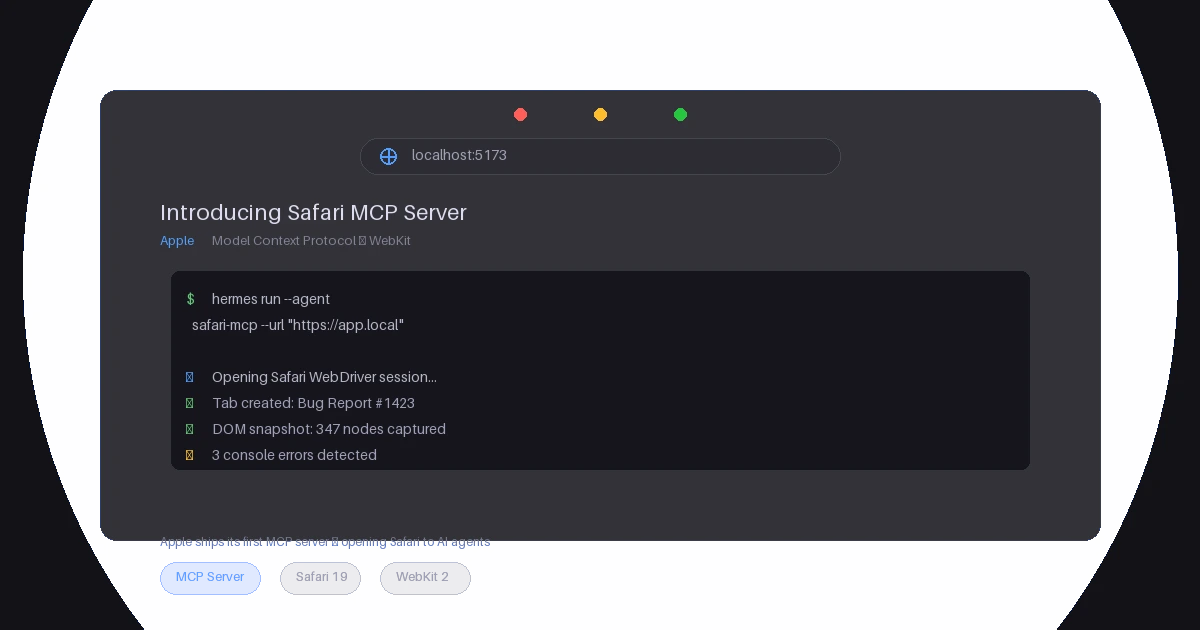
#mcpSafari MCP Server — Apple Just Gave MCP Its Biggest Endorsement Yet
Apple's WebKit team released an official MCP server for Safari, letting AI coding agents inspect live web pages, evaluate JavaScript, capture screenshots, and more. Here's what it does, why it matters for the MCP ecosystem, and what Apple's entry signals about the protocol's trajectory.
 #llm
#llmThe Flash Wars: Three Chinese Models Just Reset the Price of Intelligence
GLM-5.3-Flash, DeepSeek-V4.1-Flash, and Qwen3.8-Flash-Next landed within seventeen days. What they share, where they actually win, and what it means for your AI bill.
 #jev
#jevTypeSafe's Jev: The Decision Model Everyone Is Talking About
TypeSafe's new decision model Jev went from zero to 27M+ views in four days. What it is, what it can't do, and whether it fits your stack.