Character Bible Template: Keep ChatGPT Fiction Consistent
Download a free character bible template. Track voice, relationships, knowledge, and scene changes with ChatGPT prompts and a worked continuity example.
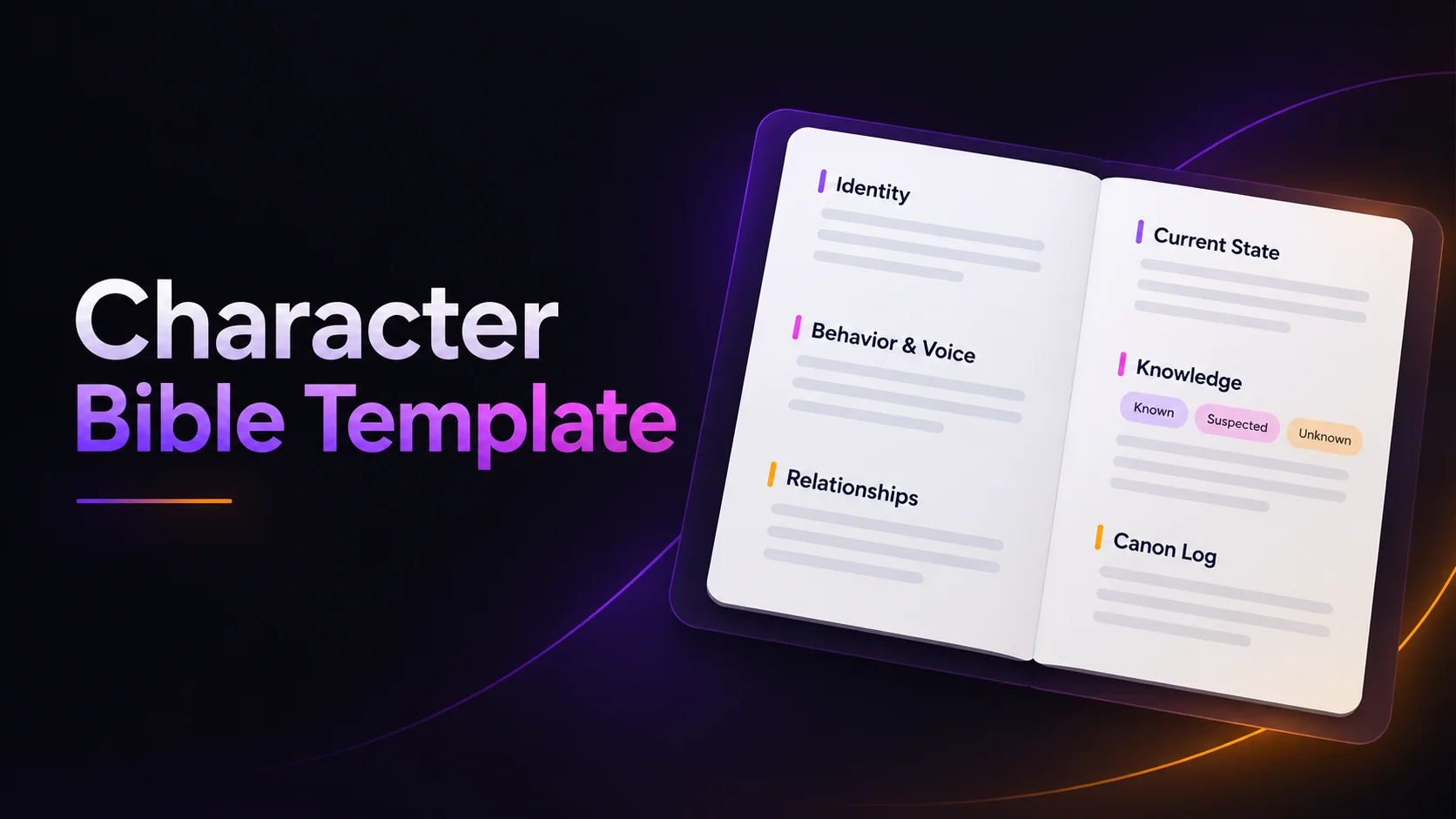
Start With a Character Bible
A character bible is a saved reference for who a fictional character is, what they know, and what has changed. A profile helps you invent a character; a bible helps you write that character across multiple scenes without losing established facts.
Download the blank Markdown template or download Mara's filled example. Both are free and editable in a text editor or notes app.
If you have no character yet, start with the character-creation quick-start prompt. This guide is about narrative continuity, not keeping a generated face consistent; for that task, use visual character reference sheets.
What to Record
| Section | Purpose | Example |
|---|---|---|
| Identity | Stable facts used in scenes | Mara Vale, 34, ferry-radio repairer |
| Behavior and voice | How traits appear in action and speech | Withholds uncertain evidence; asks precise questions |
| Relationships | Each person's view of the relationship | Jun trusts her repairs but resents her secrecy |
| Current state | Things that can change | At the workshop; recorder on the bench |
| Knowledge | Known, suspected, mistaken, and unknown facts | Heard a nickname; does not know the caller's identity |
| Development | Changes earned through events | Begins sharing incomplete evidence with Jun |
| Canon log | Approval status and supporting scene | A new fact is proposed until the writer accepts it |
Record what affects the story, not every possible biographical detail. Keep the authoritative file outside the chat. Model memory and long conversations are not a substitute for an up-to-date record you can inspect.
Copyable Character Bible Template
Use scene labels in the evidence fields. “Unknown” is a valid entry. A model-generated suggestion is not canon until you approve it.
# Character Bible: [Name]
Version: [number/date]
Story point: [chapter/scene; story date or relative day]

## Stable Identity
- Name and aliases:
- Age, occupation, setting:
- Appearance details relevant to continuity:
- Approved background facts and their sources:

## Behavior and Voice
- Values, goal, motivation, fear:
- Strength and observable behavior:
- Flaw and consequence:
- Speech rhythm, vocabulary, avoidance patterns:
- Two example lines:

## Relationships
| Person | My character's view | Other person's view | Shared/private facts | Source |
| --- | --- | --- | --- | --- |
| [Name] | [Trust/tension] | [Trust/tension] | [Facts] | [Scene] |

## Current State
- Location and story time:
- Physical condition, injuries, recovery:
- Possessions and where they are:
- Emotional state and its cause:
- Immediate objective:

## Knowledge at This Story Point
| Fact | Status: known/suspected/mistaken/unknown | How learned or why believed | Source |
| --- | --- | --- | --- |
| [Fact] | [Status] | [Evidence] | [Scene] |
- Reader-only facts the character must not act on:

## Development
- Starting belief or behavior:
- Events that challenged it:
- Change already demonstrated:
- Planned change, not yet established:

## Canon and Revision Log
| Detail/change | Status: approved/proposed/unresolved/replaced | Evidence | Decision |
| --- | --- | --- | --- |
| [Detail] | [Status] | [Scene/author decision] | [Keep/change/ask] |
Filled Example: Mara Vale
This is an authored fictional example, not a recorded model run. It continues the character from our creation guide.
Story point: End of Scene 1, night before the ferry leaves.
- Stable identity: Mara is 34 and repairs ferry radios in Bellwether. Her brother disappeared three years ago. She is not a police officer.
- Behavior: She tests faults systematically and withholds evidence she cannot corroborate. This protects her from false leads but excludes allies.
- Voice: Brief, precise questions. When avoiding an emotional answer, she corrects a technical detail. Example: “Channel six works now.”
- Relationship: Jun trusts her technical judgment. After she evades his question, he resents being kept outside the investigation; they have not reconciled.
- Current state: Mara and Jun are in the workshop. The recorder is on the bench. Mara has no established injury. Jun has left his repaired radio on the bench.
- Known: Mara heard a caller use her brother's private nickname for her.
- Suspected: The call might be connected to her brother.
- Unknown: The caller's identity and whether her brother is alive.
- Reader-only planning note: The writer is considering making harbor clerk Elias the caller. This is a proposal, not established canon, and Mara has not learned it.
- Development: Sharing uncertain evidence is a planned arc; Mara has not yet demonstrated that change.
The filled download includes the same facts in the template's structure.
Draft a Scene From Relevant Facts
Paste only the character entries, world rules, and recent events needed for this scene. For dialogue, include the other character's voice and objective too.
Use the following approved reference to draft a fictional scene.

Character bible excerpts: [paste relevant entries]
Other characters' profiles: [paste relevant entries]
World rules and recent events: [paste relevant facts]
Scene time, place, and viewpoint: [specify]
Immediate objective and obstacle: [specify]
Required ending: [what changes; what must not happen yet]
Length and tone: [specify]

Respect each character's knowledge at this story point. Do not treat
reader-only notes, proposed ideas, or planned growth as established facts.
Avoid adding permanent history, skills, injuries, or relationship changes
without identifying them as proposals after the draft.
If the scene requires a missing fact, ask before drafting.
Return the scene, then a separate list of proposed additions, if any.
Check a Scene for Contradictions
Check against the supplied record before asking for a rewrite. Require evidence so you can inspect the diagnosis rather than accept an unsupported verdict.
Approved bible at the start of this scene: [paste]
Scene to check: [paste]
Intentional changes authorized for this scene: [list, or none]

Check identity, voice, location/time, injuries, possessions, relationships,
and character knowledge. Distinguish an actual contradiction from an
unknown fact, a plausible inference, or an authorized character change.

Return a table:
- Scene passage or exact quote
- Relevant bible entry
- Issue: contradiction / unsupported addition / question
- Minimal correction or clarification

Do not rewrite the scene or update the bible. Do not invent evidence.
If no conflict is supported by the supplied text, say so.
Worked Continuity Error
Draft: “Mara pocketed the recorder. She knew Elias had made the call, and that her brother was waiting on the ferry. Jun grinned; they had settled their argument.”
| Draft detail | Reference | Diagnosis |
|---|---|---|
| Mara pockets the recorder | Recorder starts on the bench | A possible scene action, not inherently a contradiction; track it afterward if approved. |
| She knows Elias made the call | Caller identity is unknown; Elias is only a proposed writer note | Unsupported knowledge presented as fact. |
| Her brother is waiting on the ferry | His survival and location are unknown | Unsupported addition. |
| They have settled their argument | No reconciliation is established or authorized | Missing relationship transition. |
Minimal repair: “Mara pocketed the recorder. The nickname could have been a lure; it was the only lead she had. Jun didn't look at the radio. ‘You could let me hear it,’ he said.”
This preserves uncertainty and the unresolved tension. It does not lock the characters into permanent conflict: a later scene can earn a reconciliation and update the record.
Propose Updates After a Scene
Bible before the scene: [paste]
Approved scene text: [paste]

Extract changes to location/time, condition, possessions, knowledge,
objectives, relationships, and demonstrated development.

For each proposed update, give:
1. The old entry.
2. The proposed replacement.
3. The exact passage supporting it.
4. Whether it is explicit or inferred.

Keep inferences and unanswered questions separate. Do not convert a
character's suspicion into truth. Do not replace the authoritative bible;
wait for the writer to approve individual updates.
After the repaired scene, the recorder can move from “bench” to “Mara's possession.” The caller remains unknown, the brother's survival remains unknown, and Jun's request alone does not establish renewed trust.
Resume in a New Chat
We are continuing a fiction project. Use the attached/pasted current
character bible as the reference for this task, not as a promise of memory.

Story point: [scene/time]
Relevant bible excerpts: [paste]
Recent approved events: [brief summary]
Next task: [outline, dialogue, scene, or continuity check]

Before drafting, summarize each character's current objective and knowledge
limits. Flag missing or conflicting context. Treat proposals as proposals.
Wait for my corrections, then perform the task.
Keep the full file locally; supply current, relevant excerpts whenever you start a session. Review generated scenes yourself: these prompts organize context and checks, but do not guarantee error-free continuity.
For distinct voices, use the dialogue workflow. For the larger narrative, connect approved changes to your story development and world rules.
Related Articles & Guides
 #Creative Writing
Creative Writing with ChatGPT: Complete Guide
Choose ChatGPT prompts for character creation, dialogue, plots, and world-building. Follow worked examples and save a character bible for story continuity.
 #Creative Writing
Character Creation Prompts for ChatGPT
Copy ChatGPT character prompts for profiles, backstories, voice, and arcs. Follow a worked example, revise weak traits, and save a reusable character bible.
Dialogue Writing Prompts for Natural Conversations
Write distinct character voices with ChatGPT dialogue prompts. Follow a worked conversation, revise flat dialogue, and check subtext and continuity.