GPT Image 2 Character Sheet and Reference Prompts
Keep a recurring character consistent in GPT Image 2 with casting sheets, expression grids, pose studies, and reusable hair and wardrobe cards.
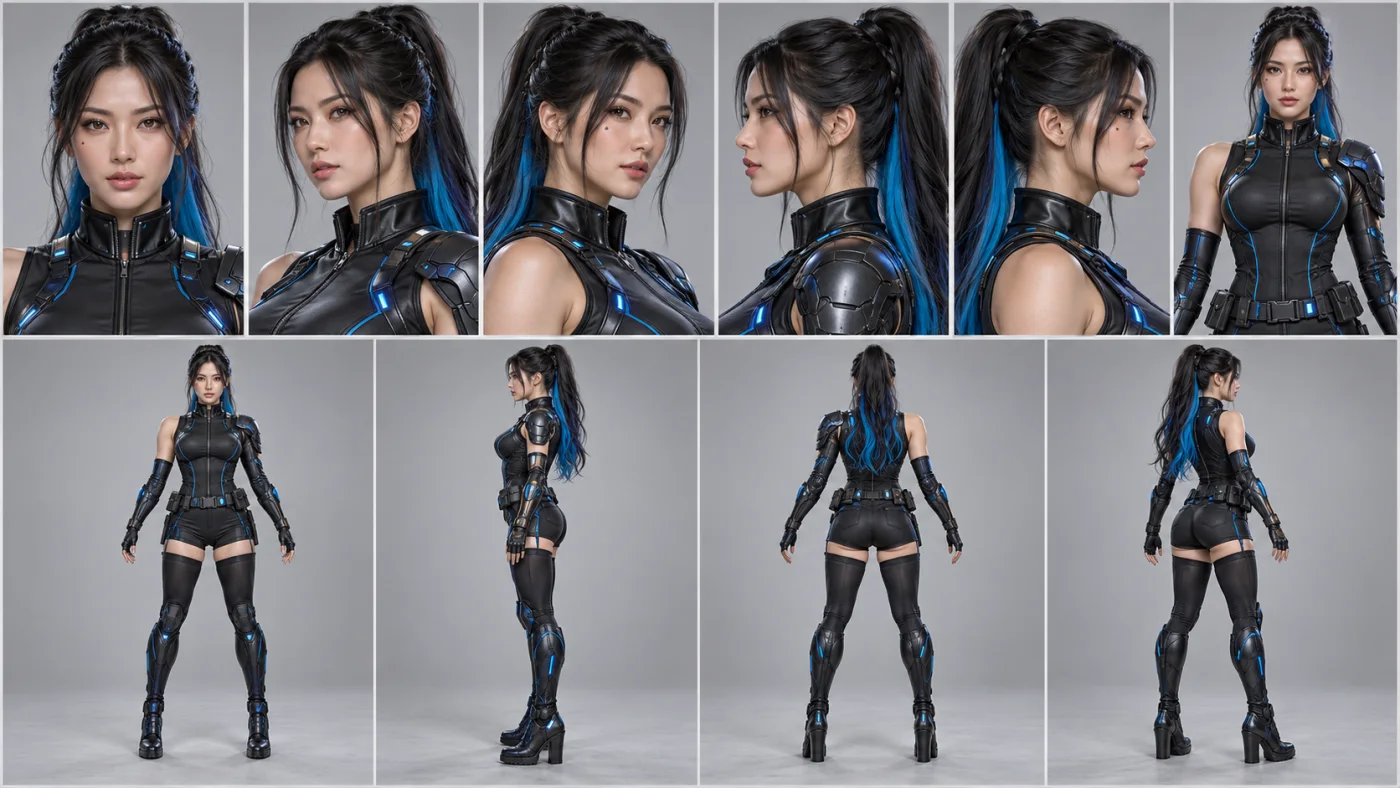
Keeping one character recognisable across many images starts with a reference sheet designed around the character's signature face, silhouette, hair, and costume. Here, one original adult cyberpunk game heroine anchors every example: black-and-cyan hair, amber eyes, a beauty mark, and a cobalt-lit pilot suit, with confident gravure-idol fashion-editorial glamour.
The eleven assets turn that design into a casting sheet, a face plate at working resolution, a game dossier, an expression grid, two pose studies, a documented costume failure, separate hair, loadout, and material cards, and one cinematic frame that proves the sheet survives outside the studio. She stays fully clothed in every example; the glamour comes from styling, pose, and game-art direction rather than exposure.
Start with a casting master sheet
Establish a strong visual identity first, then generate one page containing every angle you will need later. This original heroine uses a braided high ponytail with a cyan underlayer, amber eyes, and a high-collar armored pilot suit as the anchors that subsequent cards can preserve.
Two rules carry the weight here. Give the character one memorable silhouette and a compact palette, then list what stays fixed across panels so the model does not redesign her face, hair, or armor between views.
Create a polished landscape 16:9 sci-fi video-game character reference sheet, exactly ten panels on one page, all showing the SAME clearly adult fictional woman, age 27. CHARACTER: Japanese cyberpunk action-RPG heroine with confident gravure-idol fashion-editorial glamour. Long glossy black hair in a high braided ponytail, vivid electric-cyan underlayer and two loose face-framing strands; warm amber-brown eyes; a small beauty mark below her left eye; softly angular oval face, defined cheekbones, natural full lips, subtle asymmetry. Warm ivory skin with realistic texture. Tall, athletic-curvy adult proportions, strong legs, natural waist, believable anatomy. SIGNATURE COSTUME, identical in all panels: fitted midnight-black futuristic pilot suit with cobalt-blue armored seam piping, high collar, opaque torso panels, one asymmetrical shoulder guard, segmented forearm bracers, utility belt, fitted shorts over fully opaque black technical thigh-high legwear, and knee-high boots. Stylish, fully clothed, non-explicit. No logos or weapons. LAYOUT: precise studio grid on neutral light-grey, thin gutters. Top row, six head-and-shoulder angles: front, left three-quarter, right three-quarter, left profile, right profile, relaxed waist-up front. Bottom row, four full-body turnarounds: front, left side, back, three-quarter back. Neutral relaxed stance; arms slightly away from torso to show costume construction. IDENTITY LOCK: same woman in every panel. Preserve her facial proportions, amber eyes, beauty mark below left eye, braided ponytail, cyan underlayer, adult proportions, and complete costume. Only camera angle and crop change. No face drift, costume redesign, or extra characters. VISUAL STYLE: premium photorealistic game-character concept photography, realistic skin and material detail, controlled studio rim light with subtle cyan accents, sophisticated sci-fi art direction and confident fashion-editorial polish. No text, letters, labels, numbers, logos, UI, watermark, extra limbs, nudity, or costume changes.
Why it works: the design uses a small set of high-salience anchors—amber eyes, a left-side beauty mark, braided black-and-cyan hair, and a high-collar pilot suit. Repeating those anchors and fixing the costume in the brief makes the turnarounds useful for both character identity and game-asset development.
Get one face close enough to keep
A ten-panel sheet spends its resolution budget on the wrong thing. In a full-body turnaround her face occupies roughly thirty pixels of a 1600-pixel frame, which is enough to read as a face and not enough to re-attach. If the face is going to be reused across dozens of images, it needs its own plate, generated separately, at a crop where it fills the frame.
The move is arithmetic rather than clever. State the crop as a fraction of frame height rather than as a shot name, because “portrait” and “close-up” both resolve to a head-and-shoulders crop that still leaves the face small. Asking for the face to occupy seventy percent of frame height forces the crop, and the identity lock written for the body suddenly starts paying off, because there are finally enough pixels on it to lock.
Expect a vertical plate. The crop instruction and the aspect ratio agree with each other, and the model reads a tight head-and-shoulders framing as a portrait canvas without being told.
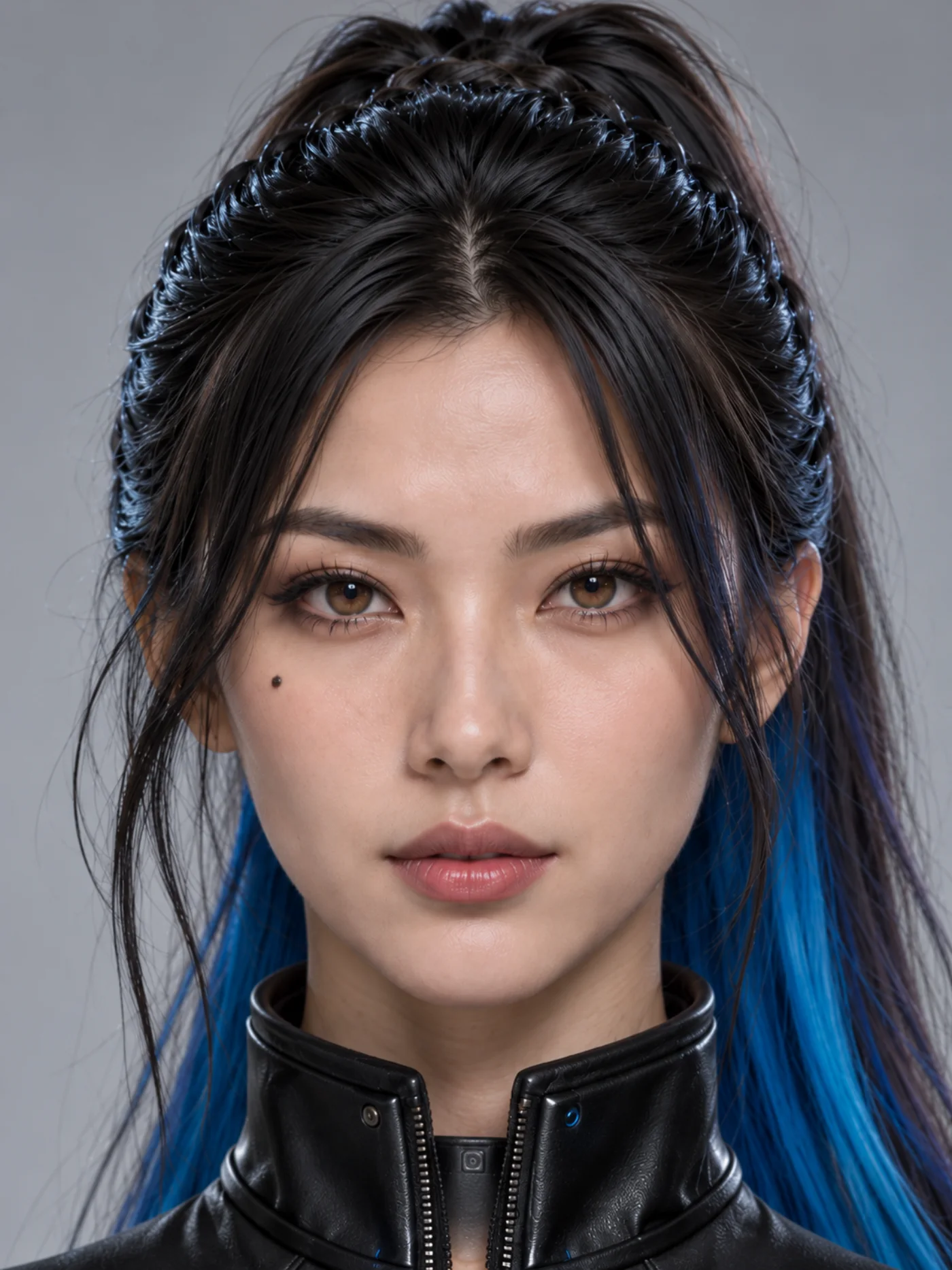
Use the attached casting master sheet as the ONLY identity reference. Create a single photorealistic face plate of the SAME clearly adult fictional woman, age 27. CROP, this is the whole point of the prompt: her face must fill about seventy percent of the frame height. Frame her from the top of her head to just below her collarbone. No shoulders, no arms, no torso, no background body. This is a face at working resolution, not a portrait of a person. IDENTITY LOCK, and every one of these features is now large enough to be visible and therefore large enough to drift: softly angular oval face, defined cheekbones, natural full lips, subtly asymmetric mouth line, warm amber-brown eyes, a small beauty mark below her left eye, softly angular brow, natural skin texture with visible pores and faint uneven tone, warm ivory skin, apparent age twenty-seven. Long glossy black hair in a high braided ponytail with an electric-cyan underlayer, two loose face-framing strands falling across her temples. EXPRESSION LOCK: neutral and faintly deadpan, mouth closed, eyes toward camera. No smile, no parted lips, no raised brow, no strain. She is not performing anything. LIGHT: soft even diffused key from camera left, very gentle fill, no hard shadow under the cheekbone or the jaw. Neutral light grey seamless background, out of focus. REALISM: real facial anatomy, natural eyelids, real brows, visible skin texture and pores, no skin smoothing, no beauty filter, no plastic sheen, no airbrushing. Render as close to life size as the frame allows. Premium photorealistic game-character concept photography, sharp focus on skin and eye detail. No text, labels, numbers, watermark, or extra panels. One single image, one single face.
Why it works: the crop is stated as a measurement because that is the only phrasing the model cannot resolve its way out of. Shot names are negotiable—“portrait” gets you a head-and-shoulders frame where the face is still a minority of the image. A percentage of frame height is a constraint rather than a suggestion. The second lesson is about ordering: generate this plate from the master sheet rather than from the ten-panel sheet, because upscaling a thirty-pixel face costs you more than re-running the identity lock at a usable size.
Rebuild a structured sheet from one photo
Once you have a sheet you like, the next step is to turn it into a document you can skim. A narrow spec column gives each identity attribute a fixed home, so a prompt later in the chat can refer to a name instead of re-describing a face.
Attach the master sheet and separate two lists: what must be preserved, and what must never change. The preserve list keeps skin texture and apparent age intact; the change list stops the model from beautifying what it rebuilds.
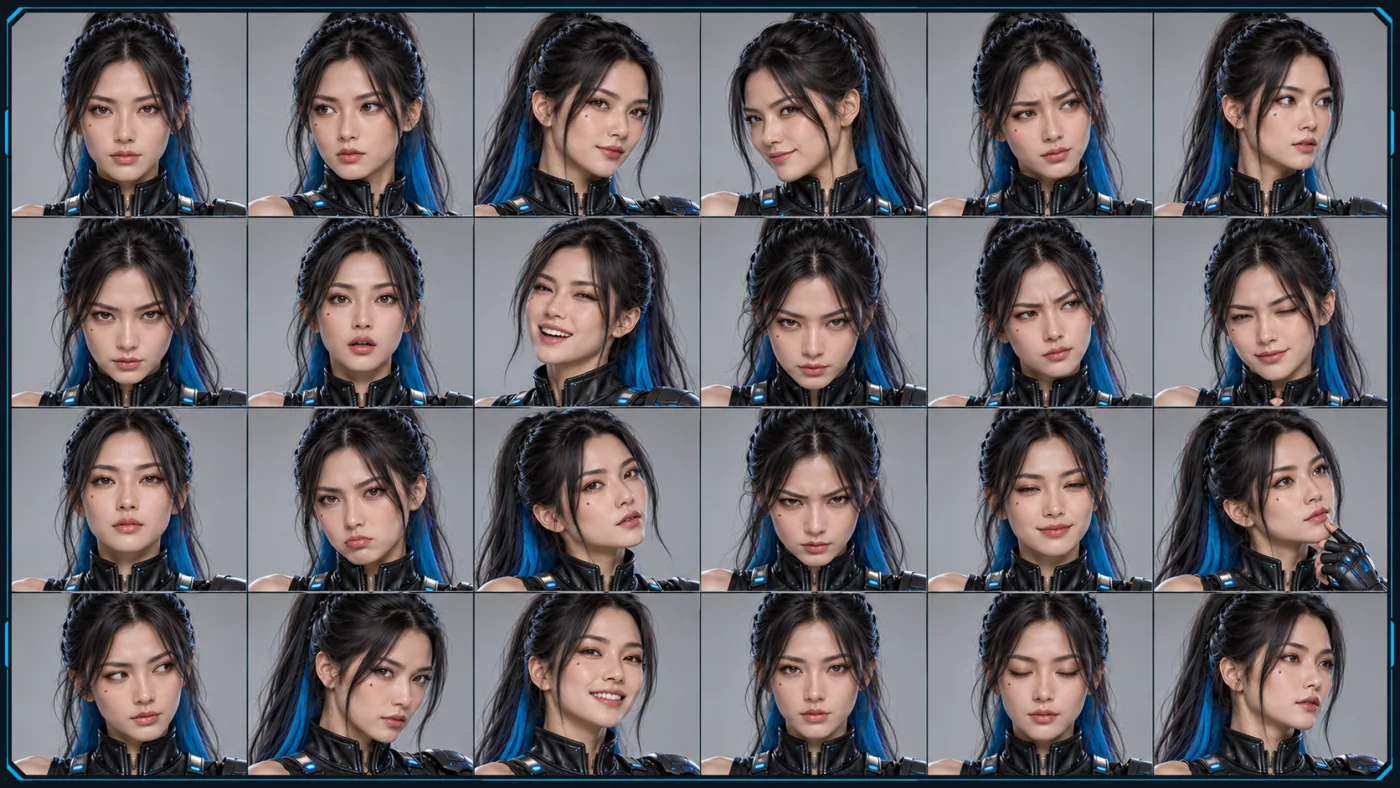
Use the attached casting sheet as the ONLY identity reference. Create a landscape 16:9 photorealistic character reference sheet, single page, for the same adult woman. PRESERVE EXACTLY: face, facial structure, hair, bangs, hairline, eye shape and spacing, nose shape, lip shape, jawline, skin tone, age impression, body proportions, photo realism, natural skin texture. DO NOT CHANGE: identity, apparent age category, hairstyle, hair length, hair color, body type. Do not beautify, average, smooth or de-age her. Do not change her apparent ethnicity. LAYOUT: a narrow left spec column about eighteen percent of the width, and a large panel area on the right. Left spec column, small clean uppercase sans-serif, dark grey on off-white, generous line spacing, in this order: AGE HAIR EYES SKIN BUILD MOOD Then a short paragraph of fine print at the bottom of the column. Right panel area, six photographs in a two row by three column grid with thin even gutters: front face close crop, left three-quarter face, right full profile, one relaxed waist-up front view, standing full body front, standing full body back. All six must be the same woman, photographed against the same seamless light grey backdrop with the same soft even diffused light, wearing the same plain light grey short-sleeve top and matching shorts. AESTHETIC: clean editorial design, off-white margins, thin panel spacing, realistic photographic character sheet, natural color, high resolution, sharp focus on skin and hair detail. No watermark. No decorative flourishes. No extra logos.
Why it works: "do not beautify, average, smooth or de-age" is the load-bearing sentence. Rebuilding a face from an attachment invites the model to improve it, and most identity drift in this step is a quiet upgrade rather than a substitution. Naming the preserve list and the change list separately keeps those two instructions from cancelling each other.
Vary expression without losing the face
An expression sheet turns one neutral face into a reusable range. The critical structural move is the anchor panel: fix one cell as the neutral identity, and define every other cell as a variation on that same panel rather than on the original photo.
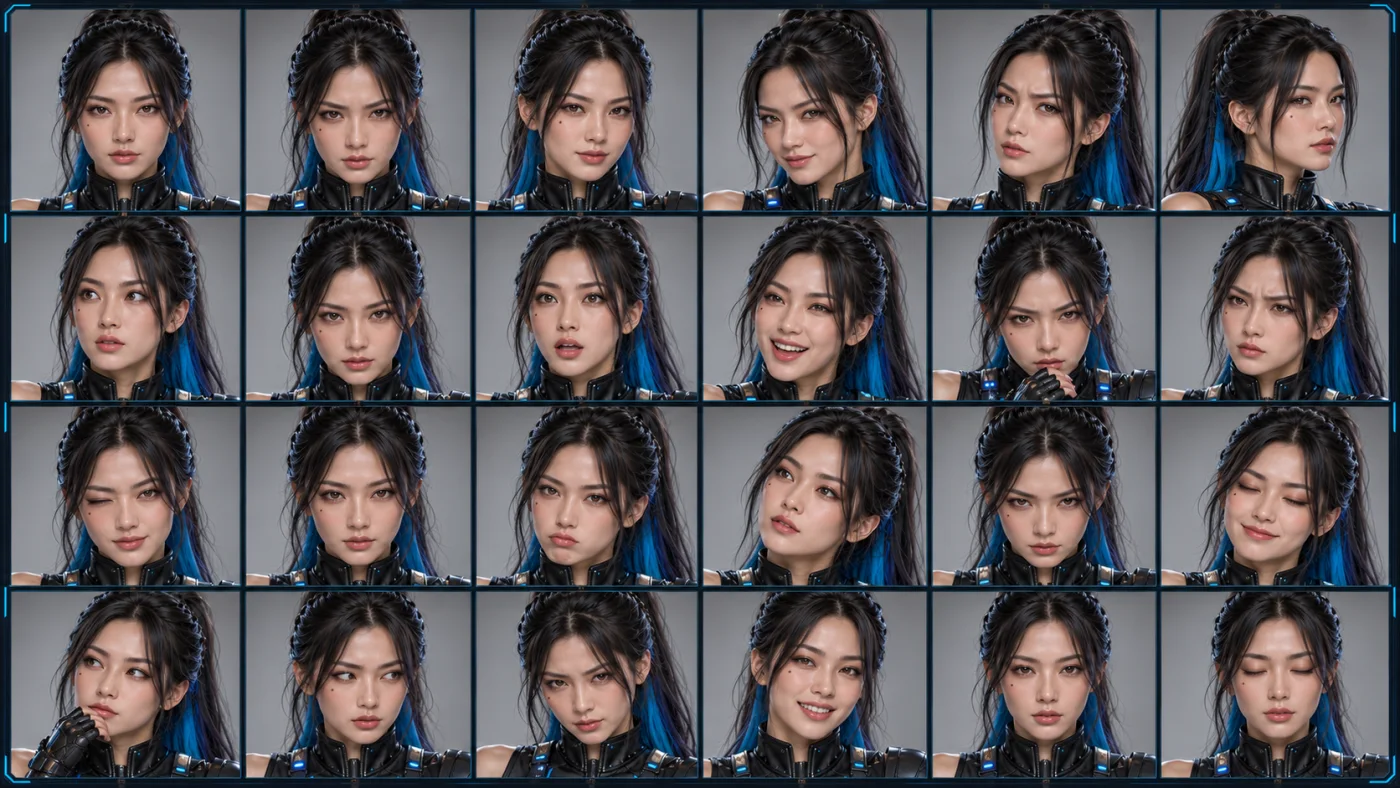
Use the attached casting sheet as the ONLY identity reference. Create a landscape 16:9 photorealistic facial expression reference sheet for the same adult woman, on a single page. GRID: exactly twenty-four panels, six columns by four rows, thin even white gutters, soft off-white margins. Every panel is an identical head-and-shoulders crop, same scale, same camera height, same seamless light grey backdrop, same soft even diffused light. PANEL ONE, top-left, is the IDENTITY ANCHOR: her neutral resting face, mouth closed, looking straight at camera. Treat this one panel as the fixed reference that all twenty-three others must match. PANELS TWO THROUGH TWENTY-FOUR all show small, believable variations within ONE family: mild, restrained fatigue. Examples of the register: slightly heavier eyelids, a faint crease between the brows, one corner of the mouth lowered a little, a short blink caught mid-blink, lips faintly parted, a small yawn, glancing off-camera then back, a quiet wince, a suppressed yawn, lowered chin. Keep every variation subtle and photographic. Do not make them cartoonish or exaggerated. IDENTITY LOCK across all twenty-four panels: same face, same facial structure, same hair, same bangs, same hairline, same eye shape and spacing, same nose, same lips, same jawline, same skin tone, same age impression, same visible plain light grey crew-neck top. Only the expression changes. Do not let her age, change ethnicity, change hairstyle, or change face shape between panels. REALISM: preserve real facial anatomy and skin behavior, natural eyelids, real brows, cheek and jaw muscle movement, natural under-eye shadow, no skin smoothing, no beauty filter, no plastic sheen. Absolutely no text, no letters, no numbers, no captions, no labels, no watermark.
Why it works: constrain the sheet to a single emotional register, such as restrained fatigue, and the model spends its effort on believable variation instead of on range. The other lever is the instruction that recognisable identity outranks expression intensity. Without it, dramatic expressions reshape the face, because a squint and a grimace both read as a different person to a model optimising for expression.
Explore poses without losing the character
The turnaround establishes how the character looks from every angle; a pose sheet shows how she moves. Keep the same face, hair, proportions, and costume locked while varying the silhouette, gesture, and balance of each full-body pose.
Ask for clear separation between poses and a consistent camera and lighting setup. That makes the sheet useful as a quick reference when a later scene needs a specific stance without redesigning the character.
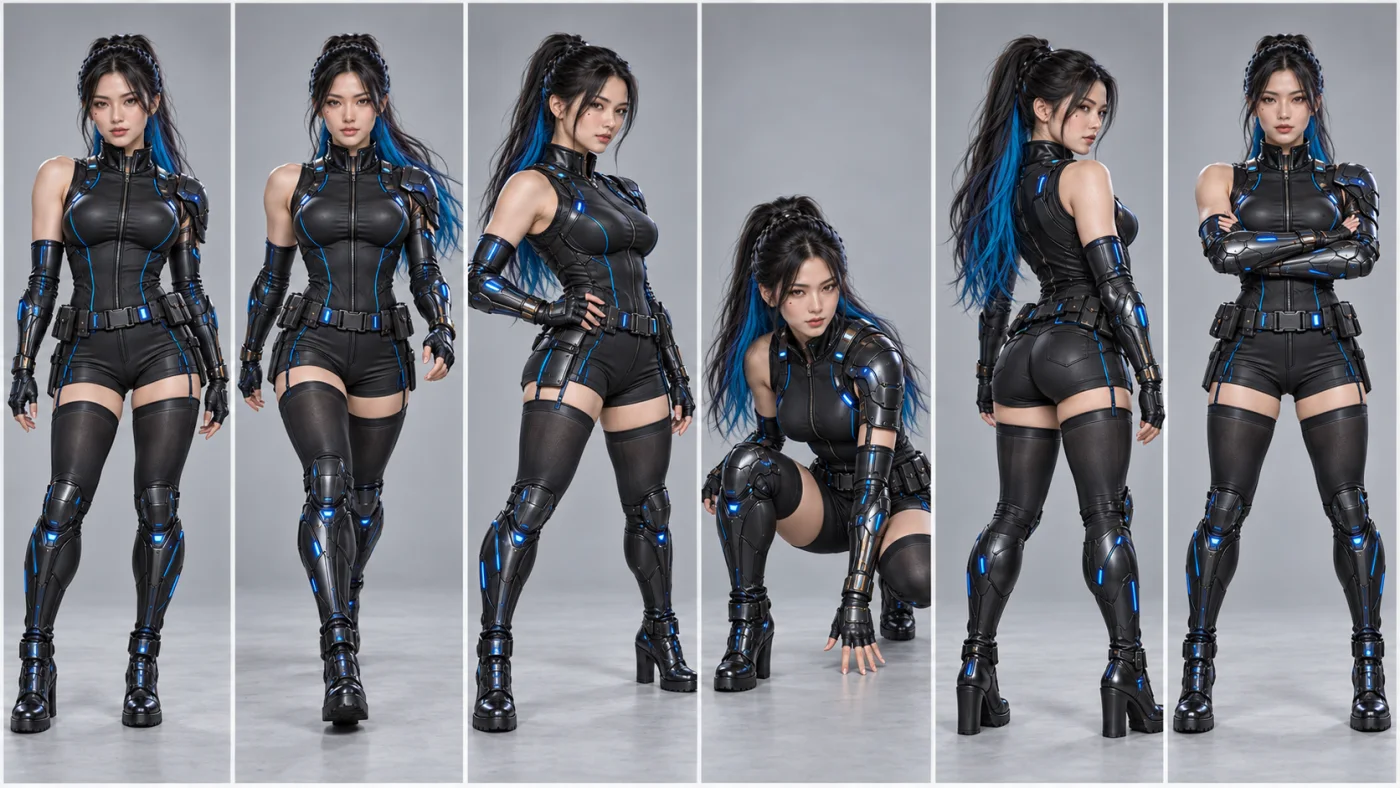
Use the attached casting master sheet as the ONLY identity and costume reference. Create a landscape 16:9 full-body pose reference sheet showing the SAME clearly adult fictional woman, age 27, in six distinct poses. CHARACTER LOCK: Japanese cyberpunk action-RPG heroine; same softly angular oval face, amber-brown eyes, small beauty mark below her left eye, long glossy black hair in a high braided ponytail with an electric-cyan underlayer and two face-framing strands. Preserve her adult athletic-curvy proportions and recognizable silhouette. Keep her complete midnight-black pilot suit with cobalt-blue seam piping, high collar, asymmetrical shoulder guard, bracers, utility belt, opaque thigh-high legwear, and knee-high boots identical in every pose. Fully clothed, no redesign. LAYOUT: exactly six equal vertical panels in one clean row, full figure visible head to boots in every panel, generous gutters, neutral light-grey studio background. Use the same camera distance, eye-level viewpoint, soft studio lighting, and scale in every panel. No overlap between poses. POSES, left to right: 1. relaxed confident idle stance, weight settled on one leg, arms loose; 2. purposeful walk toward camera, natural stride, one arm moving forward; 3. three-quarter ready stance, feet planted, one hand resting near the utility belt; 4. low athletic crouch, balanced and alert, both boots fully visible; 5. looking back over one shoulder, torso turned, relaxed hand gesture; 6. arms-crossed hero pose, upright and self-assured. CONSISTENCY: all six are the same woman with the same face, hair, body proportions, and costume. Only pose and body orientation change. Keep natural anatomy, believable balance, hands and fingers correctly formed, and clear readable silhouettes. Fashion-editorial confidence with polished sci-fi game-art direction; no weapons or props. No bald or shaved head, no hairstyle changes, no extra characters, no cropped limbs, no text, labels, numbers, logos, or watermark.
Why it works: naming the six poses fixes the sheet's coverage but not its coherence, and coherence is what breaks first. Every panel has to hold the same camera distance and the same scale, or a crouched figure reads as a different-sized character. The more useful instruction is the priority rule: identity outranks pose. When a requested angle starts to distort the face, move the camera rather than the character. Naming six poses and then stating that rule separately gives the model an order of operations, which is what stops it solving the pose and sacrificing the face.
Let the model invent the poses
Naming every pose works when you already know the shot list. It fails the moment you want coverage you did not think of, and it spends your effort budget on choreography instead of identity. The alternative is to specify the constraints and let the model choose the poses.
This method comes from a deliberately odd prompt template: it asks for six poses that are strange, impractical, and hard to explain, while forbidding the model from performing strangeness through expression. The joke is the point, but the mechanics underneath are the useful part — a neutral expression lock, a visible floor for weight placement, and costume behaviour held constant under twisting and kneeling.
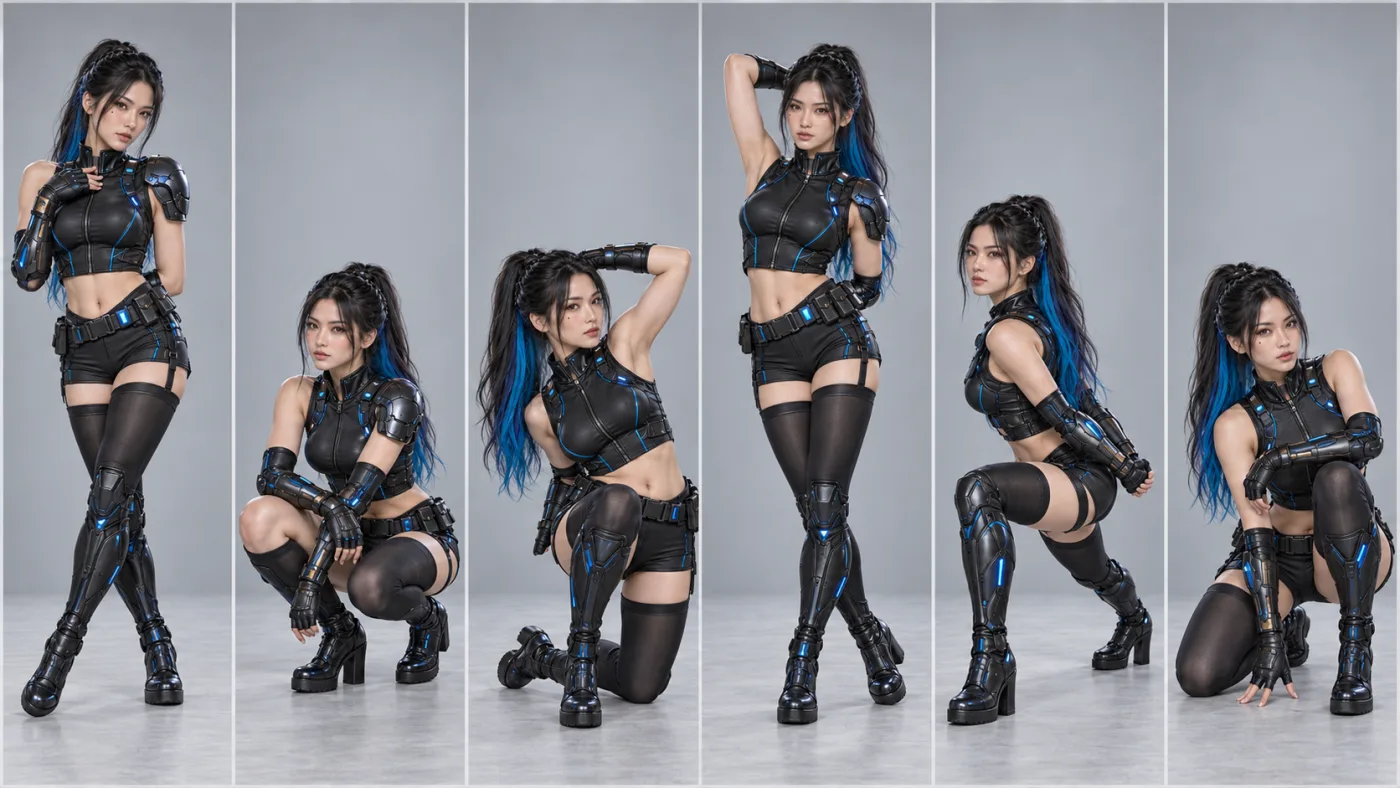
Use the attached casting master sheet as the ONLY identity and costume reference. Create a landscape 16:9 photorealistic pose reference sheet showing the SAME clearly adult fictional woman, age 27. DO NOT NAME THE POSES. Do not list them. Before generating the image, invent six original full-body poses yourself, then draw those six. Every pose must be difficult to explain and impractical, while still obeying all the rules below. IDENTITY LOCK, higher priority than any pose: same softly angular oval face, amber-brown eyes, small beauty mark below her left eye, long glossy black hair in a high braided ponytail with an electric-cyan underlayer and two face-framing strands, same adult athletic-curvy proportions. If a pose angle would distort the face, change the camera angle and keep the pose concept intact. Preserve the face before you satisfy the pose. EXPRESSION LOCK: keep her neutral or faintly deadpan in all six panels. Do not use smiling, laughter, surprise, fear, embarrassment, or strain to explain the difficulty of a pose. She performs each one with complete physical commitment and total seriousness. COSTUME LOCK: byte-for-byte the same in all six panels and identical to the attached reference. Sleeveless high-collar armored vest in midnight black with cobalt-blue seam piping, cropped bodysuit ending above the navel so a bare midriff stays visible, short fitted bottoms, black utility belt with pouches, one asymmetrical shoulder guard on her left shoulder, black gloves and segmented forearm bracers, opaque black thigh-high legwear, knee-high platform boots. Bare shoulders, bare upper arms. Keep the garment physically believable while she twists, kneels, bends, or balances. No panel may add sleeves, cover the midriff, move the shoulder guard, or change the outfit's color, material, or design. PHYSICAL REALISM: real joint limits, believable balance, readable weight distribution, muscle tension, and clear contact with the floor. Keep the head, hands, feet, and floor contact points inside the frame in every panel. No props — express each pose entirely through body position. LAYOUT: exactly six equal vertical panels in one clean row, full figure visible in each, generous gutters, neutral light-grey studio wall and a plain light studio floor that clearly shows contact points. Same camera distance, eye-level viewpoint, soft even lighting, and figure scale in every panel. The page must read as a serious art and anatomy reference sheet at first glance while the pose content stays deliberately useless. No overlap between panels. No bald or shaved head, no hairstyle changes, no extra characters, no cropped limbs, no text, labels, numbers, logos, or watermark.
Why it works: "identity lock, higher priority than any pose" is the sentence doing the work, because it resolves conflicts in the model's favour instead of leaving it to guess. Withdrawing the pose list moves the difficulty from choreography to compliance, and the neutral expression lock stops the model from paying for a strange pose by rewriting the face. The floor is part of the instruction too: without a visible ground plane the model floats the figure and the balance cues that make a pose readable are simply lost.
The costume lock is where this prompt failed first. Naming the garments as a category — “identical midnight-black pilot suit” — is not enough, and the model quietly grew sleeves and closed the bodysuit across panels while holding the face perfectly stable. Enumerating the exposed and covered skin instead, bare shoulders and a bare midriff as explicit invariants, is what stopped the drift. When the variable you are holding constant is a shape, describe the shape; when it is the presence of a shape, name the absences.
Keep the failure next to the fix
An abstract warning about drift teaches nothing, because the reader cannot tell whether the failure they are being warned about is the failure they already produced. The fix is to generate the failure on purpose. Render the same identity wearing the costume the loose prompt actually produces — sleeves that were never asked for, a bodysuit zipped to the throat, the midriff sealed — and you own an artifact you can put beside the corrected plate.
This is worth the extra generation because the failure is specific and diagnosable once you can see it. The face in the broken version is almost always perfect. That is the point: costume drift is silent, it does not announce itself through a face that has degraded, which is exactly why a loose prompt reads as a success until you compare the two plates side by side.
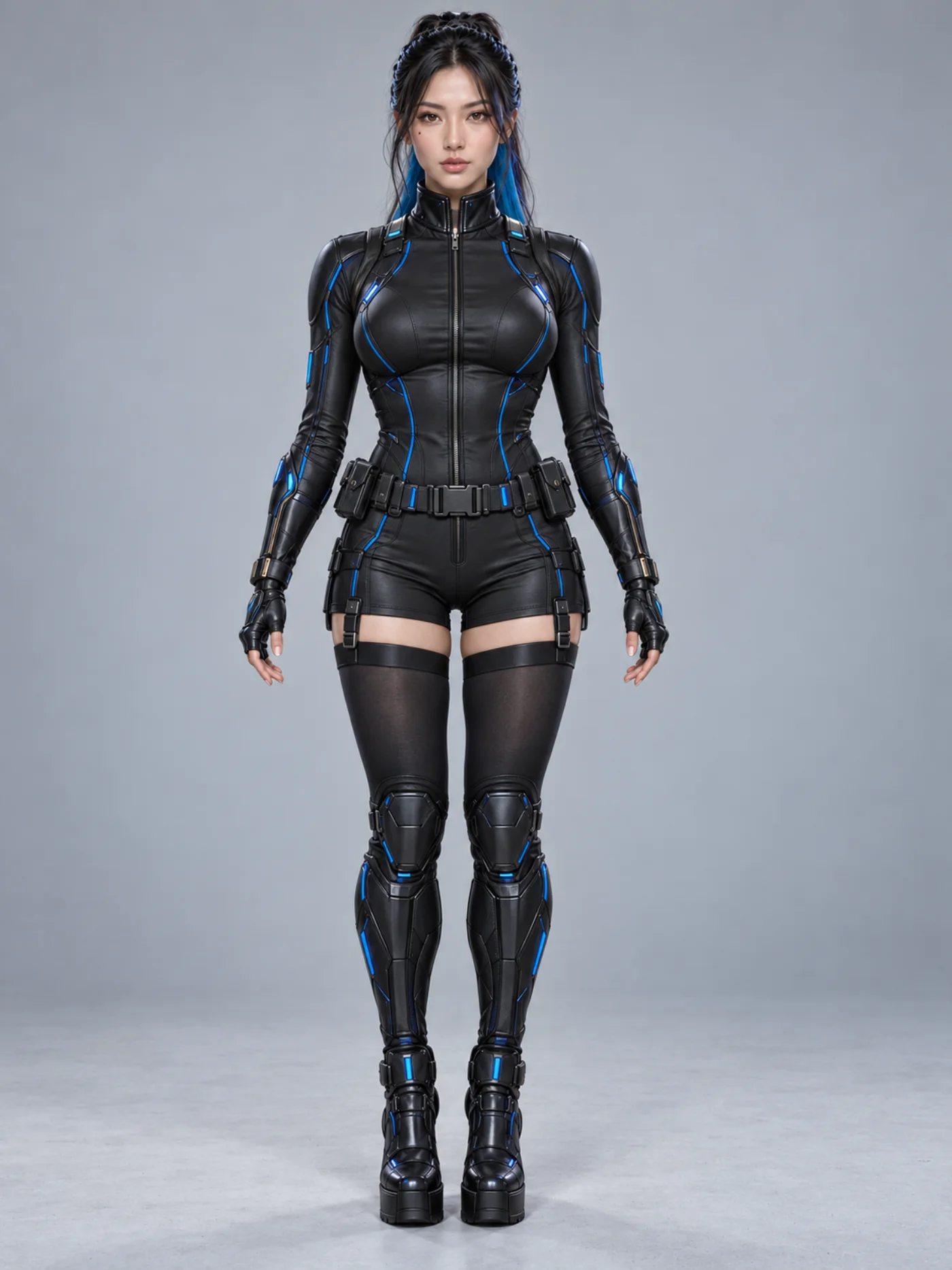
Use the attached casting master sheet as the ONLY identity reference. Create a single photorealistic full-body character plate of the SAME clearly adult fictional woman, age 27, wearing the WRONG VERSION of her costume. This image documents a failure on purpose. IDENTITY, keep this exact and unchanged: softly angular oval face, warm amber-brown eyes, a small beauty mark below her left eye, long glossy black hair in a high braided ponytail with an electric-cyan underlayer and two face-framing strands, adult athletic-curvy proportions. Her face must be the best, most faithful rendering in the image. Preserve it perfectly. WRONG COSTUME, and this is the subject of the image. Render the drift a loose prompt produces. She wears a midnight-black futuristic pilot suit that has grown features nobody specified: full-length tight sleeves covering her bare upper arms, and the bodysuit zipped all the way to the throat with the midriff completely sealed shut. No bare shoulders. No bare midriff. High collar, cobalt-blue seam piping, black utility belt with pouches, opaque black thigh-high legwear, knee-high platform boots. Add no shoulder guard. The failure to show is silent costume substitution: the face is perfect and the outfit is quietly wrong in a way no viewer would notice without the reference to compare against. FRAMING: single full-body figure, front-facing, feet together, arms relaxed at her sides, the entire figure visible from the top of her head to the soles of her boots with clear margin. She occupies the middle of the frame at a readable size. LIGHT AND BACKGROUND: soft even studio light, plain neutral light grey seamless backdrop, no props, no scenery. STYLE: premium photorealistic game-character concept photography, sharp focus, realistic skin and material detail. One single image, one single full panel. No text, labels, numbers, logos, watermark, grid, split layout, or multiple panels.
Why it works: it converts a warning into a comparison. Once both plates exist, the failure has a location — the shoulder line, not the jaw — and the reader can check their own output against it in seconds. The prompt also demonstrates that identity and costume drift independently, because the face is locked as faithfully here as in the corrected plate while the garment is wrong. That separation is the diagnostic value: when a generation looks fine and something is still off, knowing the face survives the error tells you to diff the costume block, not the identity block.
Isolate one attribute at a time
A pose sheet varies the body while holding the design fixed, which makes it a poor tool for extracting a single feature. These three cards do the opposite — they take one attribute off the character and present it as an object, so a later prompt can reference hair, wardrobe, or material without dragging the face along.
Hairstyle card
The hair must be built as a finished object. Without an explicit instruction to complete the crown, temple, and back-of-head structure, models often produce a fragment of hair floating in front of an empty cavity.
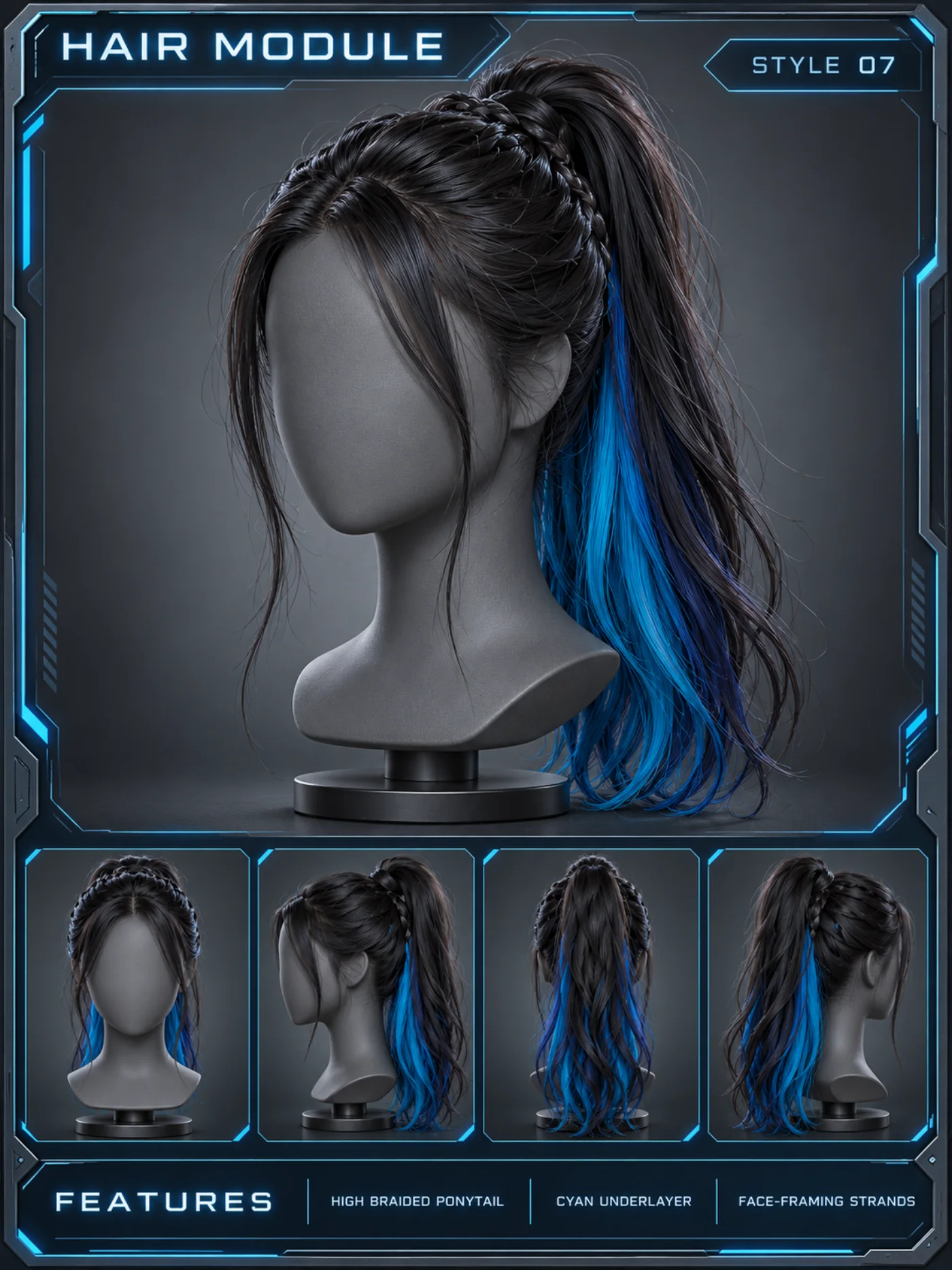
Use the attached casting sheet as the ONLY reference. Create a tall portrait 3:4 collectible reference CARD for a hairstyle. Extract ONLY the hairstyle from this same adult woman. Do not reproduce her face, expression, body, clothing or personality. The subject of the card is the hairstyle as a physical object. CRITICAL CONSTRUCTION RULE: the hairstyle must read as a complete, finished, three-dimensional wig sitting on a display head. It must NOT be a flat fragment of hair floating in front of a face. There must be no hollow face cavity, no transparent hole where a face would be. Complete the structure consistently: crown, hairline, temple, side, and the continuous flow from front to side to back. The hair must connect into one coherent object. DISPLAY HEAD: a plain, featureless, neutral matte pale grey mannequin head. No eyes, no eyebrows, no nose, no mouth, no eyelashes, no ears, no skin texture, no human character. It exists only to show the shape of the hairstyle, but it must have real three-dimensional volume at the crown, sides and back of the head. CARD LAYOUT, fixed: Top ten percent: the words "HAIR TYPE" in small clean uppercase letterspaced sans-serif, dark grey. Border: a heavy layered collector frame, brushed pewter metal with a thin warm gold inner line, engraved filigree in the corners. Restrained archive prop, not jewellery-store glitter. Left side, upper area: a small plaque reading "ARCHIVE 11". Right side: a narrow vertical panel reading "STYLE 07", letterspaced uppercase, top to bottom. Centre: the photorealistic wig on the mannequin head, large, filling about sixty percent of the card height, cropped cleanly with nothing cut off at the top or bottom. Bottom area: the word "FEATURES", and under it exactly three short lines: SHORT BOB CENTRE PART SOFT LAYER Bottom right: one small engraved star emblem, no lettering. The frame and ornaments must never overlap or cover the hair silhouette or the lettering. Legible, correctly spelled text only. No watermark.
Why it works: the construction rule is doing the work, not the layout. A prompt that says “hairstyle” reliably returns a fragment of hair with an empty cavity where a face should be, because hair is described as a pattern and the model has no reason to complete it as an object. Naming crown, hairline, temple, and the continuous flow from front to side to back gives it an inventory to close. The featureless display head is the second half of that fix: an object needs a body to sit on, and asking for a mannequin with no features removes the face the model otherwise drifts back toward.
Wardrobe card
Ghost-mannequin presentation removes the body while keeping the garment's shape. Requiring see-through openings is what stops the model filling the neck and arm holes with a body it was never given.
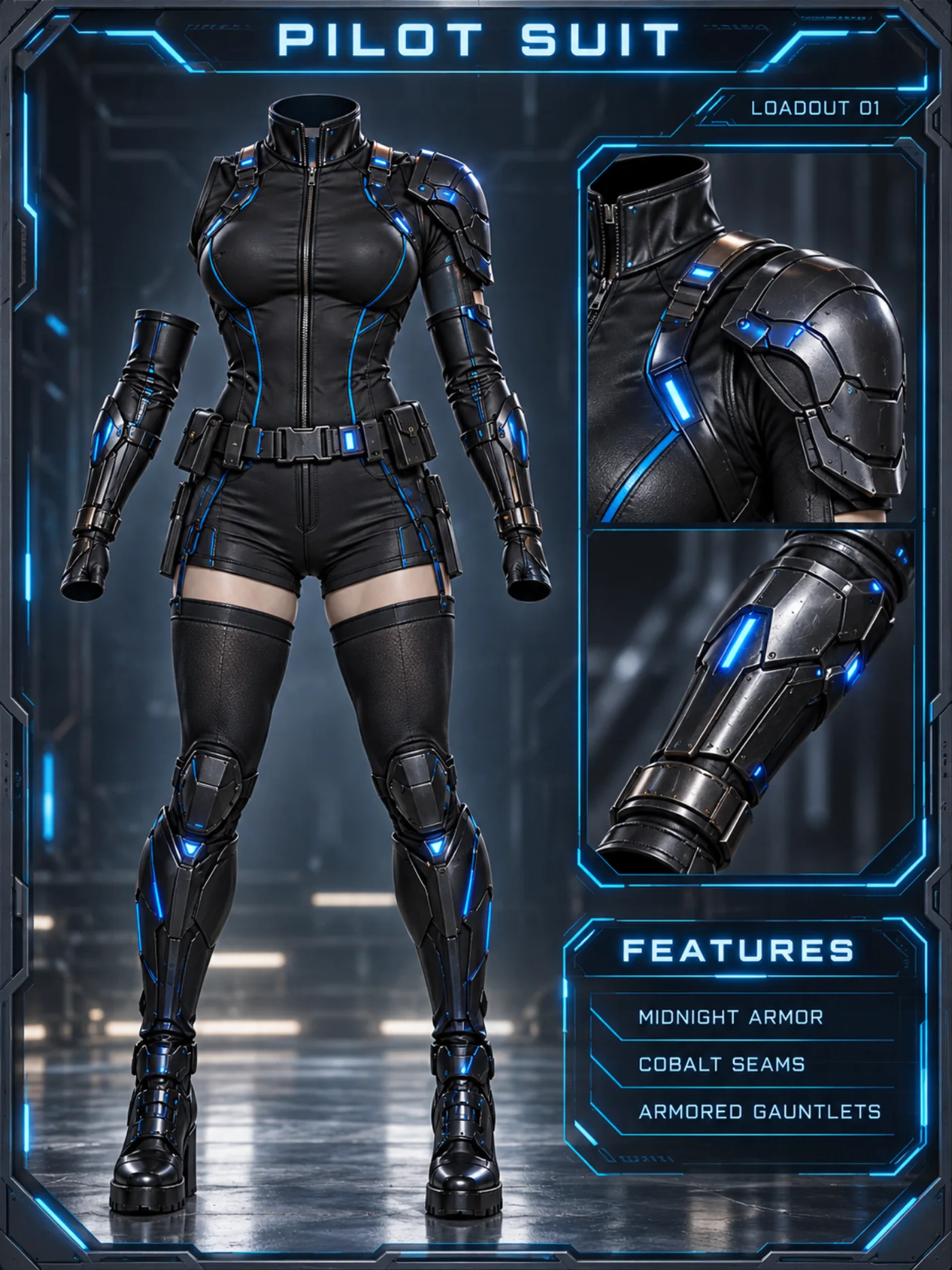
Use the attached casting sheet as the ONLY reference. Create a tall portrait 3:4 collectible reference CARD for a wardrobe set. Extract ONLY the clothing from this same adult woman. Do not show her face, head, hair, skin, hands, or any body part. The subject of the card is the garment set itself. THE GARMENT: a plain light oat-grey fitted short-sleeve crew-neck top and a matching plain oat-grey short, exactly as worn in the reference. Real fabric: fine cotton jersey with visible knit texture, natural seam lines at the shoulder, sleeve hem and waistband, soft believable folds and drape, slight natural wrinkling. No pattern, no print, no logo, no branding, no trim, no buttons, no zippers. PRESENTATION: ghost mannequin. The two pieces float in place as if worn by an invisible person, with the shoulders, sleeves and waistband holding their real shape. Completely empty neck opening, empty arm openings, empty leg openings. You must be able to see through the openings to the background. No body, no skin, no mannequin, no stand, no hanger. STYLE: high-end studio product photography of a real garment, seamless pale grey backdrop, soft even diffused light, natural realistic color, sharp focus on fabric texture, subtle contact shadow only. CARD LAYOUT, fixed: Top ten percent: the word "WARDROBE" in small clean uppercase letterspaced sans-serif, dark grey. Border: a heavy layered collector frame, brushed pewter metal with a thin warm gold inner line, engraved filigree in the corners. Restrained archive prop, not jewellery-store glitter. Left side, upper area: a small plaque reading "ARCHIVE 19". Right side: a narrow vertical panel reading "SET 02", letterspaced uppercase, top to bottom. Centre: the garment, large, filling about sixty percent of the card height, cropped cleanly with nothing cut off. Bottom area: the word "FEATURES", and under it exactly three short lines: OAT GREY SHORT SLEEVE MATCHING SET Bottom right: one small engraved star emblem, no lettering. The frame and ornaments must never overlap or cover the garment silhouette or the lettering. Legible, correctly spelled text only. No watermark.
Why it works: the see-through requirement is the whole card. A ghost mannequin is a contradiction the model resolves by inventing a wearer, because a garment floating in space has no cue telling it not to. Saying you must be able to see through the neck, arm, and leg openings to the background gives it a test it can fail visibly, which is far more reliable than listing body parts to exclude. Declaring the real fabric in the same breath as the negative is what keeps the result a product photograph instead of a costume sketch: “fine cotton jersey with visible knit texture” and “no body, no mannequin” are solving opposite halves of the same problem.
Material swatch card
Identity is partly material, and material is the first thing a model gives up when it has to fit a new composition. Specify a garment by name and you get that garment's default fabric; specify its weave, its coating, and how light sits on it and you get the one that was in the reference. This card is a macro, not an object, so it isolates surface rather than shape.
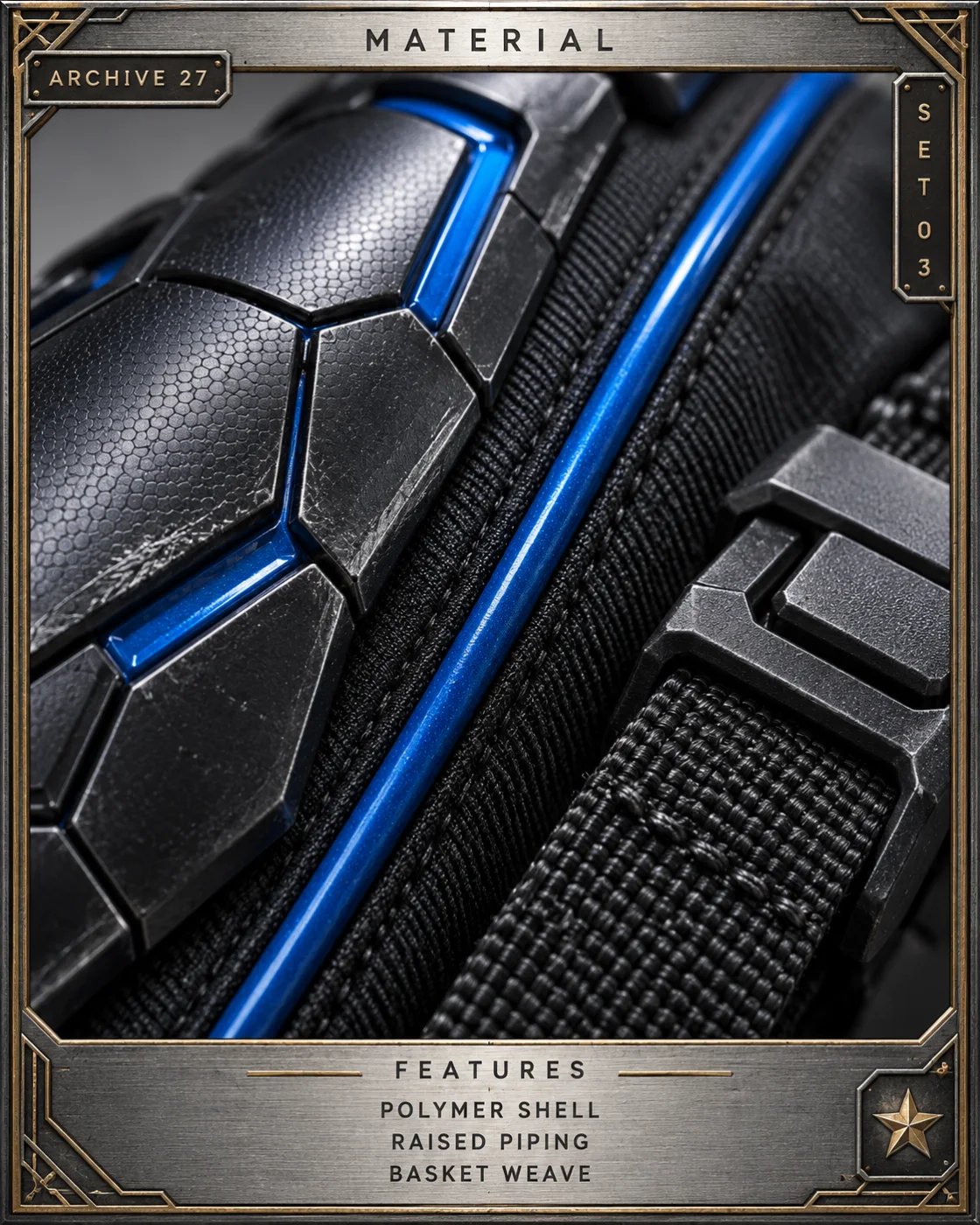
Use the attached casting sheet as the ONLY reference. Create a tall portrait 4:5 collectible reference CARD for a set of materials. Extract ONLY the surface treatment from this same adult woman's costume. Do not show her face, head, hair, eyes, or any skin. The subject of the card is three material samples shot as one continuous macro study. THE SAMPLES, arranged as one continuous extreme close-up running diagonally across the card: 1. A hard-shell shoulder guard panel in dark midnight charcoal polymer, hexagonal micro-faceted surface, visible molding seams, two flush cobalt-blue accent channels inset into the shell, a shallow scuff on one edge. 2. Cobalt-blue seam piping where two panels of matte black stretch woven fabric meet, the piping a raised glossy cord about three millimeters wide, the fabric's fine diagonal knit clearly resolved with individual yarn structure visible. 3. A black utility belt with a matte polymer buckle and a stitched webbing loop, the webbing showing a tight basket weave and a single row of tonal stitching. CRITICAL CONSTRUCTION RULE: this must read as real photographed material at high magnification, not as fabric swatches or vector illustration. Real material response to light: a broad soft specular roll off the polymer shell, a tighter sharper highlight on the glossy piping, and light scattering softly inside the woven fabric. No flat shading, no drawn outlines, no uniform plastic sheen, no cartoon rendering. DEPTH: shallow macro depth of field. The nearest material is critically sharp; the samples further along the diagonal fall progressively out of focus. No surface is fully blurred and no surface is rendered flat. LIGHT: soft directional studio light raking across the surfaces at a low angle to reveal weave and molding texture, subtle gradient falloff toward the frame, neutral light grey seamless background behind the samples. CARD LAYOUT, fixed: Top ten percent: the word "MATERIAL" in small clean uppercase letterspaced sans-serif, dark grey. Border: a heavy layered collector frame, brushed pewter metal with a thin warm gold inner line, engraved filigree in the corners. Restrained archive prop, not jewellery-store glitter. Left side, upper area: a small plaque reading "ARCHIVE 27". Right side: a narrow vertical panel reading "SET 03", letterspaced uppercase, top to bottom. Centre: the macro material study, large, filling about sixty percent of the card height, cropped cleanly with nothing cut off. Bottom area: the word "FEATURES", and under it exactly three short lines: POLYMER SHELL RAISED PIPING BASKET WEAVE Bottom right: one small engraved star emblem, no lettering. The frame and ornaments must never overlap or cover the material samples or the lettering. Legible, correctly spelled text only. No watermark.
Why it works: the card asks for a lighting response rather than a texture, because “matte fabric” and “glossy cord” describe intent while the specular roll, the tighter highlight, and the light scattering inside the weave describe the thing itself. That distinction is what survives into a later generation; adjectives about finish get averaged away. Shallow depth of field is doing structural work here too — it tells the model this is one continuous photographed scene, which is what stops it laying out three flat swatches in a row.
Prove the sheet leaves the studio
Every reference plate on this page sits on neutral grey, and that is a real limitation: grey seamless tells you the character is consistent but not that the reference survives contact with a scene. A sheet that only works under studio light is a diorama, not a production asset. The proof is a single frame with uncontrolled background, uncontrolled lighting, and the same identity lock doing its job.
The interesting failure mode is that the model treats a real environment as licence. Busy backgrounds pull the palette, coloured practical lights tint skin, and the face that was neutral grey a moment ago picks up a cyan cast from a sign. Carrying the identity lock into a cinematic frame is the test that matters, and it is also the frame you will actually ship, so the reference sheet and the deliverable stop being separate artifacts.
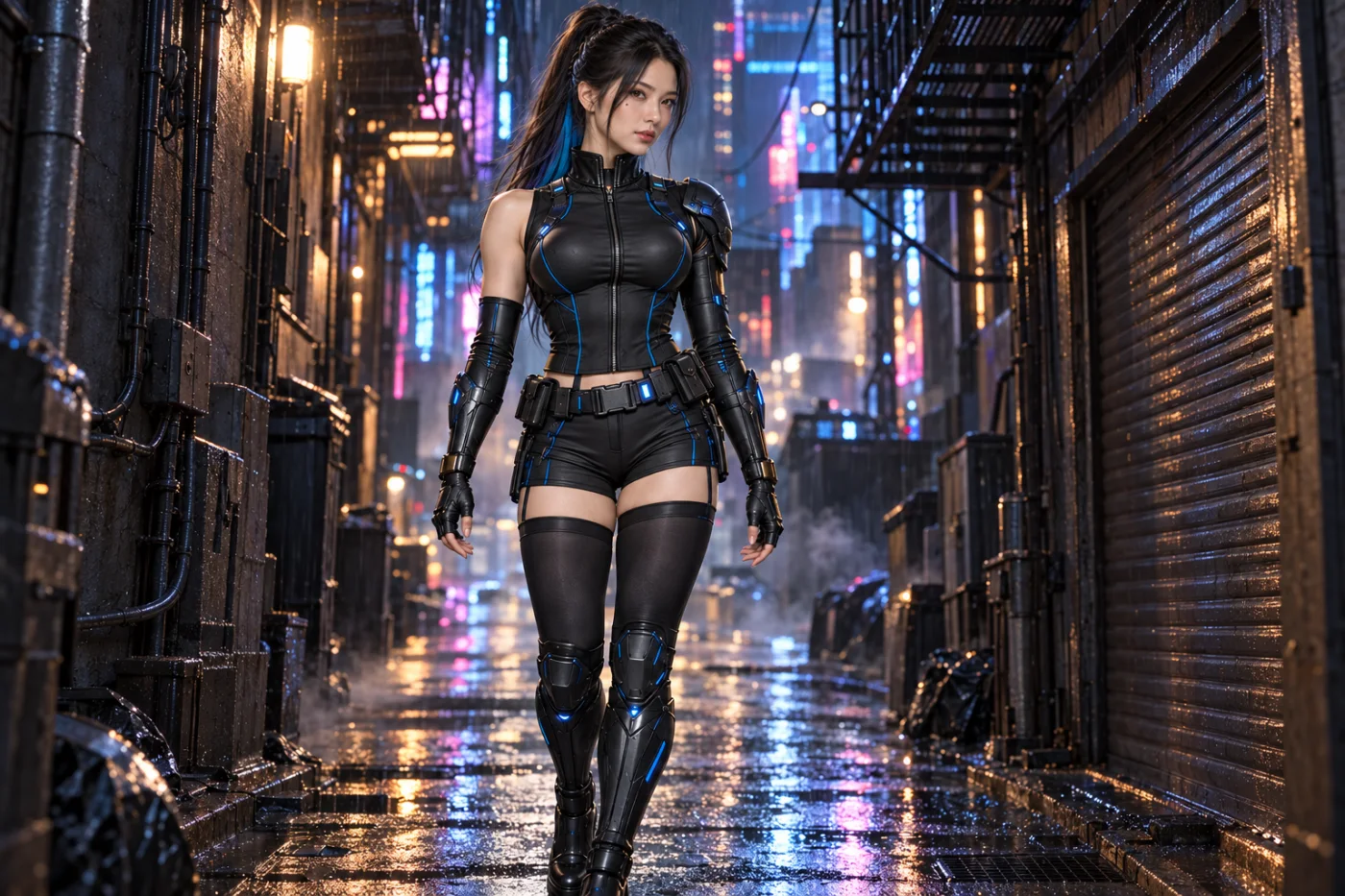
Use the attached casting master sheet as the ONLY identity and costume reference. Create a single cinematic 3:2 frame of the SAME clearly adult fictional woman, age 27. CHARACTER LOCK: softly angular oval face, warm amber-brown eyes, a small beauty mark below her left eye, long glossy black hair in a high braided ponytail with an electric-cyan underlayer and two loose face-framing strands, adult athletic-curvy proportions. COSTUME LOCK: byte-for-byte the same as the attached reference and identical in every visible respect. Sleeveless high-collar armored vest in midnight black with cobalt-blue seam piping, cropped bodysuit ending above the navel so a bare midriff stays visible, short fitted bottoms, black utility belt with pouches, one asymmetrical shoulder guard on her left shoulder, black gloves and segmented forearm bracers, opaque black thigh-high legwear, knee-high platform boots. Bare shoulders, bare upper arms. Fully clothed. No panel, inset, split, or second figure may alter the outfit. EXPRESSION LOCK: neutral and faintly deadpan, mouth closed. She is not posing for anyone. No smile, no strain, no theatrical intensity. SCENE: a narrow rain-wet service alley at night in a dense cyberpunk city. Wet asphalt reflecting signage, a steel fire escape overhead, exposed conduit and ducting on the walls, a rusted roller shutter, standing rainwater in the gutters, light rain falling. She stands at a three-quarter angle to camera, weight settled, mid-step, filling the middle of the frame head to boots. SKIN PROTECTION, the part that is easy to miss: her skin tone stays warm ivory. The neon is coloured but it must not colour her. Keep a neutral soft key light on her face and body so the ambient practicals read as background only. No cyan or magenta cast on her skin, no colour spill on her costume that changes the black or the cobalt. STYLE: premium photorealistic game key art, cinematic depth, natural atmospheric haze, filmic contrast, realistic wet-surface reflections and skin. She is the sharpest and most detailed element in the frame; the background falls slightly out of focus. One single image, one single full frame. No text, letters, labels, numbers, readable signage, logos, UI, or watermark. No inset panels, no split layout, no before-and-after, no character sheet grid.
Why it works: the skin-protection clause exists because colour spill is the failure nobody predicts. Everything else in the frame can be wrong and the character still reads correctly; a face that has gone cyan from a nearby sign is an unusable asset, and the model treats a saturated environment as an invitation to unify the palette. Naming the failure explicitly — coloured practicals must stay background — is the same technique as the costume lock in the pose section: describe the absence you need when the environment is pushing against it. The focus instruction matters for the same reason, since a subject that shares the background's sharpness reads as part of the scenery rather than as the character you built.
A prompt order for reference sheets
Each example above follows the same sequence. Keeping the order stable makes a drifted result easy to diagnose.
| Prompt block | Specify | Example |
|---|---|---|
| Source of truth | Which attachment is the identity reference | “Use the attached casting sheet as the ONLY identity reference” |
| Identity lock | Which features cannot drift between panels, and what wins a conflict | “Identity lock, higher priority than any pose… change the camera angle and keep the pose” |
| Extraction scope | What to keep, and what to remove | “Extract ONLY the hairstyle… do not reproduce her face” |
| Invariants | Features that must not change | “No color change, no material change, no seam” |
| Structure | Panel count, grid shape, anchor cell | “Exactly twenty-four panels, six columns by four rows” |
| Register | The specific variation to explore | “Small, believable variations within ONE family” |
| Copy budget | Every literal string, quoted in full | “FEATURES / SHORT BOB / CENTRE PART / SOFT LAYER” |
| Craft terms | Frame, material, and finish | “Brushed pewter metal with a thin warm gold inner line” |
| Failure plate | The wrong output, generated on purpose, so drift has a location | “Render the drift a loose prompt produces… her face must be the perfect part” |
| Constraints | Likely scene-specific failures | “No watermark”, “no hollow face cavity” |
| Environment guard | What a background is allowed to change, and what it is not | “The neon is coloured but it must not colour her… no cyan cast on her skin” |
The copy budget is the row that matters most for the card format. Quote every string you expect, keep the count low, and specify case and alignment. Leaving card text to the model produces invented labels on the first attempt and a re-roll on the second.
Register the character, then invoke it by name
A sheet you have to re-attach every time still costs a decision each round. In ChatGPT you can do better: create a project scoped to project-only memory, open a first chat, upload the master sheet, and register the character with a single line naming it and pointing at that image. Every later chat in the project then inherits the definition, and you refer to the character by name inside any prompt.
Two details decide whether this works. Register the character only after you are satisfied with the master sheet, because anything generated from a face you dislike inherits the same flaw. And when you drop the character into someone else's prompt, wrap rather than edit — ask for the prompt's protagonist to be replaced with your named character, leaving the rest of the text untouched.
Where a project is not available, the same effect comes from attaching the relevant card to each prompt. The name is convenience; the attachment is what carries the likeness.
WIP sources and attribution
The casting-sheet structure follows MrGafish’s character master prompt, including the per-feature negatives and the cross-cell consistency rule, and the project-memory registration method follows their follow-on workflow post. The preserve-list and change-list split, the identity-anchor panel, and the reference-card layouts come from tonomisugi's character sheet template, expression sheet template, hairstyle card, and costume card. The invented-pose method — withholding the pose list, locking the expression, and ranking identity above pose complexity — follows tonomisugi's pose collection template.
These prompts and images were created independently for PromptGenius; the cited posts informed the techniques, not the depicted character or scenes. Generated faces drift between runs, so treat every sheet as a starting reference and regenerate when a panel breaks. For related GPT Image 2 work, see photorealism prompts, art styles and media, and the full GPT Image 2 collection.
Related Articles & Guides
 #gpt-image-2
GPT Image 2 Typography Poster Prompts
Create GPT Image 2 posters with real rendered text — letterform grounds, Swiss grids, archival hierarchy, signage, covers, and event key art.
 #gpt-image-2
GPT Image 2 Art Style and Media Prompts
Explore original GPT Image 2 art prompts for paper collage, oil pastel, sumi-e ink, felted wool, palette-knife oil, and botanical watercolor, with reusable techniques.
 #gpt-image-2
GPT Image 2 Photorealism Prompt Guide
Create more believable GPT Image 2 photos with concrete camera, lighting, material, framing, and imperfection cues instead of generic realism keywords.