GPT Image 2 Candid Street & CCD Photography Prompts
Shoot candid street and CCD-style photos with GPT Image 2 using direct flash, a night-street master template, film-stock color, and scene transfer.
Candid street photography fails when you describe it with adjectives. "Retro", "gritty", and "film look" produce a costume party, not a photograph. What makes the genre work is a small number of physical behaviours: how the light separates the subject from the background, how the background moves, and whether the subject seems to have been caught mid-thought.
The prompts below are organized into two families that share that logic. The night-street family uses on-camera flash to cut a lit subject out of a dark, moving city. The daylight family imitates a specific camera and film pairing, then earns its mood from an ordinary object in the scene rather than from style words.
Two families of light
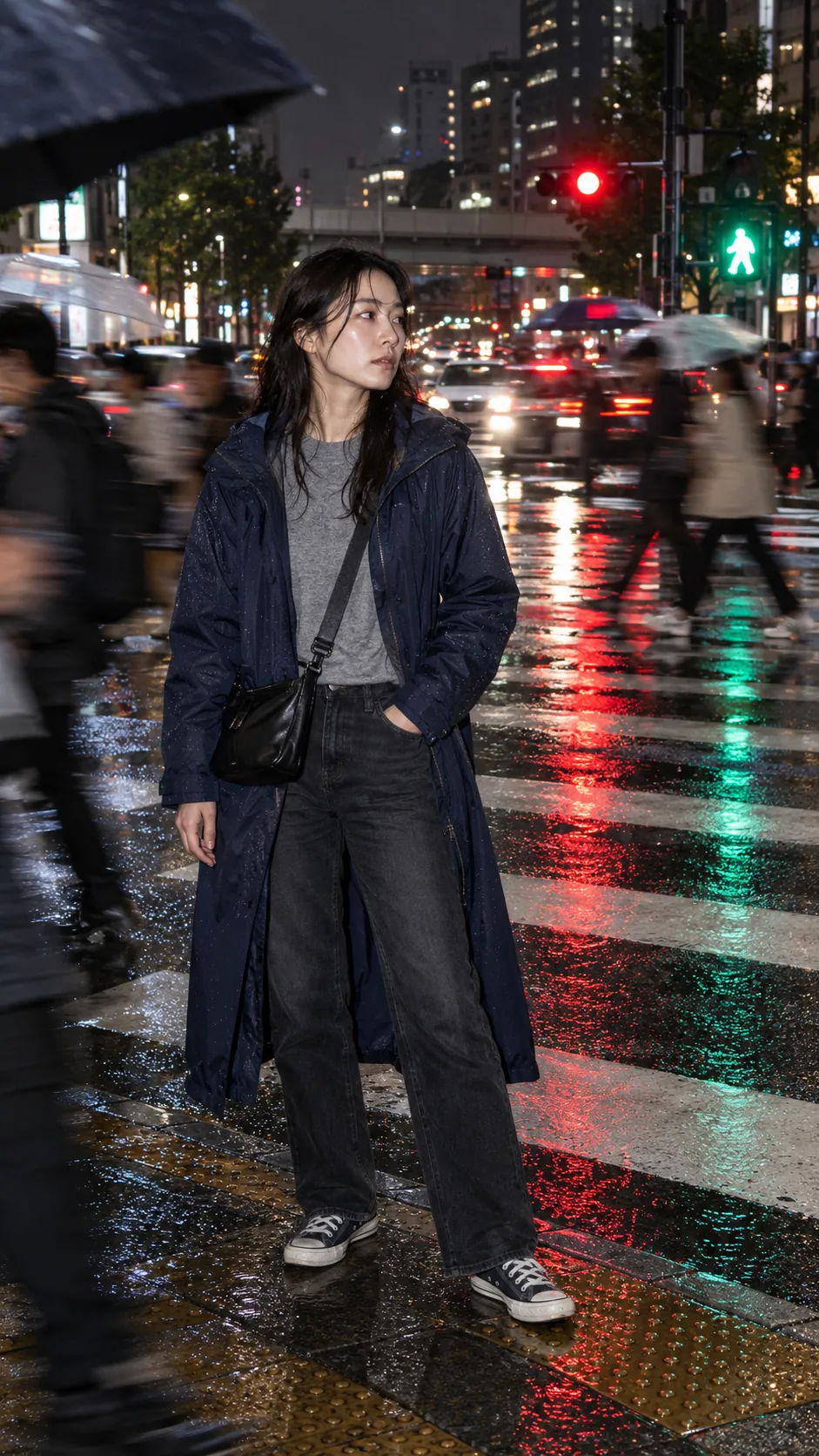
Direct flash at night. The flash fires at the subject and falls off fast, so her face and jacket are bright while the city behind stays several stops down. Umbrellas, headlights, and wet asphalt carry motion blur. The result reads as a friend with a compact camera catching you at a crossing, not as a portrait session.
Film-stock pairing by day. Here you name a camera and a stock together — a Ricoh GR III with the HDF tonal curve, or a GR III graded toward Fujifilm Pro 400H — and then describe its behaviour: highlight diffusion, halation around every light source, low contrast, blown highlights, fine grain. Nothing about that needs flash.
Both approaches work because they specify light physics instead of nostalgia.
The five-point night-street master
A widely circulated rainy-night street breakdown distills the night version into five transferable relations. They are worth keeping because each one is a decision rather than a mood.
- Build the mess before the person. Traffic, crowds, umbrellas, neon, signal heads, shop signs, wet reflections, foreground occlusion. A high-information background is what makes the subject read as present in the location.
- Subject still, city moving. Name motion blur explicitly for background pedestrians and vehicles while stating the subject stays sharp. Two speeds in one frame is the whole trick.
- Let the flash do the separating. Not mood lighting — a hard near light against a dark deep background, with the split stated in the prompt.
- Keep the pose accidental. "Just looked back", "just adjusted her jacket". Looseness reads as chance; a described pose reads as a shoot.
- Keep only the cheapest identity anchors. Three or four features are enough for the reader to place her. Everything else is free.
Compress those into five words: city messy, subject still, flash hard, background moving, pose loose.
Six prompts
Rainy crossing, direct flash
The canonical case. The city carries all the visual noise, the subject does nothing interesting, and the flash creates the separation.
9:16 vertical, CCD direct-flash documentary street photography. A busy signalised crossing in a mid-size East Asian city, twenty minutes after the rain stopped. Wet asphalt throws back red and green from the signal heads and shop signs; headlights smear into soft horizontal streaks; umbrellas pass through the near field, one cutting across the top-left corner as a dark out-of-focus shape. Crowds are still crossing. Behind the subject, traffic and pedestrians carry visible motion blur and light trails, so the background reads as moving water while the foreground holds still. The flash fires straight at the subject from about two metres, lighting her face, shoulders, and the front of her jacket while the city behind stays several stops darker. Keep that split explicit: bright near subject, murky deep background. Fine grain, slight highlight bloom on wet skin, low contrast in the shadows, natural digital-camera colour with a faint cool cast. The subject is a clearly adult woman in her late twenties, standing at the kerb edge with her weight on one leg, head turned toward the crossing signal rather than the camera. Full-length navy rain shell over a plain grey crewneck, straight dark jeans, canvas sneakers, a small crossbody bag. Hair damp at the ends. One hand loose at her side, the other halfway into her jacket pocket. She is mid-glance, not posing: shoulders slightly uneven, weight shifted, expression neutral and a little tired. Keep the frame candid. No logo, no readable signage, no watermark, no border, no beauty retouching, no plastic skin, no motion blur on the subject, no extra limbs, no distorted hands.
Why it works: the background is specified before the person appears, and the flash distance is given in metres. "Bright near subject, murky deep background" tells the model which of the two zones gets the light, which is the instruction that separates this from an evenly lit night portrait.
Convenience store at night, HDF halation
The daylight-family logic applied after dark. Camera and stock are named as a pair, and one ordinary object carries the story.
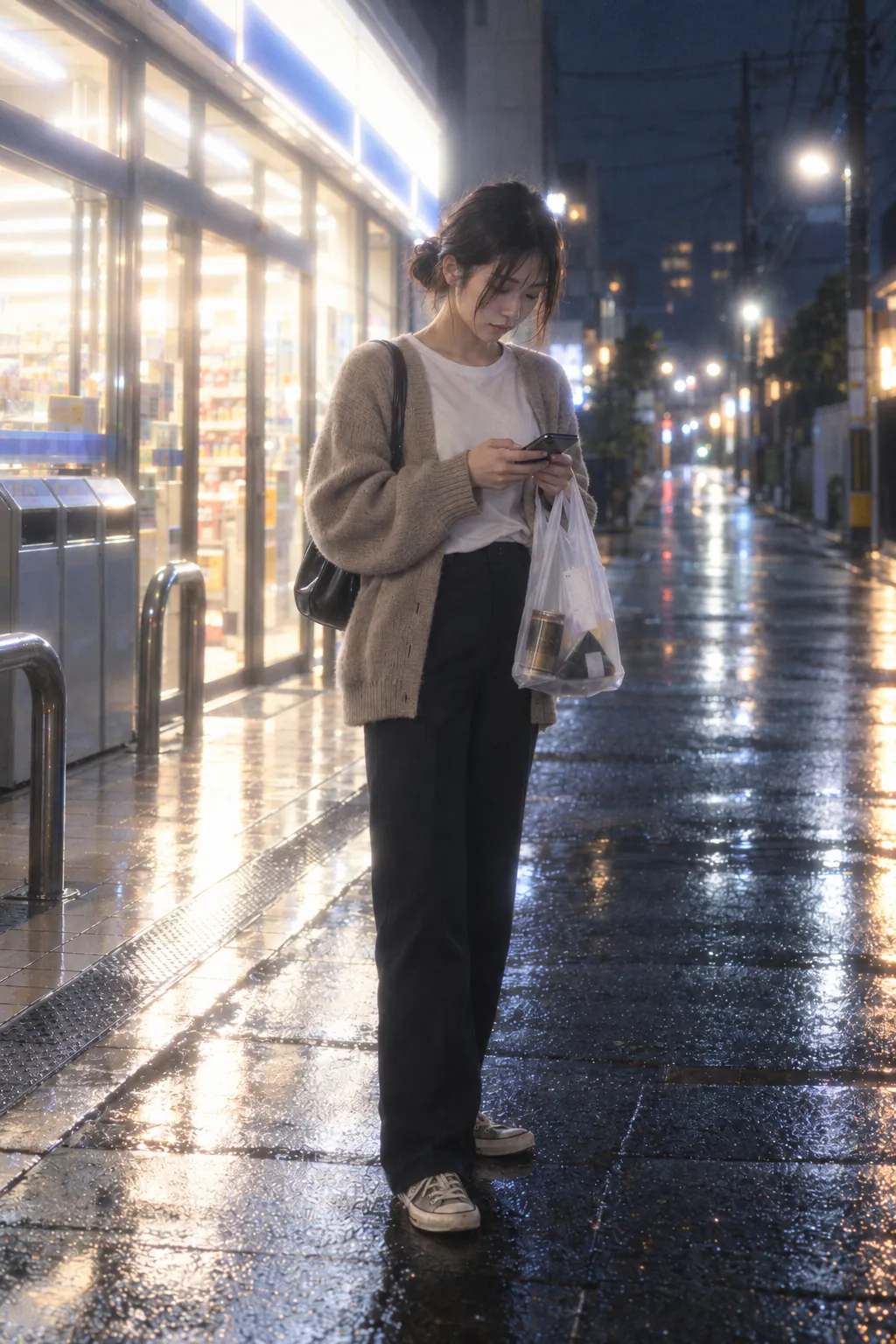
Photorealistic Japanese street-fashion portrait, vertical 2:3, eye-level full-body, shot on a Ricoh GR III with the HDF tonal curve. Very strong highlight diffusion: glowing halation blooming around every light source, dreamy highlight spill, low overall contrast, slight overexposure where the sign meets the sky, cool bluish-grey night tones warming where skin catches the light, pronounced film grain and high-ISO texture. A clearly adult woman in her mid-twenties stands alone on wet pavement outside a Japanese convenience store after closing hours. She wears a loose oat-coloured cardigan over a white tee, straight dark trousers, worn canvas shoes, and a thin shoulder bag. Her hair is loosely tied, with stray strands across her face. She is looking down at her phone, not at the camera. She carries one transparent convenience-store plastic bag with a canned coffee, a rice ball, and a receipt visible inside. The storefront is bright behind her: fluorescent spill across the pavement, shelves legible through the glass, a recycling bin near the door, wet reflections stretching toward the camera, the street behind her empty and fading to dark. Mood: late-night, faintly lonely, entirely ordinary. The kind of photo a friend takes because the light was good. Negative prompt: harsh digital sharpness, plastic skin, doll face, blown highlights with no halation, extra fingers, distorted hands, extra limbs, readable signage or text, watermark, blurry face, low quality, oversaturated neon.
Why it works: halation is requested as behaviour, not as a word — bloom, spill, low contrast, overexposure where the sign meets the sky. The plastic bag with a canned coffee is doing narrative work that no adjective could do, and the negative block bans blown highlights specifically so the halation survives.
Last train, two people
Two subjects stay separable because the prompt assigns distinct styling to each and scripts where the hands are.
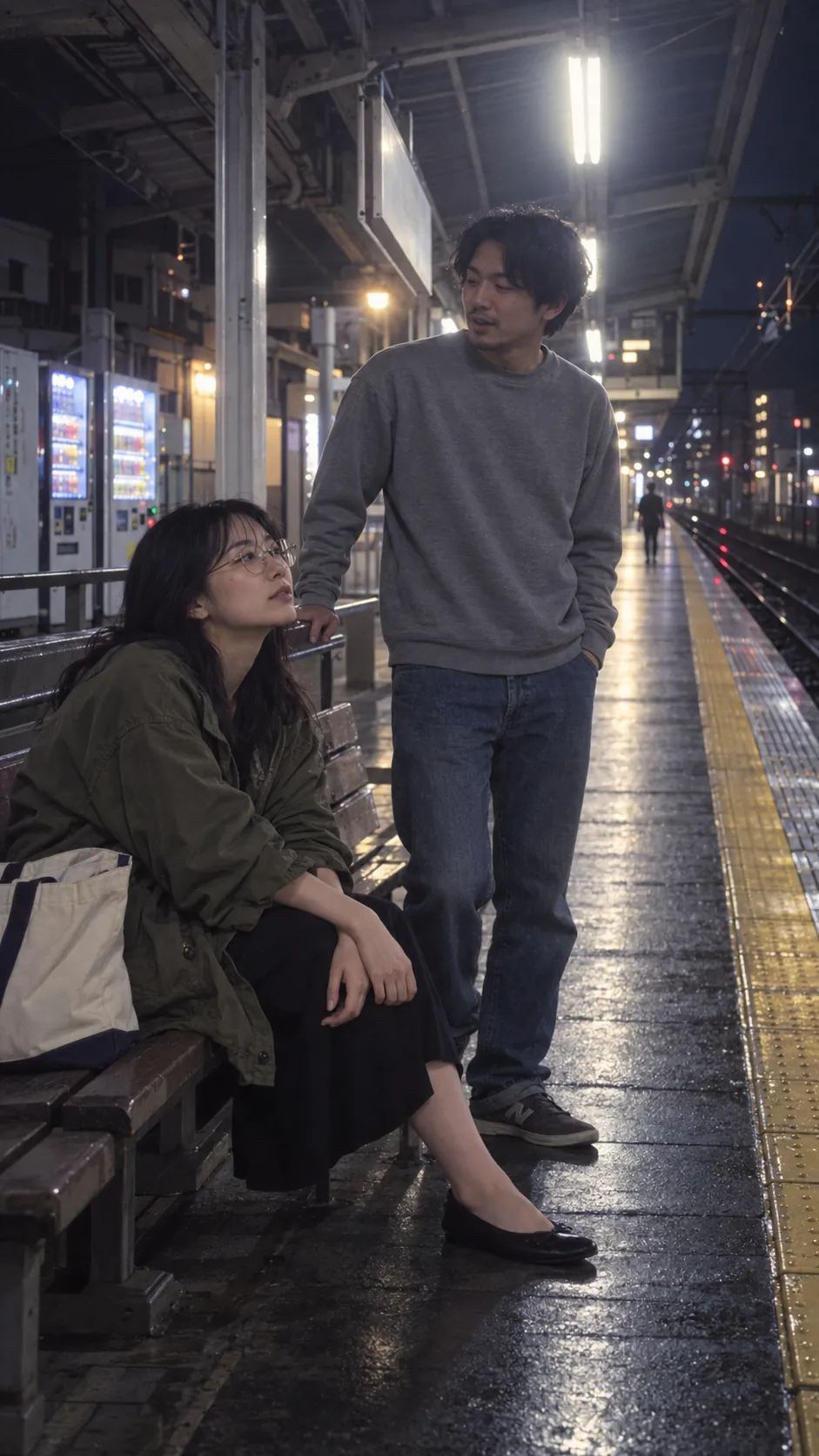
Photorealistic Japanese photobook aesthetic, vertical 9:16, eye-level, medium-full framing of two people on a late-night train platform. Ricoh GR III HDF rendering: pronounced glowing halation around the platform lights, soft bloom, low contrast, cool purplish-grey shadows, cinematic film grain, nostalgic Japanese cinema mood. Subject A is a clearly adult woman in her late twenties, seated on a station bench in an oversized olive work jacket, straight dark hair, thin gold wire-frame glasses, flat shoes, a canvas tote on the bench beside her. She has one leg extended, her forearms resting on her knees, looking up and slightly away. Subject B is a clearly adult man in his early thirties, dark hair, a grey crewneck and jeans, standing beside the bench, turned three-quarters toward A, one hand resting lightly on the far end of the bench. He is mid-sentence, mouth slightly open, not looking at the camera. Background: yellow tactile paving running the length of the platform, a row of softly glowing vending machines, a station sign, empty rails, one blurred commuter figure far down the line with light trails. Dim, quiet, a little humid. Mood: the ordinary comfort of ending a day together. Candid, not romanticised. Negative prompt: extra people in the foreground, extra limbs, distorted hands, plastic skin, harsh digital sharpness, legible signage text, watermark, heavy bokeh, blown halation, oversaturated colour, cgi look.
Why it works: each subject gets one unshared styling anchor — glasses and olive jacket against grey crewneck — so the model cannot merge them. Scripting the hands (forearms on knees, one hand on the bench end) is what carries the relationship without a described embrace.
Summer street, backlit daylight
No flash, no night. The whole look comes from a stock pairing and a rim of light.
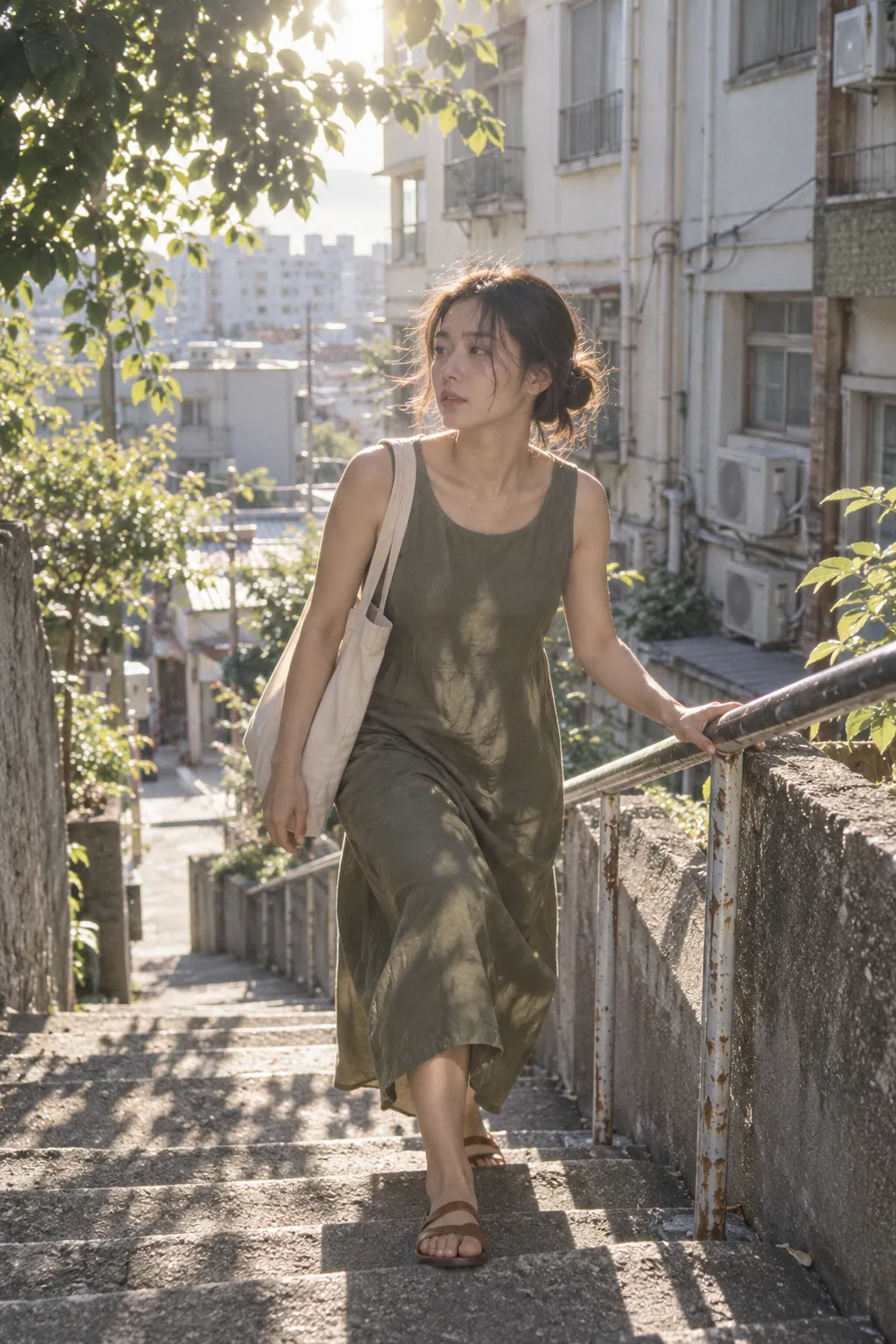
Photorealistic candid summer street portrait, vertical 2:3, full body at eye level, natural perspective, captured on a Ricoh GR III graded toward Fujifilm Pro 400H. Low contrast, muted faded colour, soft highlight bloom, visible grain, gentle halation in the brightest patches. A clearly adult woman in her late twenties walks up an outdoor concrete staircase beside an old apartment block. She wears a plain olive sleeveless dress, flat leather sandals, and a canvas tote over one shoulder; her hair is tied back and moving in the breeze. She is caught mid-step on the third stair, one hand on the rail, not looking at the camera. Warm afternoon sun comes from behind and slightly above her, so her hair and shoulders carry a thin bright rim. Dappled leaf shadows fall across her dress, legs, and the concrete. The background is a soft, shallow-focus wall of windows, air-conditioning units, and a bit of sky. Mood: an ordinary good afternoon, remembered more than photographed. Negative prompt: runway posing, deliberate fashion pose, extra limbs, distorted hands, plastic skin, beauty retouching, oversaturation, harsh digital sharpness, legible signage, watermark, cgi sheen.
Why it works: the stock is given as a pairing and then immediately translated into observable behaviour. "Caught mid-step on the third stair" plus "not looking at the camera" is enough to prevent the posed fashion frame that otherwise takes over this kind of prompt.
Bicycle at the school gate, flash in daylight
Flash is not only a night tool. Firing it in full daylight is what produces the flat-bright subject against a darker background in a casual snapshot.
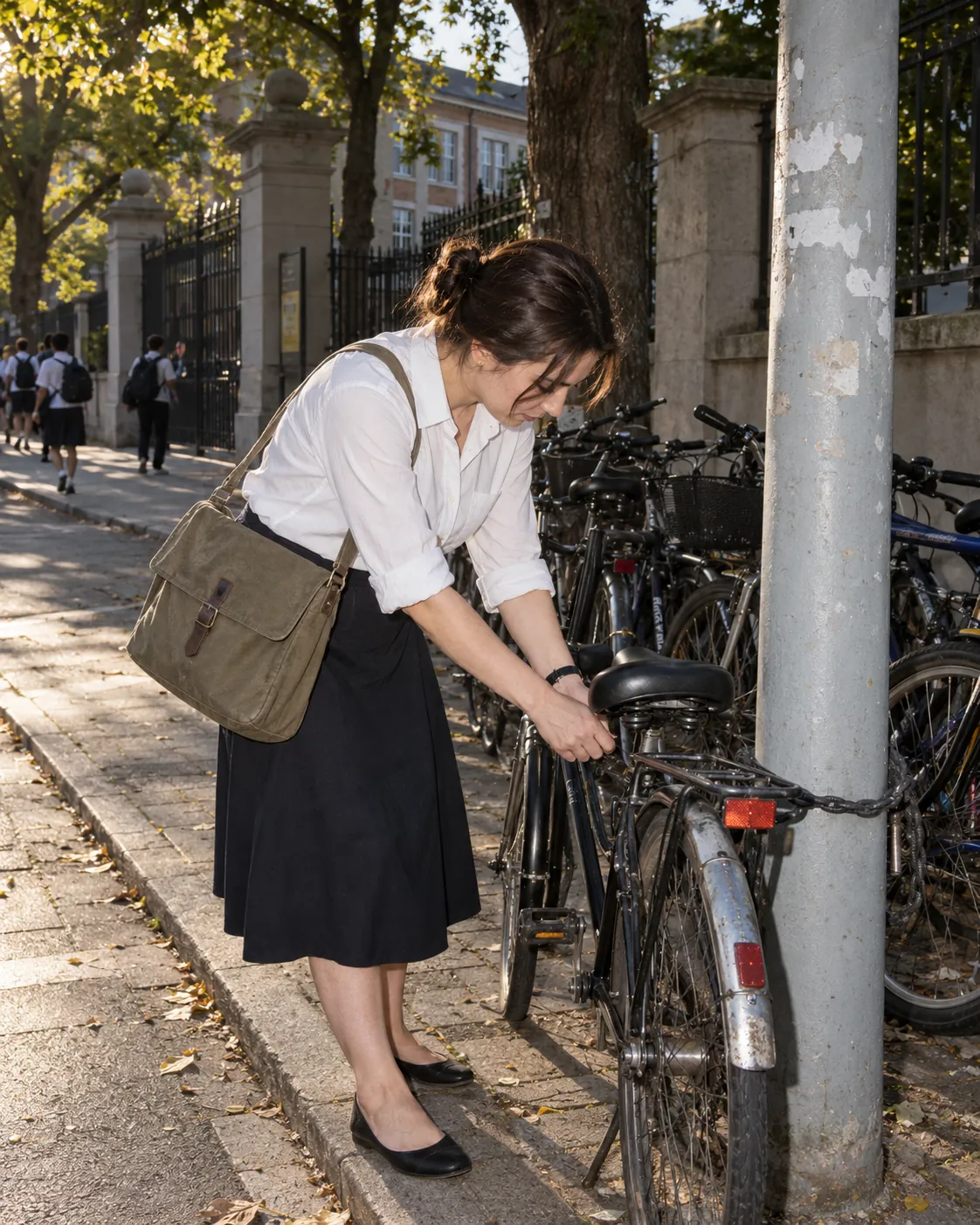
4:5 vertical, direct-flash documentary photography in full daylight. A quiet street outside an old school gate in late afternoon. A row of bicycles stands along a low wall; one bicycle leans against a utility pole in the near field. The subject is a clearly adult woman in her thirties, a teacher on her way home, wearing a plain white shirt with rolled sleeves, a dark skirt, and flat shoes, with a canvas satchel over one shoulder. The on-camera flash fires at about three metres and lights her directly against the daylight: her face, shirt, and the front of the satchel are bright and clear while the background falls off noticeably darker, keeping some detail in the trees and gate behind her. Slight highlight bloom on the white shirt, fine grain, low shadow contrast, natural colour. She is crouched slightly to unlock her bicycle, one hand on the saddle, the other at the lock, looking down at the mechanism. It is a working moment, not a portrait. Mood: ordinary, unposed, the small ritual of leaving work. Negative prompt: glamour pose, direct eye contact, extra limbs, distorted hands, plastic skin, beauty retouching, blown highlights, motion blur on the subject, readable signage or school name, watermark, cgi look, flash falloff into pure black.
Why it works: the flash distance and the background falloff are both stated, which is what stops the model from rendering an evenly lit portrait. Naming a task — unlocking a lock — gives the hands something to do and removes the need to describe a pose.
Shopping mall, telephoto instead of flash
The same subject and framing, moved to a new location, with the light technique swapped. This is the move that turns one prompt into a family.
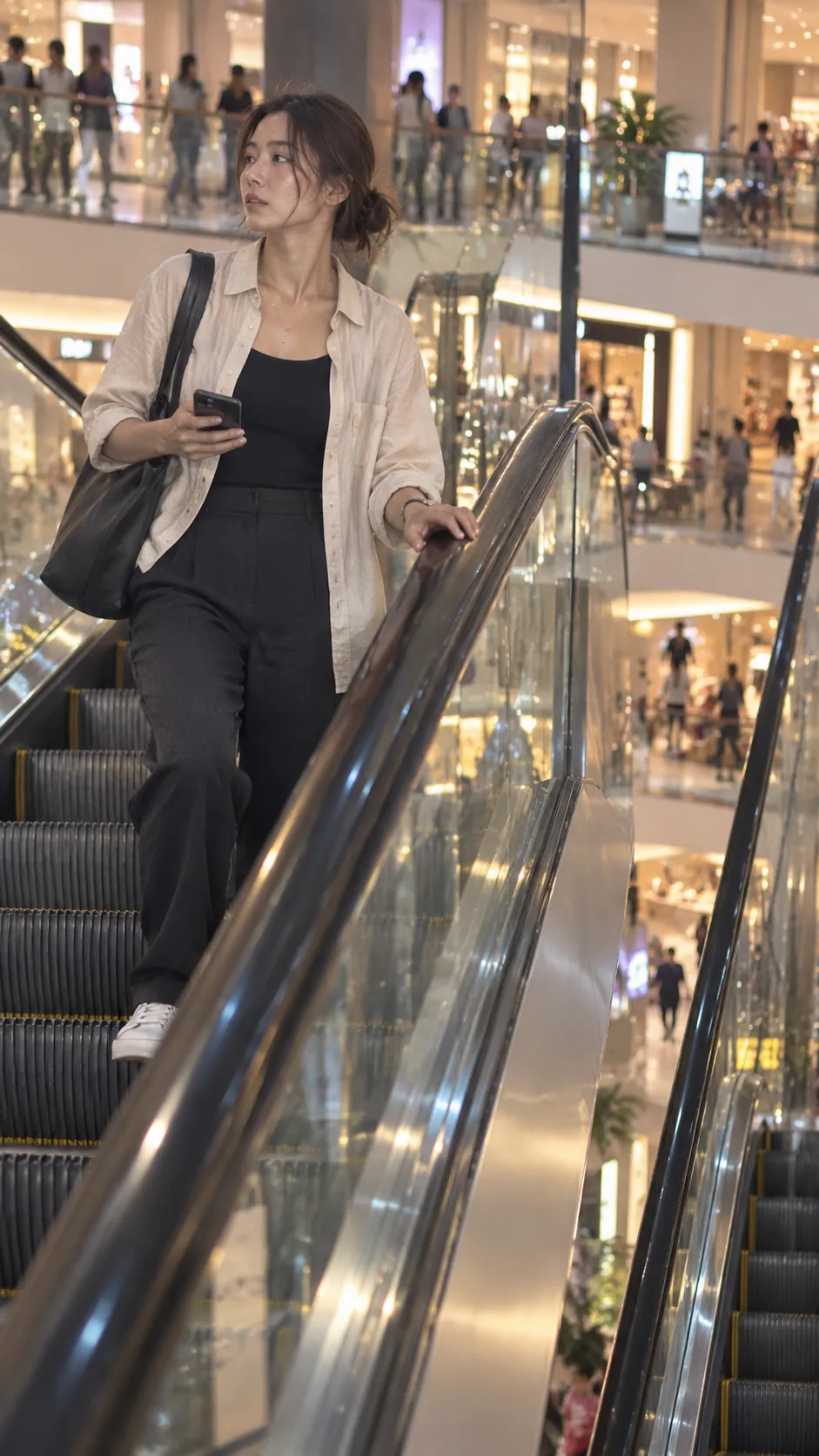
9:16 vertical, long-lens candid street-style photograph inside a large modern shopping mall at evening peak. No flash — the look comes from a 3× phone telephoto at conversational distance, giving mild compression and a soft background. Two escalators run side by side in opposite directions, separated by a glass balustrade and two separate black handrails. The subject, a clearly adult woman in her early thirties, is on the left escalator travelling down from a higher floor, caught a few seconds before she reaches the level of the photographer, who is on the right escalator travelling up. She is therefore above the camera's eye line and it should read that way. She wears a cream linen overshirt open over a plain black top, straight dark trousers, and white leather sneakers; a small bag hangs from one shoulder. One hand rests on the handrail, the other holds her phone. She is looking past the camera toward the mall atrium, not at it. Her face is calm and faintly distracted. The background is a bright, busy mall: glass balustrades, a brushed-metal handrail, shop windows, glowing lightboxes, floor signage, and shoppers with slight motion blur. The photographer and the subject are clearly on different escalators — show the central glass divider between them. Mood: the small coincidence of catching someone on the way past. Negative prompt: on-camera flash, flat direct lighting, posed eye contact, extra limbs, distorted hands, plastic skin, harsh digital sharpness, legible text or logos, watermark, cgi sheen, fisheye distortion.
Why it works: the spatial relationship is the prompt, not the styling. "She is therefore above the camera's eye line and it should read that way" plus the explicit instruction to show the central glass divider is what makes the geometry believable instead of compositionally impossible.
Build the negative block
A negative list earns its length by targeting failures specific to the scene you asked for. Four categories are worth keeping:
| Category | Ban | Why |
|---|---|---|
| Anatomy and hands | extra limbs, distorted hands, extra fingers, cgi look | Cheapest failure in any full-body prompt |
| Beauty overreach | beauty retouching, plastic skin, doll face, skin smoothing | The look depends on skin that was not corrected |
| Style conflicts | harsh digital sharpness, oversaturation, heavy bokeh | Undermines halation and grain; the model defaults here |
| Environment hygiene | warped geometry, malformed structures, broken signage | Ban error classes, not brand names |
Two habits make the block stronger. First, when a look depends on a visible absence, state that absence as its own clause in the prompt and then re-ban the violation in the negative list — otherwise the model quietly reinstates it. Second, ban structural error classes ("warped car door, deformed window frame") instead of asking for a logo; asking for a logo gets you a logo, asking for correct geometry gets you a believable object.
Keep the list short enough to stay readable. A long generic negative block starts contradicting the lighting and capture style you asked for.
Swap the technique, keep the frame
Once a prompt works, the highest-value edit is usually to move it somewhere else and change how the light gets there.
| Move | What stays | What changes |
|---|---|---|
| Night street to mall | subject, wardrobe, loose pose | environment, and swap direct flash for a 3× telephoto |
| Flash to film stock | framing, subject, time of day | replace flash language with a camera and stock pairing |
| Night to daylight | composition, mood | invert the light relationship so the background is the bright one |
| Konbini to train platform | the halation treatment, the late-night quiet | change the location prop and restage the subjects |
Each move produces a sibling prompt rather than a variation on the original, which is why one good night-street prompt is worth more than six unrelated ones.
A reusable prompt order
| Prompt block | Specify | Example |
|---|---|---|
| Format | aspect ratio and vertical or landscape | "9:16 vertical" |
| Location and weather | specific place and condition of the ground | "twenty minutes after the rain stopped" |
| Background behaviour | what moves and how it smears | "traffic and pedestrians carry visible motion blur" |
| Light | source, distance, and what it does not reach | "flash fires from two metres; background stays dark" |
| Subject | age, clothing, and one or two anchors | "late twenties, navy rain shell, damp hair" |
| Action | a task or in-between moment, not a pose | "head turned toward the signal" |
| Grade | camera and stock, then its observable behaviour | "GR III with HDF: bloom, low contrast, fine grain" |
| Negatives | the four categories above, scene-specific | "no motion blur on the subject" |
All six prompts and their example images were written and generated independently for PromptGenius. Every scene is fictional and every subject is a clearly adult person described only by ordinary, fully clothed detail. For the wider craft questions behind these images see photorealism prompts and character sheets.
Related Articles & Guides
 #gpt-image-2
GPT Image 2 Lingerie and Swimwear Portrait Prompts
Direct lingerie and swimwear portraiture with GPT Image 2 using garment construction vocabulary, staging as a decision, and light you can name.
 #gpt-image-2
GPT Image 2 Anime Poster and Mecha Key Visual Prompts
Build anime posters, mecha key visuals, pixel sprite sheets, and game screenshots with GPT Image 2 using layout budgets and identity locks.
 #gpt-image-2
GPT Image 2 Character Sheet and Reference Prompts
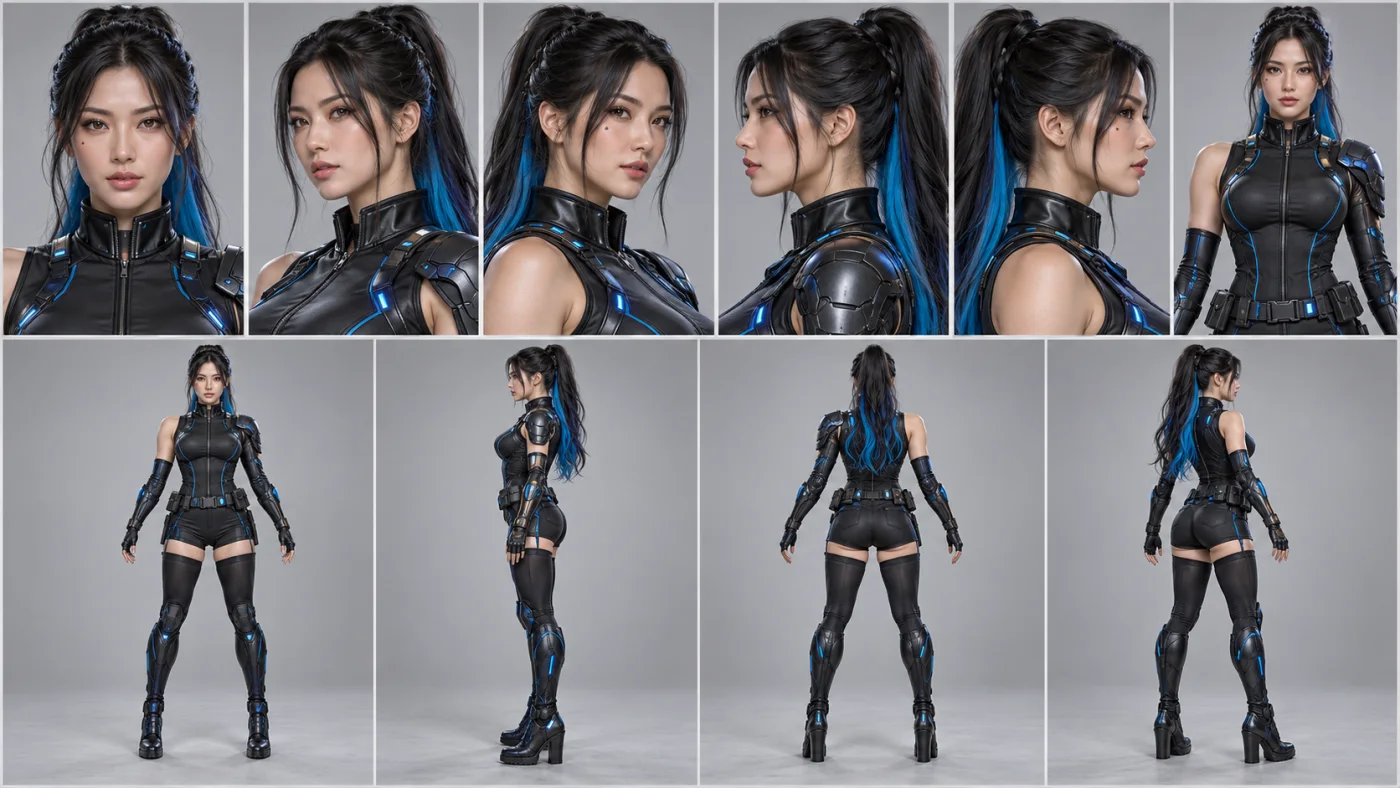
Keep a recurring character consistent in GPT Image 2 with casting sheets, expression grids, pose studies, and reusable hair and wardrobe cards.