Flat Vector-Style Prompts for GPT Image 2: Logos, Icons and Stickers
Copyable GPT Image 2 prompts for flat logos, icon sets, spot illustrations and stickers, with notes on colour control and drift.
Flat vector-style artwork is the workhorse of brand and product design: logo marks, icon sets, spot illustrations and stickers that have to read at twenty-four pixels and at poster size. GPT Image 2 handles the look well once you stop describing a mood and start describing how the shapes are built. It returns raster images — PNG, JPEG or WebP — so nothing on this page is an SVG or a vector file, and none of these prompts include a tracing or conversion step.
How flat-style prompts differ
Ten prompts were generated once each in ChatGPT and reviewed. The full set is below, with the failures left in.
Naming a tradition beats naming a look. The prompts here name a specific design tradition and its build rules — grid, stroke system, corner treatment, how one shape overlaps another — instead of asking for "flat, modern, minimal". That is what moved the output away from generic rounded clip art: all ten images read as the tradition named, and several read as it immediately. Adjectives set a mood; construction rules give the model something to obey.
Colour counts hold, with one exception. Nine of the ten images used exactly the number of flat colours requested. The exception is the risograph illustration: the pink-and-teal overprint did produce the deep purple third colour as instructed, but lighter tints of both inks crept into the steam and the crowd. When a prompt declares an overlap colour, expect the overlap — and expect the model to invent tints of it as well.
Construction rules are followed loosely. Grids, bilateral symmetry and "built from geometric parts" were the most ignored instructions. The mushroom pictograms drifted off the 45/90-degree grid into organic curves, the crest set is not symmetrical, the Bauhaus icons are not on a shared grid, and the Constructivist cyclist is drawn illustratively rather than assembled from parts. Ask for a grid and expect roughly a grid.
Solid backgrounds hold; spacing does not. Every prompt asks for one solid background colour rather than transparency, which keeps the flat look intact and gives each mark a ground to sit on. Backgrounds came out clean in nine of ten. Spacing is the fragile part: speed lines ran off the bottom edge of the Art Deco mark, the crests nearly touch the frame, and the cycling badge fills about ninety percent of the frame instead of the seventy-five percent requested. Frame-fill percentages and even gutters are the instructions to check first, and the ones to fix by cropping.
Exclusions mostly hold, and texture is the leak. "No gradients, no texture, no shading, no 3D, no drop shadows" worked in nine of ten images. The risograph is the exception twice over: its steam is soft and semi-transparent, which is a gradient in effect, and the flat areas carry a faint mottled ink texture despite an explicit "no grain". Name a print medium and the model will occasionally smuggle in that medium's texture even when you forbid it.
Text is worth testing separately. The wordmark prompt is the only item that asks for lettering, and it rendered "HOLLOW OAK" correctly on the first attempt in heavy condensed slab serif. That matches what the typography poster set found: quote the exact string, name the type style, and forbid everything else.
Reusable flat vector-style template
Name the tradition, then the rules that make it recognisable. Keep the colour list short and explicit.
A flat vector-style [subject] for [specific use], drawn in the style of [named design tradition]. Construction rules: [grid or geometry], [stroke system or no strokes], [corner treatment], [one signature trait of the tradition]. Use exactly [n] flat colours: [list]. Place it on a solid [background colour] background that fills the whole frame. Composition: [composition], [aspect] aspect ratio. Flat solid colour fills only. No gradients, no texture, no shading, no 3D, no drop shadows. No text, no watermark.
Logo marks
Jazz record shop, cut-paper mark
The cut-paper logic held: irregular scissor edges, no outlines anywhere, the record read as the trumpet's bell. The hand is the weak part — the fingers float above the valves instead of gripping them, and the valve tubing collapsed into three odd bars.

A flat vector-style logo mark for a late-night jazz record shop, in the style of 1950s Saul Bass cut-paper film titles: the flared bell of a trumpet whose opening is a vinyl record, held by a single angular hand. Construction rules: every shape looks hand-cut from paper with scissors, with slightly irregular straight edges and deliberately imperfect angles, no outlines at all, shapes defined only by colour, and one shape overlapping another without blending. Use exactly 2 flat colours: black and tomato red. Place it on a solid warm off-white background that fills the whole frame. Composition: the mark slightly off-centre on a diagonal, with generous empty space, 1:1 square aspect ratio. Flat solid colour fills only. No gradients, no paper texture, no shading, no 3D, no drop shadows. No text, no letters, no watermark.
Sleeper train, Art Deco mark
Symmetry, the stepped sunburst and the black-gold-teal palette all arrived without metallic sheen. The rays are straight rectangles rather than tapering wedges, the speed lines run off the bottom edge and break the padding, and a faint light halo sits along some gold edges.

A flat vector-style logo mark for an overnight sleeper train company, in the style of 1930s Art Deco railway posters: the front of a streamlined locomotive seen head-on, with a stepped sunburst fanning out behind it. Construction rules: strict bilateral symmetry, stepped and tiered forms, rays as thin tapering wedges, parallel speed lines in groups of three, sharp corners only, no curves except the locomotive's rounded nose. Use exactly 3 flat colours: black, antique gold, and deep teal. Place it on a solid cream background that fills the whole frame. Composition: the mark centred and vertically stacked, generous padding, 1:1 square aspect ratio. Flat solid colour fills only. No gradients, no metallic sheen, no texture, no shading, no 3D, no drop shadows. No text, no letters, no watermark.
"Hollow Oak" cider, wood-type wordmark
The text test passed: "HOLLOW OAK" is spelled correctly in heavy condensed slab serif, with the apple between the words. The oak leaf sits on a stem beside the apple rather than being cut out of it, the background reads cream rather than straw, and the side padding is too tight.
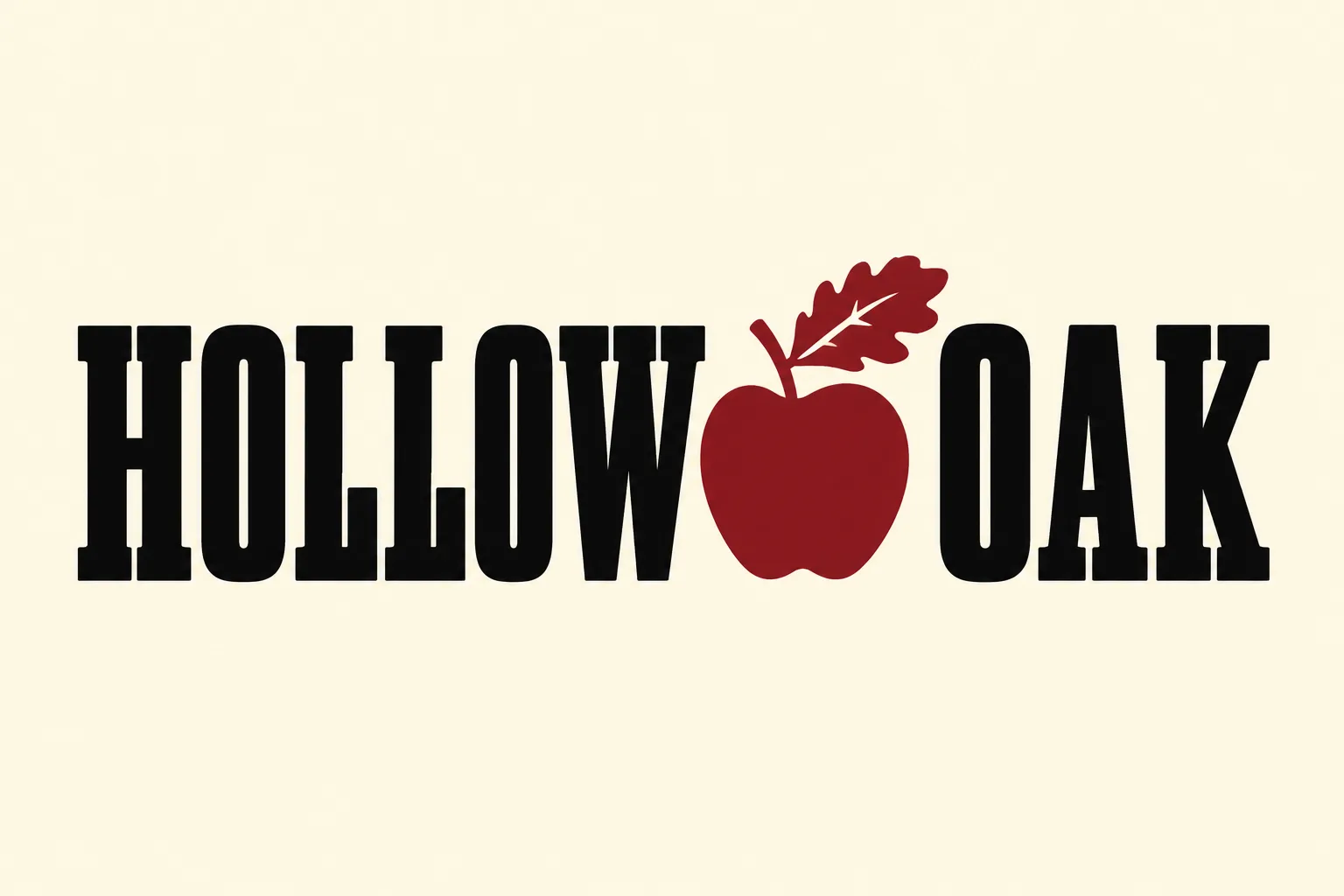
A flat vector-style wordmark for a small orchard cider press: the words "Hollow Oak" set in heavy condensed slab-serif wood-type capitals, as on a 19th-century letterpress poster, with a single apple whose leaf is an oak leaf placed between the two words. Spell it exactly as "HOLLOW OAK" in capitals, two words, no other characters. Construction rules: tall narrow letters with thick bracketed slab serifs, tight letter spacing, both words the same height, the apple drawn as one flat silhouette with a leaf cut-out. Use exactly 2 flat colours: oxblood red and black. Place it on a solid pale straw background that fills the whole frame. Composition: one horizontal line, centred, generous padding, 3:2 landscape aspect ratio. Flat solid colour fills only. No wood grain, no ink texture, no distressing, no gradients, no shading, no 3D. No other text, no tagline, no watermark.
Icon sets
Mushroom forager icons, 1972 Munich pictograms
The tile system and the poison bar held, and the white silhouettes read as solid pictograms. The 45/90-degree grid did not: the chanterelle and morel are organic curves, and the basket weave breaks into glitchy, disconnected bars.
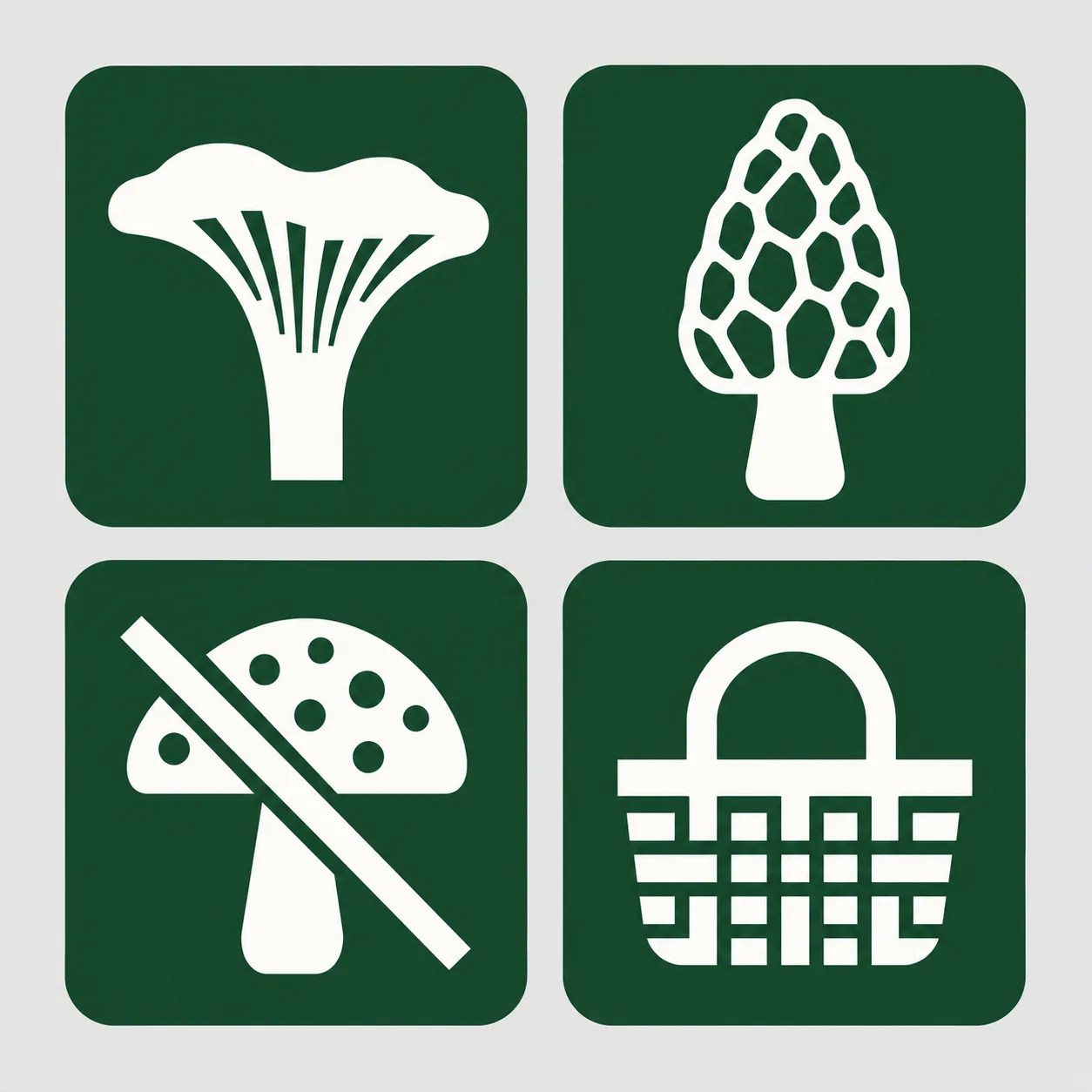
A flat vector-style icon set for a mushroom-foraging field app, in the style of Otl Aicher's 1972 Munich Olympics pictograms: four icons in a 2x2 grid showing a chanterelle, a morel, a fly agaric marked as poisonous by a diagonal bar, and a foraging basket. Construction rules: every shape built on a square grid using only 0, 45 and 90 degree angles plus perfect circle segments, uniform thick bars, no outlines, solid silhouettes only, square cut ends. Use exactly 2 flat colours: white for the pictograms and one grid of four identical rounded-square tiles in deep forest green behind them. Place the tiles on a solid light grey background that fills the whole frame. Composition: strict 2x2 grid of equal tiles, equal gutters, generous outer padding, 1:1 square aspect ratio. Flat solid colour fills only. No gradients, no texture, no shading, no 3D, no drop shadows. No text, no labels, no watermark.
Tide and moon crests, Japanese mon
One flat indigo held, the gaps-as-outlines trick held, and the ring really does contain eight moons. The symmetry did not: the wave crests are not mirrored, the gutters are uneven, and the four crests nearly touch the frame edges. This was also the slowest image of the set at about a hundred seconds.
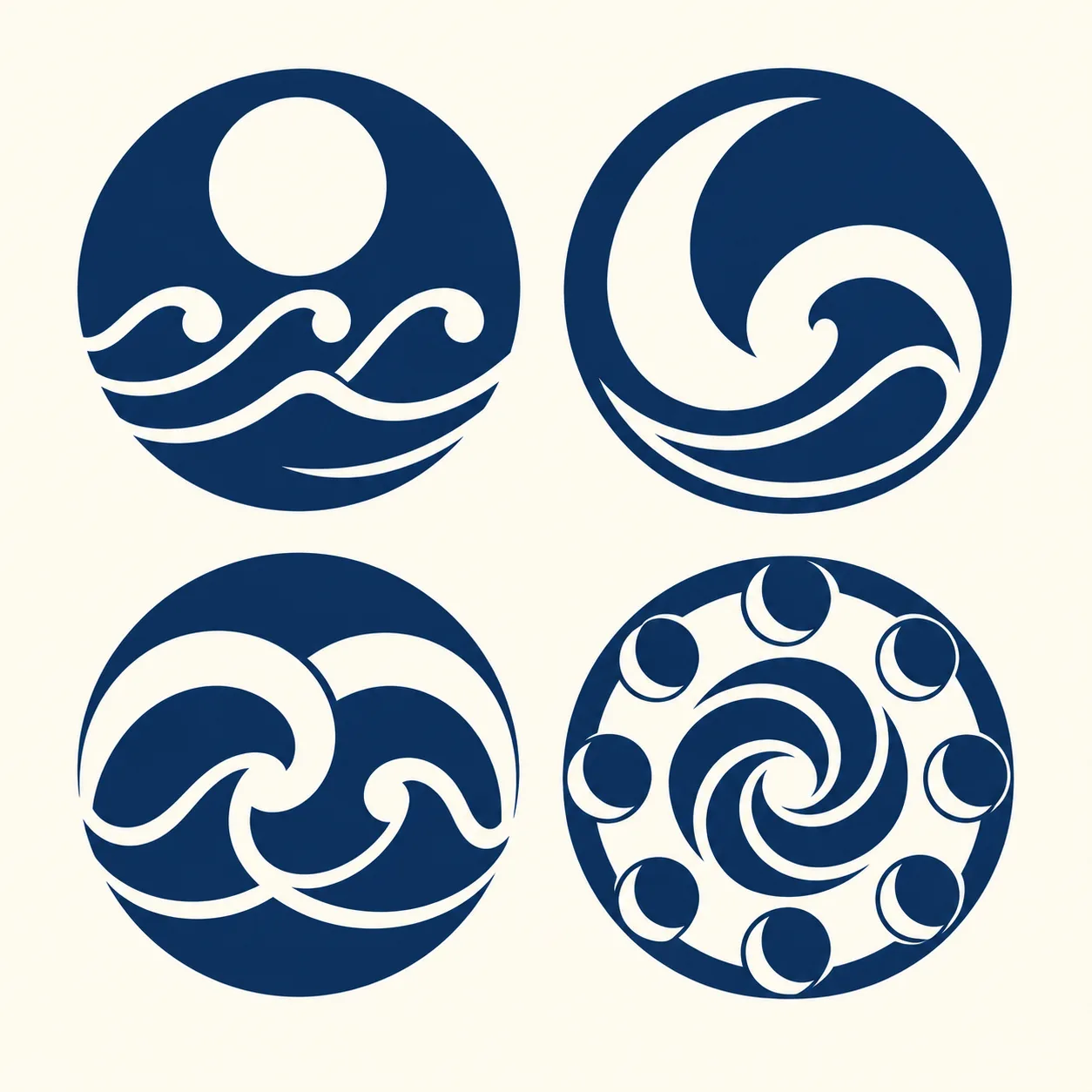
A flat vector-style set of four family crests for a coastal tide-table app, in the style of Japanese kamon (mon) crests: a full moon over three waves, a crescent moon cradling a single wave, two interlocking wave crests, and a ring of eight small moons around a whirlpool. Construction rules: each crest is a self-contained circular emblem built only from compass arcs and circles, perfect radial or bilateral symmetry, solid shapes separated by thin even gaps of background colour instead of outlines. Use exactly 1 flat colour: indigo. Place them on a solid rice-paper cream background that fills the whole frame. Composition: strict 2x2 grid, all four crests the same diameter, equal gutters, generous outer padding, 1:1 square aspect ratio. Flat solid colour fills only. No gradients, no paper texture, no brush marks, no shading, no 3D. No text, no characters, no watermark.
Kitchen tool icons, Bauhaus
Every object is built from primary shapes with visible joins, and each one mixes the primary colours differently. The shared grid is missing: the ladle is far larger than the whisk, and the kettle's handle floats free of its body.
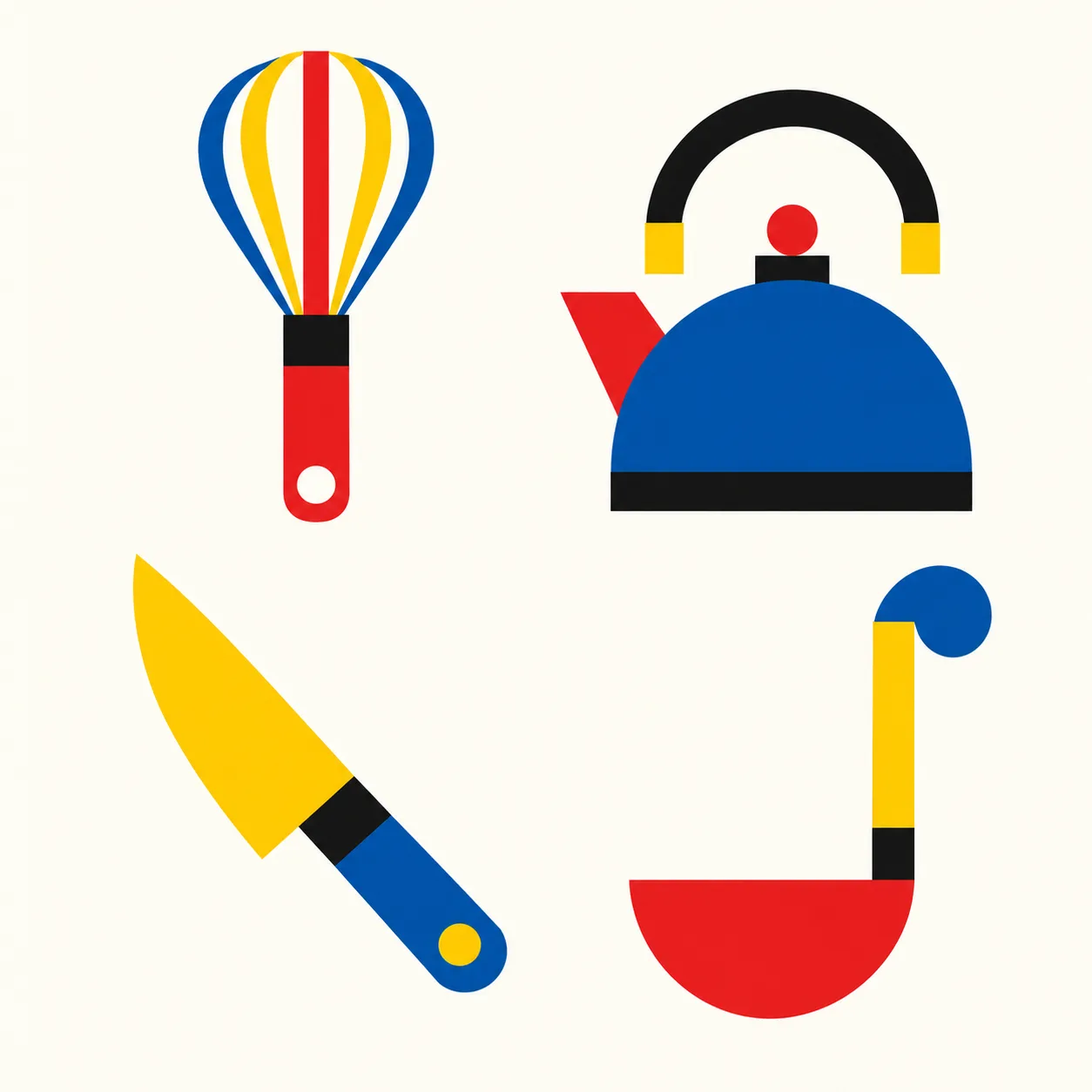
A flat vector-style icon set for a cooking-class website, in the style of 1920s Bauhaus geometric design: four icons in a 2x2 grid showing a whisk, a kettle, a chef's knife, and a ladle. Construction rules: every object assembled only from primary shapes — circles, half-circles, squares, rectangles and triangles — with visible joins between shapes, no outlines, and each object using a different combination of the primary colours. Use exactly 4 flat colours: primary red, primary yellow, primary blue, and black. Place them on a solid off-white background that fills the whole frame. Composition: strict 2x2 grid, all four icons the same box size, equal gutters, generous outer padding, 1:1 square aspect ratio. Flat solid colour fills only. No gradients, no texture, no shading, no 3D, no drop shadows. No text, no labels, no watermark.
Flat illustrations
Night market noodle stall, risograph overprint
The overprint worked: pink over teal produces the deep purple, the registration is deliberately off, and the result looks printed. Two things leaked — the steam is soft and semi-transparent rather than a flat shape, and a faint mottled texture sits under the flat areas despite the "no grain" instruction.
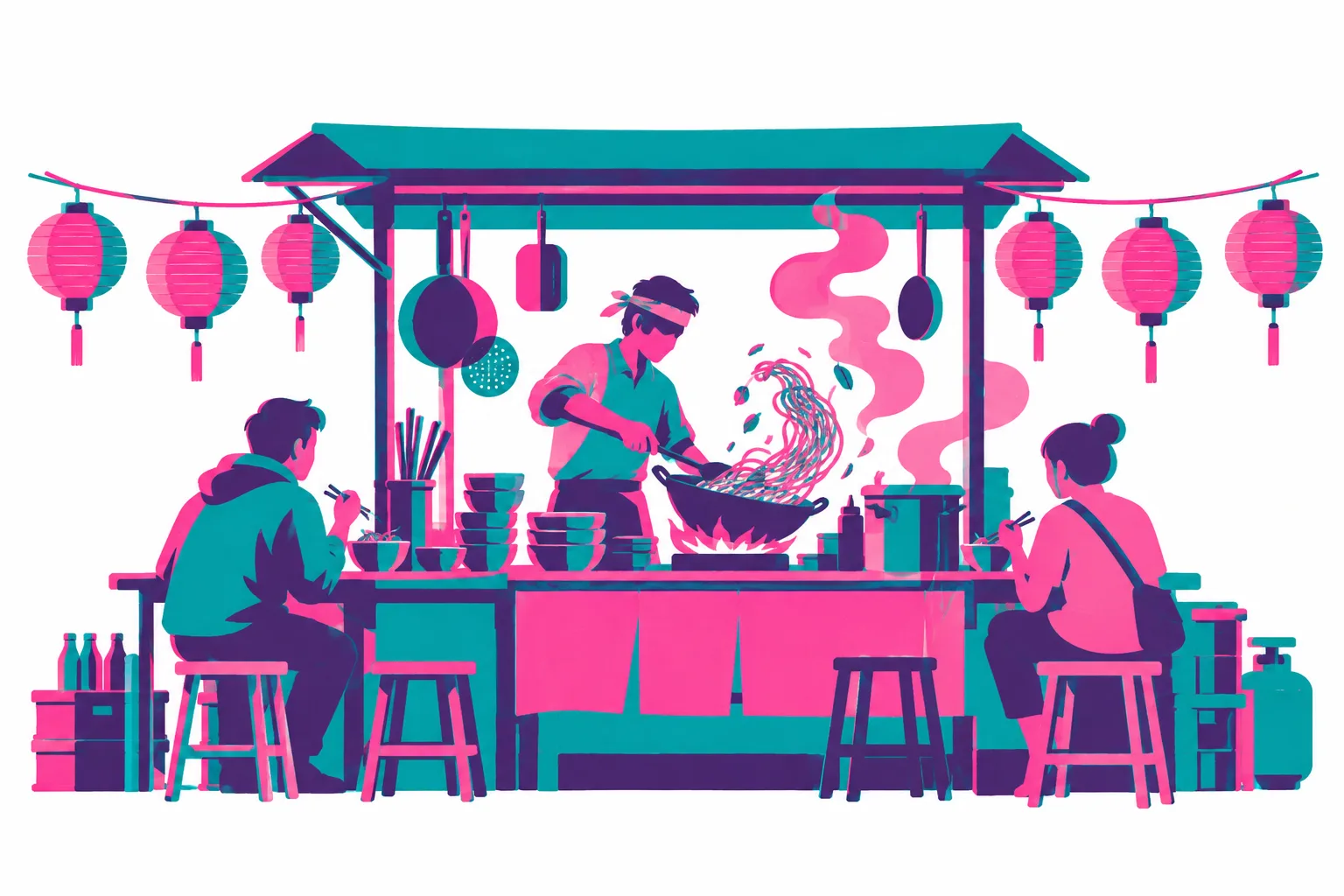
A flat vector-style editorial illustration for a food-blog header, in the style of a two-ink risograph print: a night-market noodle stall with a cook tossing noodles in a wok, steam rising, paper lanterns overhead, and two customers on stools. Construction rules: only two inks, fluorescent pink and teal, printed as flat shapes; wherever pink and teal overlap they form a third deep purple colour, and the overlaps are used deliberately for shadows and depth; shapes are slightly misregistered by a few pixels for a print feel; no outlines. Use exactly 3 flat colours as a result: fluorescent pink, teal, and the deep purple overlap. Place it on a solid white paper background that fills the whole frame. Composition: the stall centred in a wide scene with open space above the lanterns, 3:2 landscape aspect ratio. Flat solid colour fills only. No grain, no halftone dots, no gradients, no shading, no 3D. No text, no signage lettering, no watermark.
Swimmer among seaweed, Matisse cut-outs
The strongest image of the ten: organic cut shapes, white background breathing between them, a diagonal swimmer and no outlines. Two drifts — the swimmer's face and hair are drawn rather than cut, and the fronds pack almost edge to edge instead of leaving negative space.
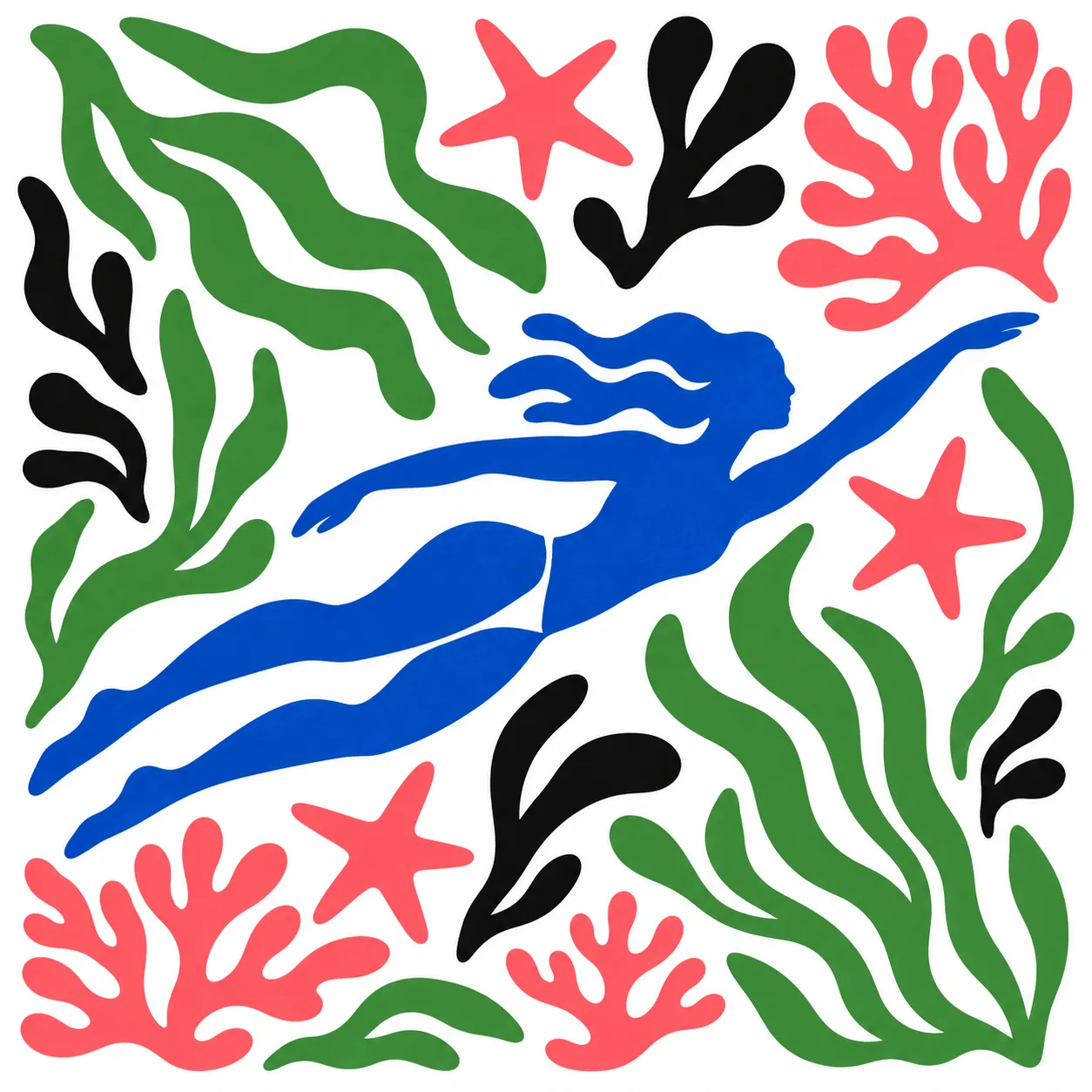
A flat vector-style illustration for a wellness-retreat poster, in the style of Henri Matisse's late paper cut-outs: a single swimmer stretched mid-stroke among large floating seaweed fronds, starfish and coral shapes. Construction rules: every shape looks scissor-cut from painted paper, with organic flowing edges, no straight lines, no outlines, shapes placed loosely so the background shows between them, and the swimmer as one solid silhouette. Use exactly 4 flat colours: ultramarine blue, coral pink, leaf green, and black. Place them on a solid white background that fills the whole frame. Composition: the swimmer on a diagonal across the centre, fronds scattered evenly to all four edges with breathing room, 1:1 square aspect ratio. Flat solid colour fills only. No gradients, no paper texture, no gouache streaks, no shading, no 3D. No text, no watermark.
Stickers and badges
Seaplane and lighthouse, 1930s travel sticker
The stacked colour bands, the low sun, the striped lighthouse and the even white die-cut border all held, with no gloss or bevel on the sticker edge. The plane flies level instead of banking, and an unrequested cottage appeared beside the lighthouse.
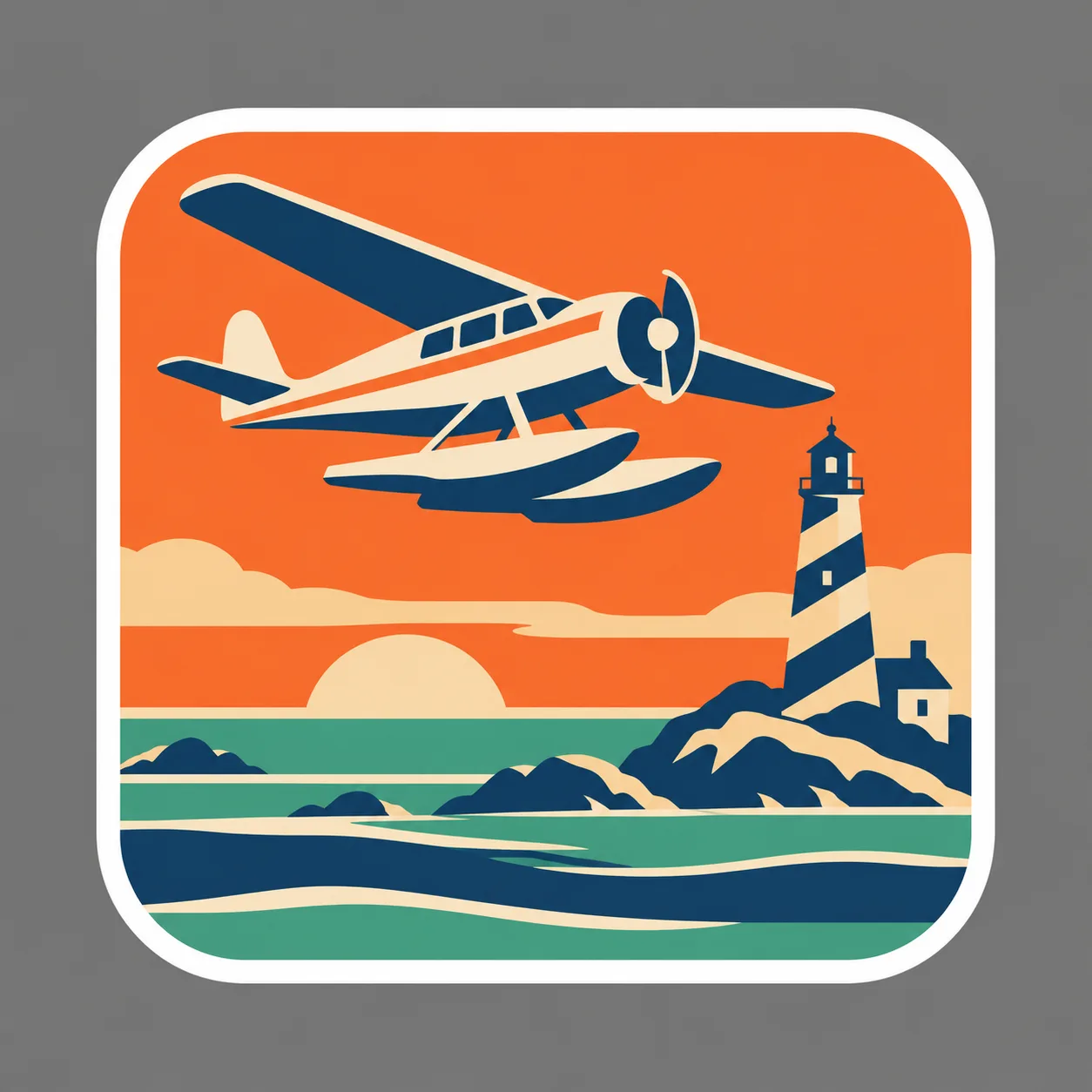
A flat vector-style die-cut sticker for a coastal travel shop, in the style of 1930s travel posters: a small seaplane banking over a striped lighthouse on a rocky islet, with a low sun and three layered sea bands. Construction rules: bold flat planes stacked like a screen print, long horizontal colour bands for sea and sky, simplified silhouettes with no outlines, light suggested only by one lighter colour band; the whole scene cut into a rounded-rectangle sticker shape with a thick even white die-cut border. Use exactly 4 flat colours inside the artwork: navy, sunset orange, sand, and sea green, plus the white border. Place the sticker on a solid mid-grey background that fills the whole frame. Composition: the sticker centred with even padding, 1:1 square aspect ratio. Flat solid colour fills only. No gradients, no sticker gloss, no texture, no shading, no 3D, no drop shadow. No text, no watermark.
Cycling club, Constructivist badge
The palette, the diagonal wedges, the black ring and the absence of text all landed. The cyclist is the failure: a modern road rider with a helmet, drawn illustratively rather than built from geometric parts, and the badge fills about ninety percent of the frame instead of seventy-five.
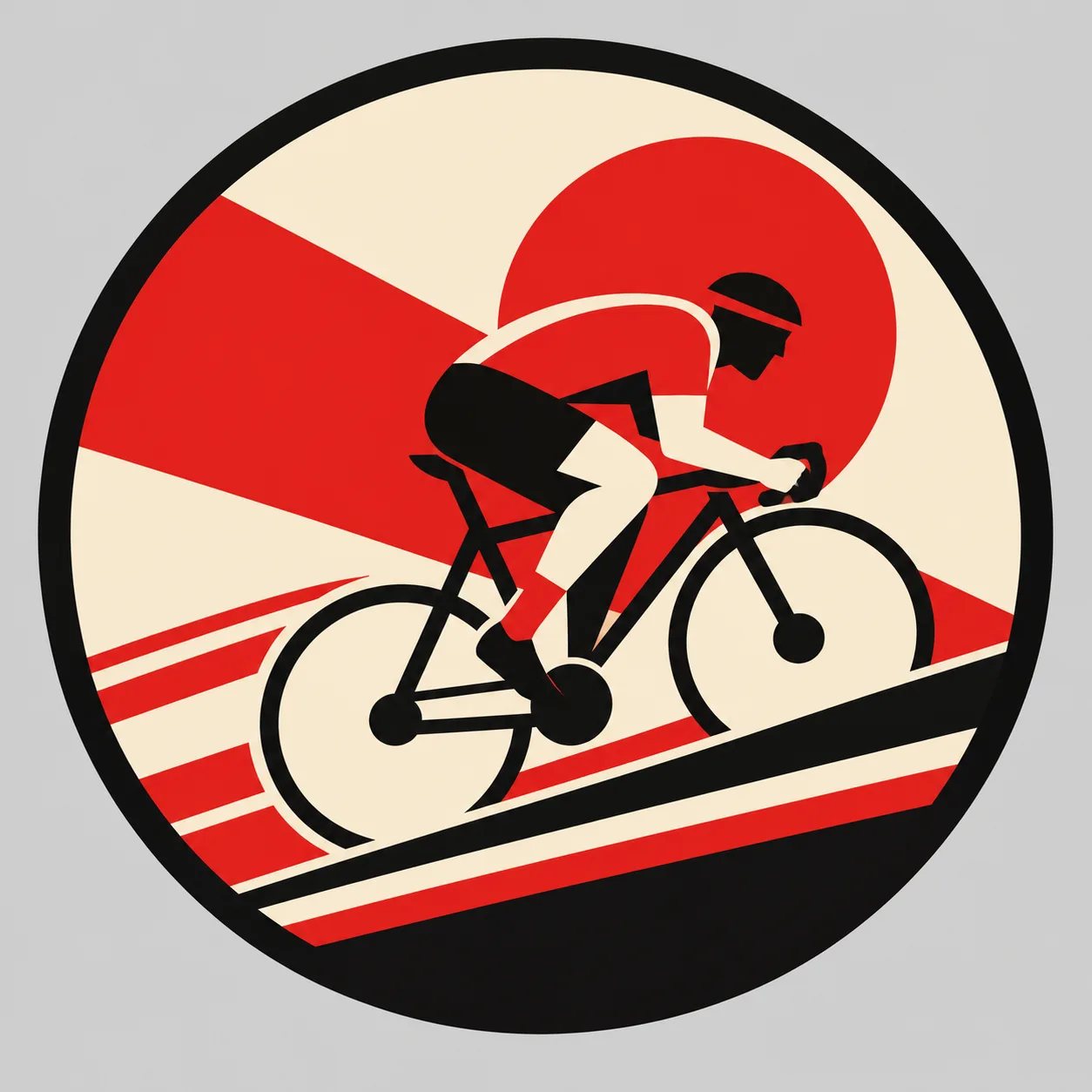
A flat vector-style circular badge for an amateur cycling club, in the style of 1920s Russian Constructivist posters: a cyclist in profile racing along a steep diagonal, with a large wedge and a circle cutting across the badge behind them. Construction rules: dynamic diagonal composition at about 30 degrees, hard-edged geometric wedges, bars and circles, the cyclist built from simple geometric parts, no outlines, colour blocks meeting at sharp edges. Use exactly 3 flat colours: red, black, and cream, with the badge enclosed in a solid black ring. Place it on a solid light grey background that fills the whole frame. Composition: the badge centred, occupying about three quarters of the frame, 1:1 square aspect ratio. Flat solid colour fills only. No gradients, no texture, no halftone, no worn effects, no shading, no 3D. No text, no letters, no stars, no symbols, no watermark.
Sources and related guides
All ten images were generated in ChatGPT on 2026-10-30, one prompt per image, with no retries; the notes above describe the first attempt for each item.
For lettering inside flat artwork, the GPT Image 2 typography posters cover text budgets and exact copy. For interface work built from the same flat vocabulary, see UI mockups. If you want the medium to carry the image rather than the geometry, art styles and media covers cut paper, oil pastel, sumi-e and watercolour. For a deliberate counter-example to flat style, 3D glassmorphism icons rebuilds 2D icons as lit glass objects. In another tool, Nano Banana logo design and sticker packs cover the same brand formats with a different model.
Related Articles & Guides
Space and Creature Book World Prompts for GPT Image 2
Nine sci-fi and creature worlds: character portraits, miniature dioramas inside open books, and painterly scenes with copyable GPT Image 2 prompts and story seeds.
Fantasy Book World and Character Prompts for GPT Image 2
Create six fantasy characters, miniature worlds inside open books, and picture-book scenes with copyable GPT Image 2 prompts and story seeds.
 #gpt-image-2
GPT Image 2 Character Sheet and Reference Prompts
Keep a recurring character consistent in GPT Image 2 with casting sheets, expression grids, pose studies, and reusable hair and wardrobe cards.